
Contents
Direct Answer
In the rapidly evolving landscape of educational technology, the transition from traditional print to interactive media presents unique legal and operational challenges for publishers. For those developing interactive book programs—specifically those utilizing OID (Optical Identification) technology, where invisible micro-dots on a page trigger audio responses from a reading pen—structuring audio rights and voice-talent approvals is not merely a legal formality; it is a critical component of product viability and brand integrity. A robust framework must account for the multi-layered nature of interactive media, ensuring that rights are secured for hardware integration, digital distribution, and long-term market scalability.
To successfully structure these rights, publishers should adopt a "hardware-inclusive" licensing model that explicitly grants the right to embed audio into physical devices, while maintaining a rigorous multi-stage approval process for voice talent to ensure pedagogical quality. This involves shifting away from standard audiobook contracts toward specialized "interactive media agreements" that define usage by trigger-point rather than just linear duration.
The Unique Nature of Interactive Audio Rights
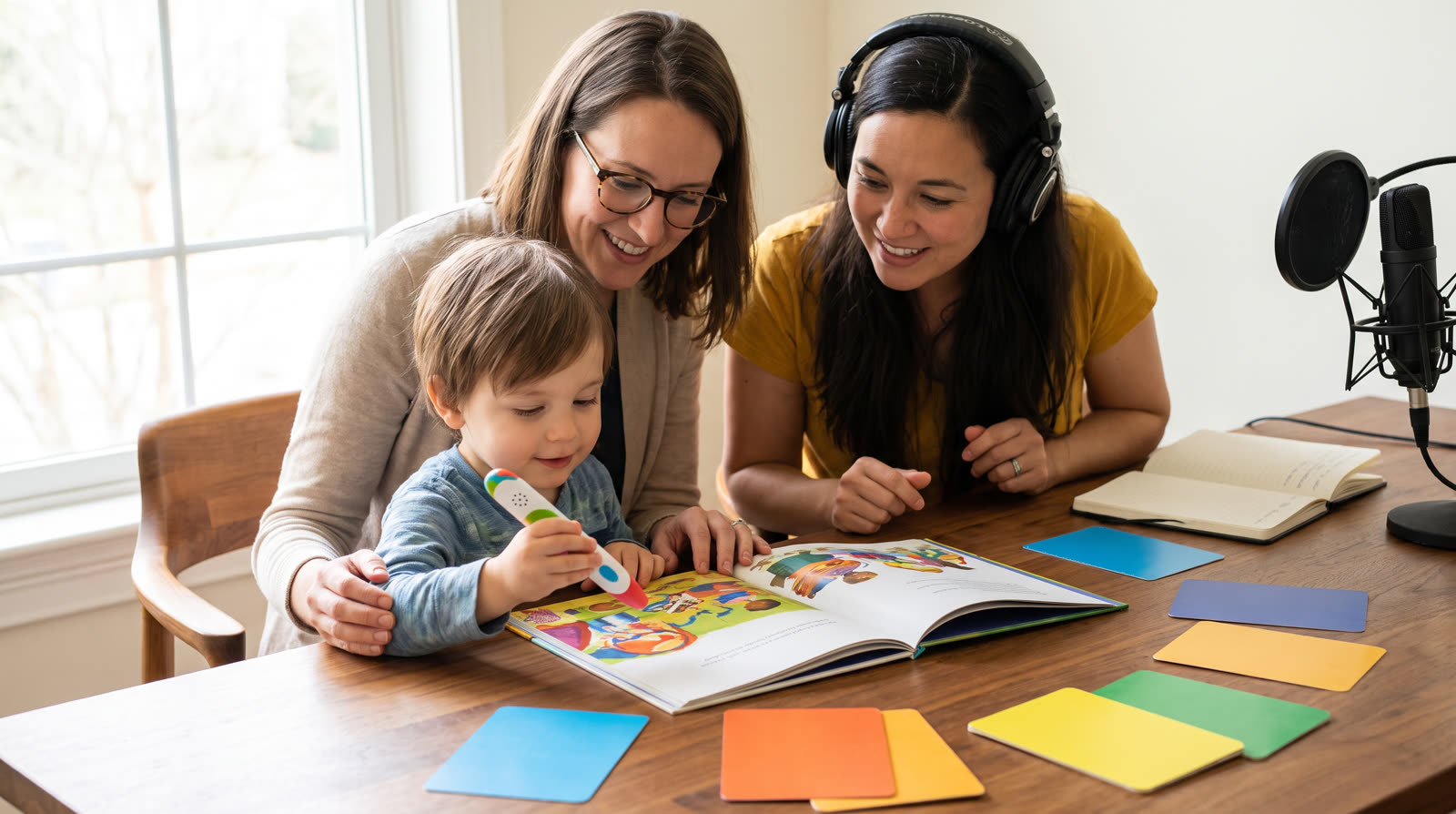
Standard audio rights in the publishing industry typically cover the linear narration of a text, usually intended for platforms like Audible or Spotify. However, an interactive book program powered by a reading pen functions differently. In this ecosystem, the audio is fragmented into hundreds or even thousands of "interactive triggers." When a child touches a specific character, word, or illustration, the pen retrieves a specific audio file.
OID (Optical Identification): A technology that uses a specialized sensor in a reading pen to detect nearly invisible patterns of dots printed on paper. These dots are mapped to specific coordinates that correspond to digital audio files stored in the pen's memory or on a cloud server.
Because the audio is integrated into a physical consumer electronic product, the rights must be broader than traditional "performance rights." They must include Reproduction Rights (to copy audio onto hardware), Interactive Trigger Rights (to synchronize clips with visual elements), and Software Integration Rights (to include audio in firmware or apps). Additionally, Marketing Rights should allow B2B partners to use audio snippets in promotional materials.
Structuring the Audio Rights Agreement
When drafting agreements for an interactive program, publishers must ensure the license matches the physical product's lifecycle. Unlike digital downloads, reading pens remain in circulation for years, requiring authorization for multiple parties in the supply chain.
1. Territory and Language For B2B distributors, territorial clarity is paramount. Publishers should secure World Rights** or rights for all target markets. The agreement should also account for localized versions; buyers can request a "modular rights clause" to add new language packs as separate addendums, preventing costly renegotiations as they expand globally.
2. Duration: The Hardware Lifecycle Hardware products have longer lead times than digital content. "Term-based" licenses (e.g., 3 years) are risky for physical goods. A responsible supplier should recommend a "Life of Product"** license or a term beginning only upon the first commercial sale. Publishers should also ensure "legacy support" rights to host audio files for existing customers even after a product is discontinued.
3. Sublicensing to Manufacturers A critical clause is the right to sublicense**. To produce interactive books, publishers must share audio files with manufacturing partners like ReadGlo. The agreement must explicitly allow the publisher to provide these assets for production, OID encoding, and quality testing. Confirming these details in writing protects all parties from copyright complications during the manufacturing phase.
Voice-Talent Selection and Approval Workflow: A B2B Perspective
| Stage | Objective | Deliverable |
|---|---|---|
| **Stage 1: Audition/Demo** | Confirm the talent's suitability for the project. | A 30-second sample of the specific script. |
| **Stage 2: Initial Pilot** | Verify the recording environment, pacing, and file quality. | The first 5–10 pages of the interactive book. |
| **Stage 3: Pre-Mastering Review** | Check for pronunciation errors or missed lines before final EQ. | Raw, uncompressed files for the entire project. |
| **Stage 4: Final Master** | Final sign-off before the audio is sent for OID mapping. | All mastered files in the required format (e.g., WAV/MP3). |
The voice is the "soul" of an interactive book. For children, the narrator's tone, pacing, and clarity are fundamental to the learning experience. A structured approval workflow prevents costly re-recordings after the OID mapping has already begun. In a B2B context, where timelines are tight and production runs are large, there is very little room for error.
**Casting for Educational Impact and Brand Consistency When selecting voice talent for a B2B interactive program, publishers should look for more than just a "good voice." The talent must demonstrate: * Articulatory Clarity: Essential for language learners and early readers. * Consistency: The ability to maintain the same character voice across multiple books in a series. * Pedagogical Tone: A balance between being engaging and being authoritative enough for an educational setting.
**The Four-Stage Approval Process To minimize risk, buyers can request a four-stage approval process in their contracts, adding a "pre-mastering" check to the standard workflow:
**Contractual Models for Talent: Buyouts vs. Royalties For interactive programs, the "Buyout Model" is generally preferred over the "Royalty Model." In a buyout, the voice talent is paid a flat fee for the session and the transfer of all rights for a specific use case. This simplifies the accounting for B2B partners who may be selling the pens as a bundle with books, making it difficult to track individual "plays" or "listens."
---
[CTA 1] Ready to transform your publishing catalog into an interactive learning experience?** ReadGlo specializes in helping publishers navigate the technical and legal complexities of OID integration. Contact our B2B team today at [info@readglo.com](mailto:info@readglo.com) to discuss your project requirements, request a sample mapping sheet, or view our latest hardware certifications.
---
Technical Specifications and Quality Control: Bridging Content and Hardware
The bridge between the publisher’s creative content and the manufacturer’s hardware is the technical specification of the audio. If the audio quality is poor, the reading pen’s hardware—no matter how advanced—will deliver a subpar experience.
Technical Requirements Publishers should confirm technical specs in writing. High-quality OID pens typically require 44.1kHz WAV files for mastering and 128kbps MP3s** for integration. Files should be normalized to a consistent volume (e.g., -3dB) to ensure clear playback through the pen's speaker.
The Audio Mapping Sheet The Audio Mapping Sheet** is the project's blueprint, linking OID index numbers to specific audio files. A responsible supplier should provide a template to ensure the voice talent’s output matches the hotspots on the page. Buyers can request a "Mapping Audit" to prevent "wrong-trigger" bugs before mass production.
Managing IP and Cross-Border Partnerships
Working with international manufacturers like ReadGlo requires a balance of legal safeguards and operational trust.
* Confidentiality: An NDA should be signed before transferring assets. Manufacturers must have secure protocols for handling digital files. * The Golden Sample: Publishers must review a fully functional prototype to verify Trigger Accuracy and Audio Fidelity before authorizing mass production. * Compliance: B2B buyers should ensure hardware meets target market standards (e.g., CE, RoHS). A responsible supplier will provide these certifications upon request.
ReadGlo project support
Send Your Requirements
Share your target market, product scope, expected quantity and launch timing. Our team can prepare a relevant product, content or quality-control discussion.
AI in Interactive Audio
AI voice synthesis offers a new frontier for large-scale programs, but introduces questions regarding voice profile ownership and long-term licensing. While human talent remains the gold standard for emotional depth, publishers should monitor the legal landscape of AI-generated content closely.
---
Comparison of Audio Licensing Models for Interactive Media
| Feature | Standard Audiobook License | Interactive OID License | Educational App License |
|---|---|---|---|
| **Primary Goal** | Linear listening (passive). | Non-linear interaction (active). | Digital-only interaction. |
| **Rights Scope** | Performance and distribution. | Embedding, OID mapping, and hardware integration. | Streaming and download rights. |
| **Payment Structure** | Often involves royalties per sale. | Usually a flat-fee buyout for hardware use. | Subscription or per-user fee. |
| **Technical Requirement** | High-quality stereo mastering. | Precise file-to-trigger mapping and normalization. | Variable bitrate for streaming. |
| **Manufacturer Involvement** | Minimal. | High; requires sublicensing and technical QA. | Moderate; requires API integration. |
| **Update Capability** | Low (new edition required). | High (via firmware or cloud update). | High (instant updates). |
Frequently Asked Questions
**1. Can we use existing audiobook recordings for OID reading pens? Yes, but with significant technical and legal caveats. Existing recordings are often recorded as long, continuous files. To make them interactive, these files must be "sliced" into individual clips corresponding to specific sentences, words, or images. Additionally, you must verify that your original contract with the voice talent covers "interactive media," "hardware embedding," and "non-linear usage." If not, a supplemental agreement or a new buyout may be required.
**2. What happens if we want to add new languages to the program later? This is a common requirement for global educational brands. You should structure your initial audio rights agreement to include "Right of First Refusal" for the original talent to record new versions, or ensure you have the rights to hire new talent for different languages while using the same OID mapping structure. A modular OID system, like those offered by ReadGlo, allows you to add new audio files to the pen via a USB connection or Wi-Fi without changing the printed book.
**3. How do we handle voice talent approvals for multi-character stories? For stories with multiple characters, it is highly recommended to use a "Voice Style Guide." This document outlines the personality, accent, and specific traits of each character. The approval process should include a "character lineup" demo where you hear all voices together to ensure they are distinct and harmonized. Buyers can also request "alternate takes" for interactive triggers to provide variety (e.g., three different ways a character says "Hello!").
**4. How do we protect our IP when manufacturing overseas? Protecting IP involves a combination of legal contracts (NDAs, manufacturing agreements) and choosing a reputable partner. A responsible manufacturer should have a track record of working with international publishers and be willing to provide references. Furthermore, the OID codes themselves can be encrypted, ensuring that the audio files can only be played by your specific branded reading pen.
Conclusion
Structuring audio rights and voice-talent approvals for interactive programs is a strategic investment in brand longevity. By embracing the technical nuances of OID technology and moving beyond traditional licensing, publishers can create high-quality educational products for global audiences. Success requires close collaboration between the publisher, voice talent, and manufacturing partner. When these pillars are aligned through clear contracts and rigorous workflows, the result is an interactive experience that brings learning to life while ensuring long-term commercial success.
---
[CTA 2] Partner with ReadGlo for Your Next Interactive Book Program** From technical OID mapping to hardware manufacturing, ReadGlo is the trusted partner for publishers worldwide. We ensure your intellectual property is protected and your audio content is delivered with crystal-clear quality. Reach out to us at [info@readglo.com](mailto:info@readglo.com) to start your B2B partnership today.
---
References
1. Society of Authors (UK): Guidelines on Audio and Digital Rights for Publishers and Authors. https://societyofauthors.org/ 2. Audio Publishers Association (APA): Best Practices for Audiobook Production and Licensing. https://www.audiopub.org/ 3. World Intellectual Property Organization (WIPO): Managing Intellectual Property in the Book Publishing Industry. https://www.wipo.int/ 4. International Publishers Association (IPA): Reports on Global Publishing Trends and Digital Integration. https://www.internationalpublishers.org/ 5. Educational Technology Industry Network (ETIN): Standards for Digital Content and Hardware Interoperability. https://www.siia.net/
---
Image Plan
**Image Suggestion 1 * Purpose: To illustrate the OID technology and the interaction between the pen and the book. * Position: Following the H2 section "The Unique Nature of Interactive Audio Rights". * Caption: A child using a high-quality OID reading pen to interact with a colorful educational book, showing the precision of the technology. * ALT Text: Close-up of a child's hand holding a sleek, white reading pen, touching a vibrant illustration of a sun in a children's book. * Image Prompt: A realistic, high-resolution photograph of a child's hand holding a modern, ergonomic white reading pen. The pen tip is touching a colorful, professionally illustrated children's book page featuring a sun and a tree. The lighting is soft and natural, suggesting a classroom or home learning environment. 16:9 aspect ratio, no text, no logos, sharp focus on the pen and the book's surface.
**Image Suggestion 2 * Purpose: To show the professional recording and approval process for voice talent. * Position: Following the H2 section "Voice-Talent Selection and Approval Workflow: A B2B Perspective". * Caption: A professional voice-over artist in a soundproof studio recording audio for an educational interactive program. * ALT Text: A female voice actor wearing professional headphones, speaking into a high-end condenser microphone in a modern recording studio. * Image Prompt: A realistic, wide-angle photograph of a professional recording studio. A voice actor (female, mid-30s) is wearing large studio headphones and speaking into a professional condenser microphone with a pop filter. In the background, a blurred computer monitor shows audio waveforms. The atmosphere is professional and focused. 16:9 aspect ratio, no text, no logos, cinematic lighting with shallow depth of field.
Continue your research
Related reading pen buyer guides
Use these related guides to compare the next product, content, sourcing or channel decision in your project.
- Publisher SolutionsHow Can Publishers Review Illustration, Page Layout and Touch-Zone Accessibility Before Printing Interactive Books?Read this guide
- Compliance & SafetyHow to Audit an OID Book Printer for Eco-Friendly Waste Management Practices?Read this guide
- Publisher SolutionsHow Should Buyers Set Private-Label Licence Boundaries for Reading-Pen Artwork, Audio and Brand Assets?Read this guide
Continue with ReadGlo
See product specifications and request model-specific documentation.
ReadGlo project support
Get a Project Quote
Request product specifications, sample guidance or a tailored proposal for your reading pen, interactive book or distributor program.