Contents
Direct Answer

The practical answer: Build the brief around the programme decision rather than a preferred brand: define the learner group, locations, language and literacy objective; state the evidence question and measurable outputs; describe the complete reading-pen-plus-book configuration in performance terms; set safeguarding, accessibility, content-rights, privacy, battery, safety, packaging and route-specific compliance requirements; request a transparent implementation and reporting plan; and publish weighted, neutral evaluation criteria. A practical future article should include a decision table contrasting must-have requirements, scored requirements, supplier declarations and post-award verification, then give a buyer-owned workflow: needs assessment, grant/donor alignment, market sounding, draft specification, risk review, competitive solicitation, sample/pilot review, award, delivery acceptance and outcome reporting. Use the title question as the direct answer and reserve any ReadGlo CTA for a request to discuss a configuration or receive a neutral technical response—not a claim that ReadGlo is approved, certified or the best value.
This guide is written for Education NGOs, grant-funded programme teams, school-system implementers, donor procurement officers, and neutral advisers sourcing reading pens with interactive books for children.. Its search intent is Informational-to-commercial: help programme buyers convert a learning need and grant conditions into a fair, evidence-aware, comparable procurement brief without preselecting a supplier or promising unsupported product outcomes.. The objective is not to create a generic supplier claim. It is to give the buyer an evidence-led way to decide what to release, revise, hold or escalate for the exact product, content, market and route.
Start With the Exact Configuration and Decision
A reading-pen programme is a system rather than one generic device. It can include a pen model, a firmware or content release, one or more book editions, interactive touch or code mapping, audio files, translations, accessories, packaging, retailer or school materials, data flows and a destination route. Before treating education grant procurement brief or reading pen procurement brief as an answer, write down exactly which elements are in scope.
Create one controlled decision record. It can link the buyer project, SKU or bundle, pen version, book edition, content release, package revision, target market, intended channel and review date. This is a traceability measure, not a legal conclusion. It prevents a photograph, quote, pilot note, content file or supplier statement from being reused as proof for a different configuration.
Separate a product fact from a market statement. A fact may be observable in a sample or proof. A market statement may add claims about age, learning, safety, compatibility, privacy, support, sustainability, availability or rights. The latter needs its own buyer-owned evidence and approval before it appears in a product listing, packaging, demo, tender response or customer message.
Decision Table: Release, Revise or Escalate
| Decision area | Buyer question | Evidence to retain | Next status |
|---|---|---|---|
| Configuration identity | Which pen, books, content, accessories, package and market are under review? | Versioned scope record, identifiers and representative samples | Release / revise |
| Real-use fit | What occurs in the actual classroom, library, publisher, retail or channel workflow? | Observed walkthrough, feedback record and issue log | Release / re-test |
| Content and rights | Which text, image, voice, translation and interaction assets are approved for this use? | Rights, editorial and release register | Release / hold |
| Market and route | Which privacy, safety, battery, claims, packaging or shipment questions remain? | Owner-led evidence register and qualified review where needed | Release / escalate |
A buyer control table for the current education, publishing, retail or distribution decision.
Use an evidence gate, not an assumption. “Release” means the named scope has the agreed evidence at this point in time. It does not approve an unspecified future model, language, edition, channel, market or route.
Do not imply UNICEF, a donor, regulator or school has approved ReadGlo or any particular reading-pen design. Product, book/content, age grading, toy/electrical/battery safety, radio features, privacy, accessibility, copyright and translation requirements vary by configuration, market, shipment route and programme setting; buyers should obtain current local advice and supplier documentation. A pen may be offline, connected or configurable, so the brief must ask what data are collected, where, why, for how long, by whom and how deletion/access requests are handled; do not assume that a product is out of scope for privacy rules. Include child-safeguarding risk assessment, partner/staff conduct, incident reporting, complaints and photography/voice/data controls. Request rights-chain evidence for books, audio, illustrations, translations and recordings. Keep MOQ, price, lead time, warranty, defect rate, certifications, test reports, battery capacity and transport classification as bid-specific fields; never invent them. Do not promise literacy gains, donor eligibility, legal compliance or value for money. Exclude Quran or religious-content examples.
Build Evidence Before the Commitment
Use evidence as a procurement input, not as a product efficacy promise. Ask suppliers to distinguish peer-reviewed or independently generated evidence from internal demonstrations, explain the learner outcome being measured, identify the comparator and baseline, and propose a feasible pilot or monitoring plan. Require evidence of content accuracy, language suitability, usability and durability for the specified configuration and context, while stating that a reading pen is a tool whose effect depends on pedagogy, training, access, implementation and local conditions. A future H2/H3 structure can cover theory of change, evidence questions, indicators, sampling and limitations, followed by a decision table for evidence maturity and verification status.
UNICEF states that its procurement is competitive and follows public-procurement principles, with integrity, transparency and accountability. It describes best value for money as an optimal combination of quality, cost, delivery times, and social and environmental aspects, and says fair processes use standardized solicitation documents, unbiased specifications, objective evaluation criteria and equal access to information. It also notes that planning should consider market conditions, sustainability, contracting, international transport, warehousing and in-country distribution. Frame these as UNICEF's published procurement approach and useful design prompts for a buyer's brief—not as a universal legal rule, donor mandate or guarantee that a reading-pen tender will be evaluated this way. For safeguarding context, UNICEF's procurement-policy page also says supplier requirements can cover governance, safeguarding and personal-data protection; the article should tell buyers to check the applicable donor and jurisdictional rules rather than infer compliance. Supporting source: https://www.unicef.org/supply/procurement-policies.
Ask the person supplying each record to say what it covers and what it does not cover. Useful fields include the model or SKU, book edition, content or firmware reference, sample date, language, market, observer, method, acceptance point and unresolved limitation. A document that names another model, a different book edition or an unconfirmed destination should be treated as a comparison input, not final proof.
For broader context, consult UNICEF Supply Division — Strategic procurement. It can help frame the relevant buyer questions, but it does not replace verification for the final product, content, market, channel, battery configuration or route.
Run a Buyer-Owned Review Workflow
1. Freeze the decision scope. Record the current configuration, market, channel and commercial question. Mark draft artwork, illustrative rendering, unapproved content or earlier samples as not released.
2. Assign evidence owners. Make the buyer own the process: (1) write the problem statement and beneficiary profile; (2) map donor rules, budget, geography, timeline and reporting duties; (3) consult teachers, caregivers, children and local partners safely; (4) conduct neutral market research and avoid brand-locked specifications; (5) separate pass/fail safeguards from scored value criteria; (6) issue the brief with quantities, delivery points, training, spares, content and rights requirements; (7) score comparable bids with conflict-of-interest controls; (8) verify samples, documentation and route-specific requirements before award; (9) accept delivery against an agreed checklist; and (10) report outputs, implementation issues, complaints and learning outcomes without overstating causality. The article should include a buyer-completed checklist and a compact table covering scope, evidence, safeguarding, reporting, commercial terms and verification. Keep product, editorial, rights, market, privacy, battery, transport and customer-information questions visible as separate workstreams rather than combining them into one broad supplier capability claim.
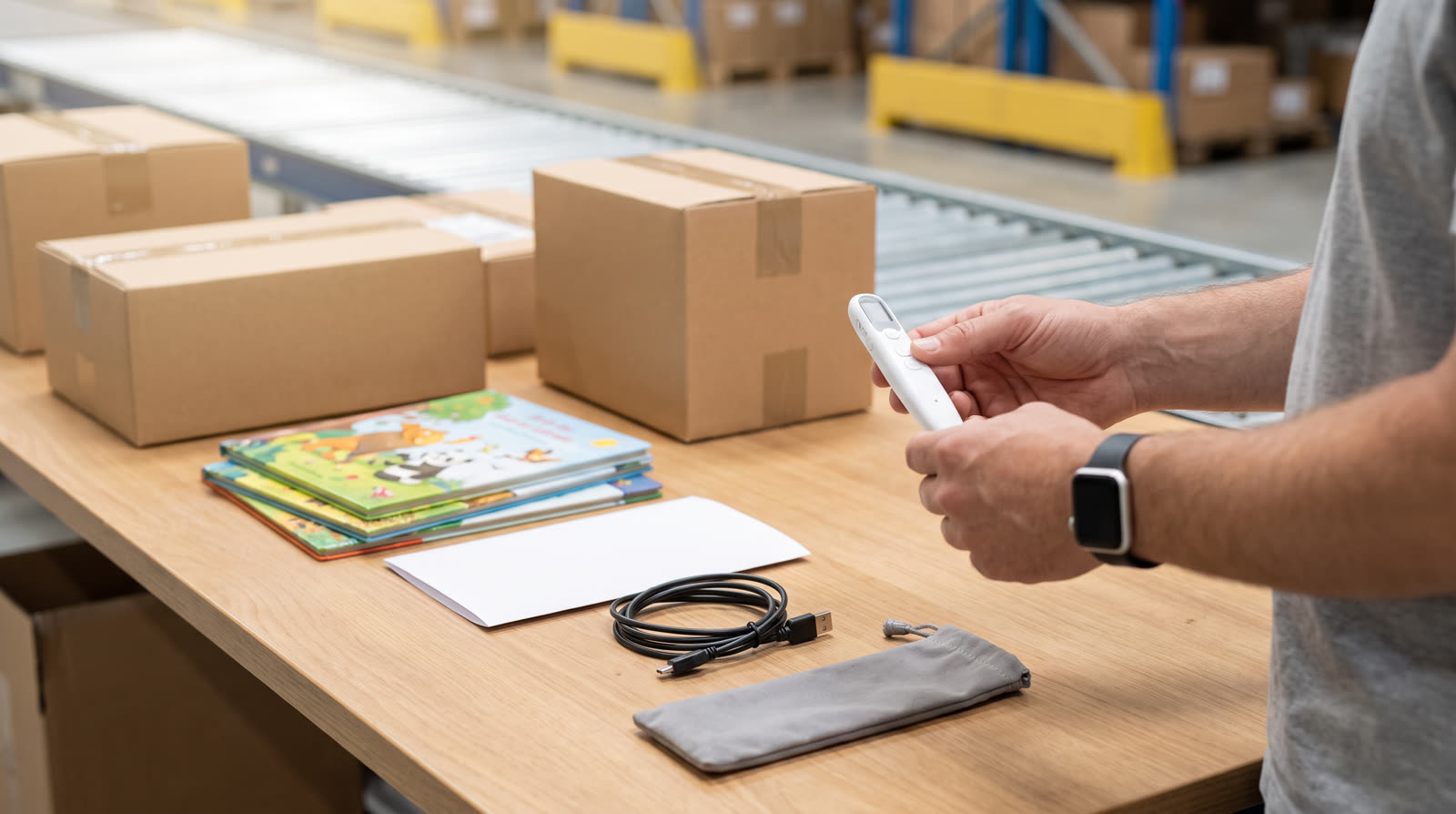
3. Test representative real use. Observe the named pen and book or content system in the relevant configuration. Record the setting, page or interaction, result, repeat conditions and recovery steps. When a classroom, library, retailer, family or distributor process is involved, walk through the actual customer or user journey rather than a shortened showroom demonstration.
4. Decide and document. Name the buyer approver, exceptions, owner of each correction and condition that triggers another review. Keep a dated release, revise or escalate outcome next to the evidence. That record should survive a staff handover and provide a defensible source of truth for later procurement, onboarding, listing, support or content-release work.
ReadGlo project support
Send Your Requirements
Share your target market, product scope, expected quantity and launch timing. Our team can prepare a relevant product, content or quality-control discussion.
Coordinate Product, Content, Rights, Data, Market and Route
No single supplier, file or reviewer automatically owns every part of a programme. Hardware, firmware, books, narration, translations, illustrations, packaging, customer information, marketplace copy, school records, product photography, battery information and shipment documents can each have a different accountable owner. The buyer should record these handovers explicitly.
Content and rights need the same discipline as hardware. Confirm the rightsholder, territory, medium, language, edition, attribution and written permission that apply to the actual text, images, recordings, translations, music or other assets. Do not assume that a print permission authorises audio, marketplace, app or promotional use. WIPO copyright and licensing guidance provides international context for questions about assignment and licensing.
Where a product is connected or used in a school, library, retailer or family workflow, map whether any personal information is collected, accessed, transferred, retained or deleted. Where battery, charging or transport are in scope, identify the final battery configuration, packaging, carrier, mode and route. These are conditional verification tracks, not blanket assertions about a product or destination.
Control Handover and Later Changes
The approved record should be useful at the next gate: school pilot, publisher handover, purchase order, inspection, receiving, retail launch, marketplace listing, distributor onboarding, customer support or programme renewal. Include the current scope, approved assets, sample or operational record, exceptions, buyer-facing wording, named owners and next-review trigger.
A change can appear small but be material. A new battery, firmware, audio file, book reprint, language variant, package panel, accessory, supplier, destination, demo format or shipment method can affect the needed evidence. Log the delta, compare it with the approved baseline, identify affected evidence and decide whether a targeted check, revised proof, trial or sample is necessary.
This approach makes education programme procurement, donor funded education supplies, NGO education technology procurement and interactive reading materials tender useful as buyer-intent search terms: they lead to a controlled question rather than a generic promise. It also gives education, publishing, retail and support teams a practical source of truth when a channel asks for a clear answer.
Buyer Checklist Before the Next Commitment
Use this checklist before approving the next commercial step.
- Confirm the exact pen, book edition, content or firmware release, accessories, package, intended users and destination.
- Separate observed sample or pilot findings from unverified future-production, market or marketing claims.
- Record who owns product, editorial, rights, privacy, market, battery, route and customer-information decisions.
- Link public wording to the configuration and evidence it describes.
- Keep approvals, exceptions, corrective actions and re-test triggers in one dated register.
- Verify that rights, translation, recording and asset permissions cover the intended territory, language, medium and channel.
- Check market-, configuration- and route-specific questions with the responsible specialists before release.
For a practical next step, share the target market, product scope, intended channel and decision window when you send requirements to ReadGlo.
Frequently Asked Questions
1. What should an education NGO include in a reading-pen procurement brief? Start with the recorded scope: the exact pen, book edition, content or firmware version, intended market, channel and decision owner. education grant procurement brief should lead to an evidence-backed buyer question, not a promise that an unspecified future configuration will perform in the same way.
2. How can a donor-funded programme compare reading-pen suppliers fairly? Assign the answer to the accountable owner and retain the evidence, date and version it covers. Where a point concerns education programme procurement, check the actual configuration and destination rather than transferring a statement from another SKU, sample, market or route.
3. What evidence should buyers request before piloting interactive reading materials? Use a controlled sample, proof, trial or operational walkthrough where the decision depends on real use. Record what was observed, the conditions, any limitation, the corrective action and the recheck trigger; do not turn one observation into a blanket quality, safety, learning or compatibility claim.
4. How should child safeguarding be written into a technology or book-supply tender? Separate product facts, content and rights approvals, customer-facing claims, privacy/data decisions, battery information and transport requirements. They can require different owners and records, especially when the audience, book edition, language, channel or destination changes.
5. What privacy questions apply if a reading pen or companion service processes children’s data? Hold, revise or escalate when the scope, evidence, rights, responsible party or market applicability is unclear. A staged decision is usually more honest than a broad assurance and preserves a usable path to re-test after the missing information is supplied.
6. How should buyers specify books, audio, translation and intellectual-property rights? Keep a dated change log. Revisit the relevant part of the review after a hardware, firmware, audio, book, translation, packaging, supplier, market or route change, and confirm whether the existing evidence still describes the released configuration.
7. What should be verified before accepting a reading-pen shipment for a school programme? Use the buyer-owned decision record to define the next action, evidence owner and customer wording. If the question affects product safety, children’s data, content rights, local requirements or battery transport, obtain qualified market-specific review instead of relying on a generic online answer.
Continue With Related ReadGlo Resources
Continue with the reading-pen product overview, the ReadGlo Buyer FAQ and the full buyer-guide library. Related internal research themes include How Should Publishers Protect Content, Audio, and OID Project Rights?; How Do You Check Product Safety and Quality Before You Order?; A Simple Scorecard for Comparing Talking-Pen Suppliers. For a configuration-specific conversation, include the target market, pen and book scope, content/language needs, channel and route when you send requirements to ReadGlo.
Conclusion: Release Only the Evidence-Backed Scope
The strongest answer to “How Should Education Programme Buyers Build a Reading-Pen Grant or Donor Procurement Brief?” is not a generic yes or no. It is a buyer-owned record that matches the exact product, content, market and route to current evidence and accountable owners. That lets buyers compare options honestly, identify gaps early and avoid turning a preliminary discussion into an unsupported market promise.
Ready to move from a broad inquiry to a controlled project brief? Use the ReadGlo contact page to request a configuration-specific discussion. Include the intended market, pen and book scope, content/language needs, expected order context and any decision that must be verified before the next commitment.
Continue your research
Related reading pen buyer guides
Use these related guides to compare the next product, content, sourcing or channel decision in your project.
- Buyer GuideHow Can an Importer Prepare a Talking Pen Battery and Accessory Shipping Brief?Read this guide
- Compliance & SafetyWhich Factories Perform Rigorous Humidity and Temperature Cycling Tests on Electronic Book Readers?Read this guide
- Buyer GuideHow Can Buyers Reconcile Pen, Book, Content and Carton Lines Before Releasing a Talking-Pen Purchase Order?Read this guide
Continue with ReadGlo
See product specifications and request model-specific documentation.
ReadGlo project support
Get a Project Quote
Request product specifications, sample guidance or a tailored proposal for your reading pen, interactive book or distributor program.