
Contents
Introduction
In modern early childhood education, interactive reading tools such as talking pens and sensor-enabled picture books have transformed how children engage with literature. By translating printed symbols into audio narration, sound effects, and musical cues, these technologies bridge the gap between pre-literate decoding and independent reading comprehension. However, educators, speech-language specialists, and B2B publishing partners frequently observe a distinct pedagogical challenge: audio over-reliance. When children rely entirely on automated auditory playback without engaging in visual tracking, cognitive deduction, or parent-child dialogue, the learning process risks becoming passive listening rather than active literacy acquisition. To address this challenge, educators and parents can implement a structured 10-minute interactive reading routine. This routine consciously regulates audio usage, intertwining digital playback with visual scanning, physical pointing, and open-ended conversation. Designed for B2B distributors, educational publishers, and institutional buyers collaborating with ReadGlo, this guide examines how intentional pacing and multisensory engagement empower children to transition from dependent listeners to confident, independent readers.
1. Understanding Audio Over-Reliance in Interactive Reading Pens
1.1 The Balance Between Auditory Engagement and Visual Decoding
Interactive reading pens provide immediate auditory feedback when pointed at encoded book pages. While this immediacy motivates young learners, it can sometimes short-circuit the natural cognitive processes required for visual decoding. In traditional reading environments, children scan letter-sound correspondences, observe illustration details, and infer narrative meaning through context. When audio is omnipresent and triggered indiscriminately, children may bypass visual symbol recognition entirely, treating the book merely as an audio trigger board. Maintaining pedagogical balance requires recognizing that audio tools should serve as scaffolds rather than replacements for cognitive effort. B2B partners and educational developers must design resources where digital audio prompts critical thinking, encourages eye-tracking across printed lines, and reinforces phonemic awareness without overshadowing the visual text.
1.2 Identifying Signs of Passive Listening in Young Readers
Recognizing audio dependency early is essential for educators and parents guiding home or classroom reading sessions. Indicators of passive listening include children tapping the page repeatedly without looking at the illustrations or text, inability to recall story events when the audio device is muted, and a lack of spontaneous verbal interaction during reading. If a child waits passively for the pen to deliver every word rather than attempting to decode familiar sight words or discuss picture details, the educational impact diminishes. Establishing diagnostic observation checklists helps distributors and school suppliers train retail staff and educators to counsel parents on corrective pacing strategies before passive habits become entrenched.
1.3 The Pedagogical Value of Multisensory Integration Without Replacement
Effective early childhood frameworks emphasize multisensory integration, where auditory, visual, and tactile modalities reinforce one another harmoniously. ReadGlo's interactive book architecture is engineered to support this balance by embedding invisible optical codes that link to contextual dialogues, character voices, and ambient soundscapes rather than continuous, uninterrupted reading blocks. By encouraging children to listen to a brief audio snippet, pause, point to the corresponding illustration, and discuss the scene with an adult, the reading experience becomes genuinely interactive. This intentional pause prevents cognitive overload and ensures that auditory input acts as a catalyst for active verbal expression and critical inquiry.
2. Designing the 10-Minute Structured Reading Routine
2.1 Minute 0 to 2: Visual Exploration and Cover Prediction
The foundation of the 10-minute routine begins before the talking pen is even switched on. During the first two minutes, parents and educators guide the child in exploring the book cover, examining color palettes, identifying character expressions, and predicting what the story might be about. This initial phase activates prior knowledge and trains the child's visual cortex to examine details independently. By asking open-ended questions about the front cover illustrations, adults establish a habit of visual curiosity. Only after this initial prediction phase is completed should the reading pen be introduced as a collaborative tool for exploring specific narrative elements.
2.2 Minute 2 to 6: Active Dual-Coding (Audio Prompting Followed by Child Speech)
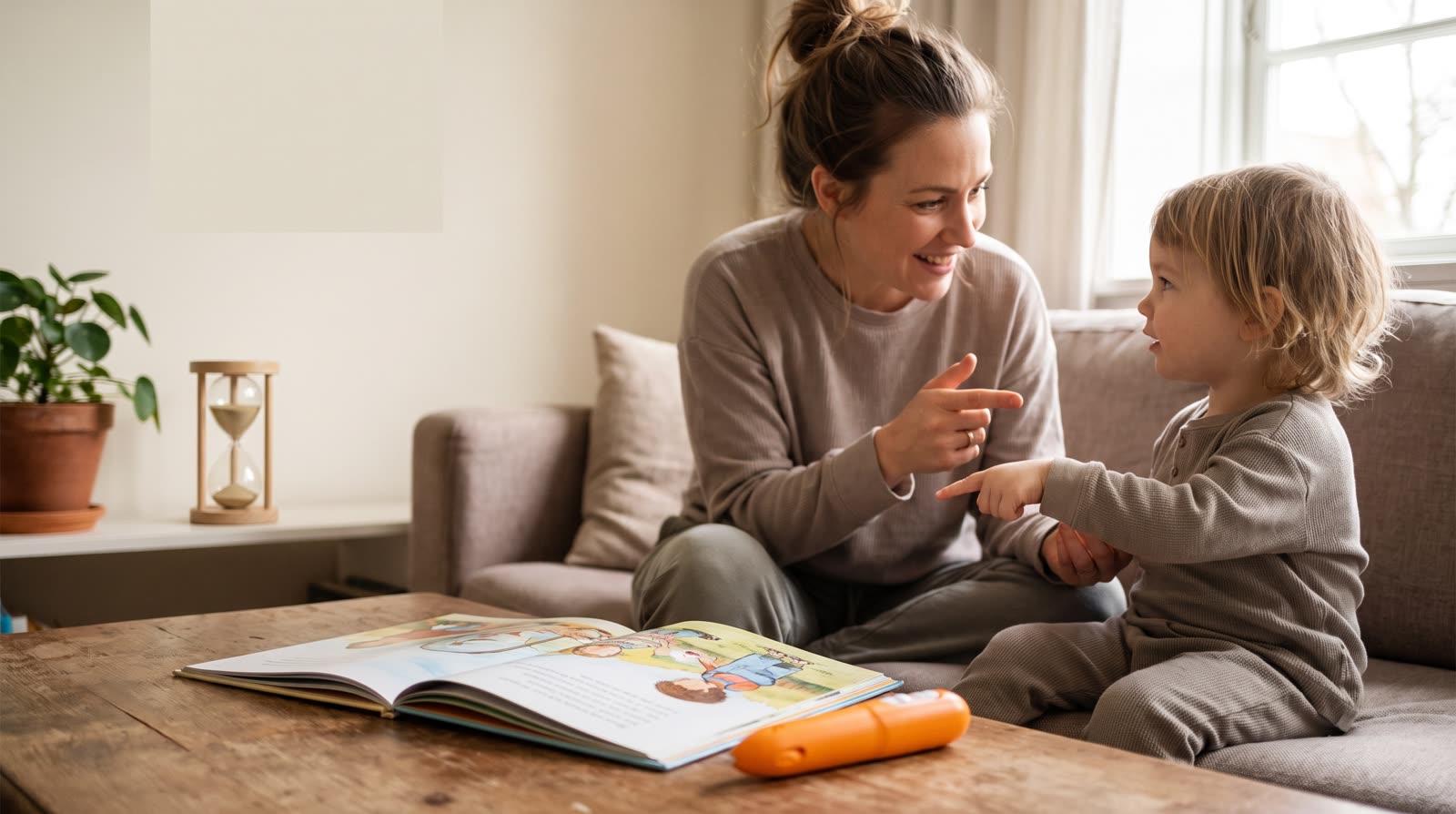
Between minutes two and six, reading enters its core interactive phase. The child uses the ReadGlo talking pen to activate a key dialogue line or sound effect, but with a strict rule: for every audio playback, the child must echo the phrase or describe what is happening in their own words. This dual-coding technique ensures that auditory input is immediately processed and articulated verbally. Adults can prompt the child by asking, 'Why did the character make that sound?' or 'Can you point to the word the pen just read?' This active participation prevents the child from falling into repetitive, unthinking tapping patterns and reinforces vocabulary retention.
2.3 Minute 6 to 10: Open-Ended Prompting, Retelling, and Comprehension Checks
The final four minutes of the routine transition away from digital audio entirely. The talking pen is set aside, and the adult invites the child to turn back through the read pages and retell the story using only the visual illustrations. This phase solidifies narrative comprehension and evaluates whether the child grasped the core storyline independently. Adults can use guided prompts aligned with early literacy frameworks to encourage critical thinking, such as discussing how a character felt or what might happen next. This structured tapering of audio support ensures children finish the reading session feeling confident in their own cognitive and linguistic abilities.
3. Implementing the Routine Across Different Developmental Stages
3.1 Toddlers (Ages 2–3): Sound-Object Association and Tactile Pointing
For toddlers aged two to three, the 10-minute routine focuses heavily on sensory exploration and sound-object association. At this developmental stage, attention spans are brief, and motor skills are still developing. The routine utilizes high-contrast picture books with chunky, tactile elements where tapping specific icons triggers delightful animal sounds or simple conversational words. Parents guide the toddler's hand to hold the pen correctly, modeling how sound connects directly to the physical image. The emphasis is on joyful discovery and vocabulary building, keeping sessions concise to prevent sensory fatigue.
3.2 Preschoolers (Ages 3–5): Sentence Prediction and Sound Effect Questioning
As children progress into preschool years (ages three to five), the 10-minute routine evolves to incorporate sentence prediction and questioning. Before tapping an interactive hotspot that reveals a character's dialogue, the adult pauses and asks the child to guess what the character might say based on the storyline context. Once the child makes a prediction, they use the talking pen to verify their guess. This gamified verification process turns passive listening into active problem-solving, enhancing both listening comprehension and expressive language skills.
3.3 Early Readers (Ages 5–7): Independent Sight Word Decoding Before Audio Verification
For early readers aged five to seven, the 10-minute routine supports transitional literacy by encouraging children to attempt decoding printed sight words independently before using the audio pen for verification. During the core phase of the routine, the child reads a sentence aloud using phonics knowledge, and then taps specific words with the pen to check pronunciation or explore extended definitions. This methodology bridges guided reading with autonomous learning, ensuring children do not become dependent on audio playback for basic word recognition.
ReadGlo project support
Request Product Catalog
Explore ReadGlo's complete range of interactive talking pens and multimodal picture books designed for balanced early literacy development.
4. B2B Integration, Publisher Guidance, and Educator Enablement
4.1 Designing Multimodal Print-Digital Layouts for Educational Distributors
For educational publishers, toy distributors, and B2B buyers partnering with ReadGlo, instructional design must account for pedagogical balance directly within book layouts. Print layouts should strategically position optical dot codes to encourage selective interaction rather than blanket audio saturation. Incorporating margin prompts, visual symbols for adult-child dialogue breaks, and structured reading guides inside the front and back covers empowers institutional buyers and school suppliers to offer comprehensive solutions that align with professional educational standards.
4.2 Equipping Retailers and Schools with Facilitation Guidelines
Successful distribution of interactive educational hardware requires robust end-user enablement. B2B partners benefit significantly from supplying structured facilitation guides alongside ReadGlo talking pen sets and book collections. These guides outline the 10-minute routine in clear, accessible language, providing educators and parents with practical scripts, milestone checklists, and troubleshooting tips for managing screen and audio time effectively. Providing such resources enhances brand trust and positions distributors as consultative leaders in early childhood education.
4.3 Maintaining Pedagogical Integrity in Global EdTech Distribution
As educational technology scales across international markets, maintaining pedagogical integrity is paramount. Distributors and publishing partners must ensure that localized audio files, multilingual translations, and cultural contexts support balanced literacy acquisition. By collaborating closely with curriculum experts and adhering to established early childhood development guidelines, ReadGlo and its global partners ensure that hardware and software innovations consistently serve the holistic developmental needs of young learners.
5. Safety, Handling, and Hardware Stewardship in Daily Practice
5.1 External Device Inspection and Child Safety Standards
Ensuring child safety during daily educational routines requires adherence to strict product stewardship guidelines. Parents and educators should perform routine external inspections of interactive reading pens and charging cables to verify casing integrity, optical lens cleanliness, and port security. According to safety guidelines established by the U.S. Consumer Product Safety Commission (CPSC), children's electronic learning devices must be handled with care to prevent mechanical damage or environmental exposure. Users should never attempt to disassemble, modify, or repair reading pen hardware independently.
5.2 Proper Storage and Environmental Care for Talking Pens
Maintaining optimal device performance and battery longevity involves consistent environmental care. Talking pens and interactive books should be stored in clean, dry environments away from direct sunlight, extreme temperature fluctuations, and moisture. If a device or book set is exposed to liquid spills, users must immediately power down the equipment, disconnect charging accessories, and allow components to dry thoroughly before secondary inspection. Regular soft-cloth cleaning without harsh chemical solvents ensures optical sensors remain unobstructed for reliable code reading.
5.3 When to Contact Manufacturers and Authorized Support Channels
In the event of device malfunction, unusual heat generation, battery swelling, or persistent operational anomalies, users must immediately cease operation, disconnect power sources, and avoid attempting any unauthorized troubleshooting or battery removal. B2B partners, retail channels, and institutional buyers should direct end-users to contact authorized ReadGlo customer service representatives or certified technical support channels for professional assessment, warranty verification, or safe replacement procedures in compliance with international consumer safety standards.
Frequently Asked Questions
What is audio over-reliance when using interactive reading pens?
Audio over-reliance occurs when a child depends entirely on automated audio playback from a talking pen without engaging in visual decoding, picture observation, or parent-child dialogue, turning active reading into passive listening.
How does a 10-minute routine help prevent audio dependency?
A structured 10-minute routine divides reading time into intentional phases: visual cover prediction, active dual-coding where audio is echoed with speech, and pen-free story retelling, ensuring balanced cognitive and linguistic engagement.
Can toddlers use interactive reading pens effectively?
Yes, toddlers aged two to three can use talking pens for sensory exploration, sound-object association, and tactile pointing under adult guidance, keeping sessions brief to match their developmental attention spans.
What should parents do if a reading pen or book set gets exposed to moisture?
Immediately power down the device, disconnect any charging cables, wipe away excess surface liquid with a clean absorbent cloth, and allow all components to dry completely in a well-ventilated area before attempting further use.
How can B2B distributors and schools support parents in implementing structured reading routines?
Distributors and educational institutions can include practical facilitation guides, milestone checklists, and teacher-parent workshops alongside ReadGlo product bundles to ensure effective, balanced usage.
Conclusion
Interactive reading tools like ReadGlo talking pens and sensor-enabled picture books represent a monumental advancement in early childhood education, offering unprecedented support for vocabulary acquisition and phonemic awareness. However, technology is most effective when thoughtfully integrated into structured, human-guided routines. By implementing a deliberate 10-minute reading routine that balances digital audio prompting with visual observation, active speech echoing, and independent story retelling, parents and educators can successfully prevent audio over-reliance. For B2B partners, educational publishers, and institutional buyers, championing balanced pedagogical frameworks ensures that interactive learning tools foster lifelong literacy, critical thinking, and genuine cognitive growth.
Continue your research
Related reading pen buyer guides
Use these related guides to compare the next product, content, sourcing or channel decision in your project.
- Early LearningHow Can Parents Avoid Over-Reliance on Audio Using a Reward Chart?Read this guide
- Early LearningHow Parents and Educators Can Prevent Audio Over-Reliance Using a Reading Pen and Picture Books TogetherRead this guide
- Early LearningHow Can Parents Avoid Over-Reliance on Audio Using Guided Questions?Read this guide
Continue with ReadGlo
See a DOT-code picture-book set designed for guided early-learning programs.
ReadGlo project support
Partner With Us
Connect with ReadGlo's B2B team to discuss custom curriculum integration, OEM/ODM solutions, and educational distribution opportunities.