
Contents
Introduction
Maintaining talking picture books after daily use requires a balanced approach that protects delicate paper fibers, laminated surfaces, and invisible optical dot (OID) codes essential for reading pen scannability. For educational publishers, school distributors, and B2B procurement partners, establishing standardized cleaning and maintenance protocols ensures product longevity, hygiene, and consistent optical recognition across extensive classroom and home circulation. By employing gentle dry-wipe techniques, avoiding harsh chemical solvents, and conducting systematic pre-shipment and incoming quality inspections, stakeholders can preserve educational value while upholding strict safety and quality standards aligned with CPSC and literacy development guidelines.
Understanding OID Optical Codes and Page Durability in Talking Picture Books
The Technology Behind Optical Invisible Dot (OID) Codes on Paper
Talking picture books rely on sophisticated Optical Identification (OID) technology, where microscopic dot patterns are printed alongside full-color illustrations using specialized carbon or infrared-absorbing inks. When a reading pen's optical sensor scans the page, these invisible dots translate into audio files corresponding to the targeted text or interactive hotspot. Because the scannability of the reading pen depends entirely on the integrity of the printed dot matrix, any surface obstruction, scratching, heavy staining, or chemical degradation can interrupt optical recognition. Educational publishers must specify durable printing substrates and protective coatings during manufacturing to safeguard these optical codes against frequent fingerprint oils, dust, and daily wear in high-turnover environments.
Importance of Lamination and Surface Protection for Daily Use
To withstand rigorous daily handling by young children, premium talking picture books utilize matt or gloss lamination over high-grade offset or board book paper. Lamination acts as a moisture-resistant barrier, preventing liquid spills, food residues, and oils from penetrating paper fibers and blurring the OID dot matrix. During the specification confirmation and sample review phases, B2B buyers should evaluate the thickness and bonding quality of the lamination film. High-quality thermal lamination not only enhances tactile engagement and visual clarity but also facilitates safe, repeatable surface cleaning without compromising the underlying optical scannability required by interactive reading pens.
Standardized Cleaning and Maintenance Protocols for Educational Distributors
Recommended Dry and Damp Wipe Procedures Using Microfiber Cloths
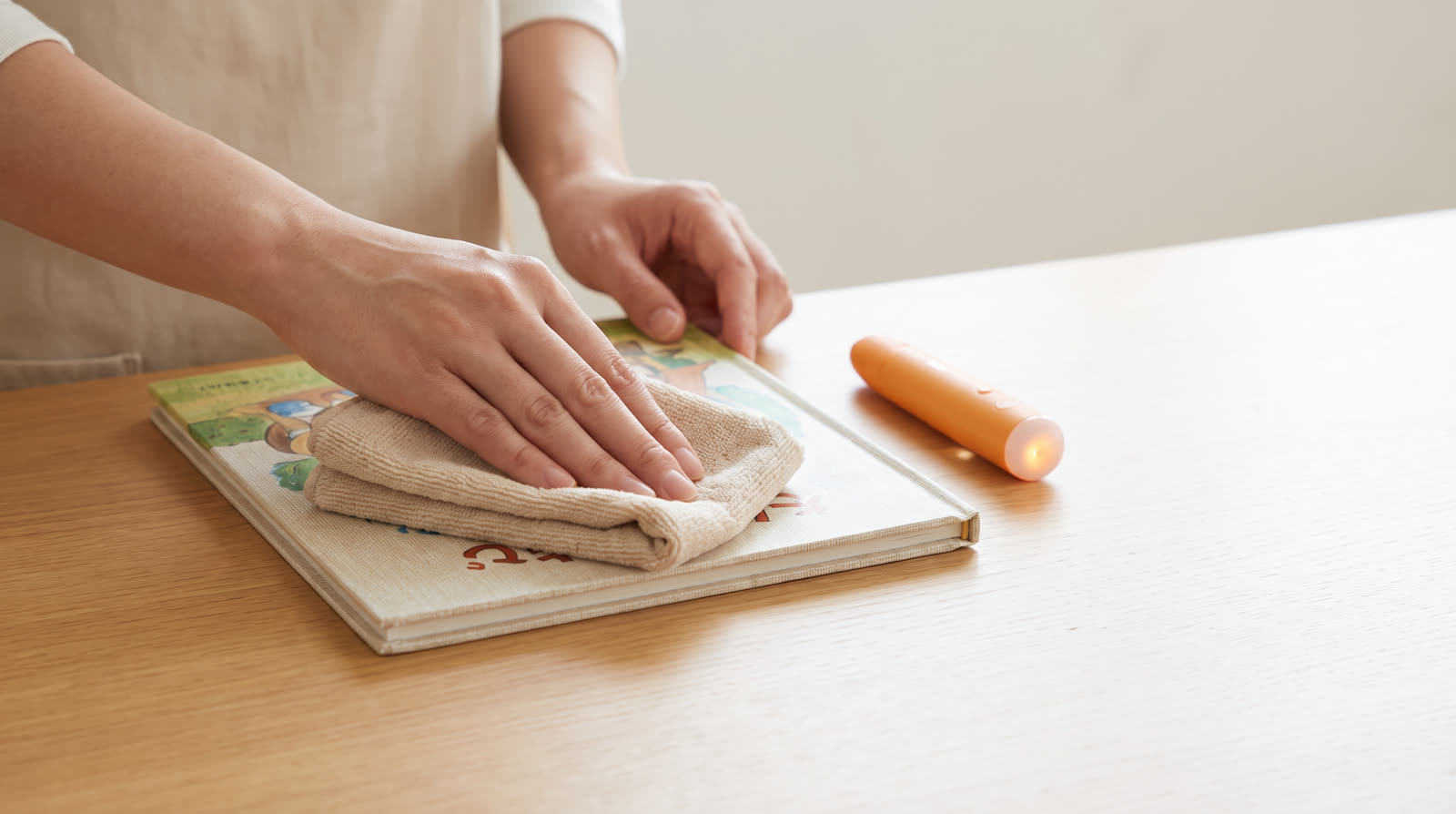
Routine cleaning of talking picture books after daily use should prioritize non-abrasive mechanical removal of dust, smudges, and light debris. Operators and educators should use a dry, soft microfiber cloth to gently wipe page surfaces in a linear motion. If sticky residues or heavier soil is present, the microfiber cloth can be very lightly dampened with plain water or a mild, alcohol-free, neutral soap solution. Direct spraying of liquids onto books must be strictly avoided to prevent moisture seepage into book spines and binding gutters. After gentle wiping, pages should be allowed to air-dry completely in a well-ventilated area before closing or returning books to storage, ensuring moisture does not cause page warping or adhesive breakdown.
Preventing Moisture Damage and Chemical Degradation on Laminated Pages
Chemical exposure is a primary risk factor in maintaining printed educational materials. Harsh cleaning agents, including bleach, ammonia, strong disinfectants, and acetone-based solvents, can dissolve laminating films, discolor inks, and chemically alter the optical properties of OID dot codes. Institutional maintenance staff must be trained to use only approved, pH-neutral cleaning solutions that preserve surface integrity. Furthermore, excessive soaking or immersion of board book edges in water can cause cardboard cores to swell and delaminate, permanently destroying the binding and rendering the book non-functional. Adhering to controlled, low-moisture cleaning protocols protects capital investment in classroom libraries.
ReadGlo project support
Request B2B Sample Kit & Quality Specifications
Partner with ReadGlo to evaluate our durable interactive talking book collections and manufacturing standards for your distribution market.
Factory Quality Assurance and Pre-Shipment Inspection for Book Durability
Specification Confirmation and Sample Review for B2B Procurement
Ensuring long-term cleanability and durability begins long before end-user maintenance—it starts at the manufacturing level with rigorous specification confirmation and sample review. B2B procurement teams must establish clear quality benchmarks with manufacturing partners regarding paper weight (e.g., 350gsm art paper for board books), lamination thickness (e.g., 25-micron matte film), and binding strength (heavy-duty thread sewing or reinforced board binding). During pre-production sample reviews, buyers should test sample pages against simulated cleaning procedures, ink rub resistance, and optical scannability to verify that production batches will withstand repeated cleaning cycles in institutional settings.
Mechanical Wear Testing and Optical Scannability Verification
Quality control protocols during pre-shipment inspection (PSI) must incorporate structured wear and scannability testing. Inspectors utilize calibrated optical reading pens to test sample books across multiple signatures, ensuring that dot code recognition rates remain at 100% even after simulated page manipulation and cleaning. Additionally, mechanical drop tests, page-turn endurance testing, and edge-seal inspections are conducted to verify that lamination edges do not peel or fray under normal operational stress. Documenting these factory inspections provides distributors and school buyers with verifiable proof of product reliability and compliance with international publishing standards.
Compliance, Safety Guidelines, and Responsible Institutional Handling
Adhering to CPSC Safety and Material Handling Standards
Educational publishing and distribution must strictly align with consumer safety regulations, such as those established by the Consumer Product Safety Commission (CPSC) regarding non-toxic inks, child-safe coatings, and mechanical safety of printed goods. While books represent low-risk items compared to electronic hardware, materials used in laminated talking books must comply with phthalate limits, heavy metal testing (ASTM F963), and choking hazard prevention for younger demographics. Institutional handlers must inspect books regularly for torn pages, sharp edges, or loose laminated flaps that could pose safety hazards, immediately removing compromised items from circulation.
Collaborating with Qualified Educators and Managing Circulation Rotation
Maintaining hygiene and educational effectiveness in shared classroom environments requires systematic circulation rotation and collaboration with qualified educators and literacy specialists. Drawing on guidance from organizations like Reading Rockets and the American Academy of Pediatrics (AAP), schools should establish structured book-handling routines that teach young learners gentle page-turning practices and proper storage. Educators coordinate scheduled maintenance days where books are systematically inspected, cleaned, and inventoried, ensuring that children always interact with clean, fully scannable, and safe educational materials that support early literacy development.
Frequently Asked Questions
How do daily cleaning methods impact OID invisible code scannability on interactive picture books?
Daily cleaning using a dry or slightly damp microfiber cloth removes dust and oils without damaging the optical dot pattern (OID) printed on the paper. Excessive moisture, abrasive pads, or harsh chemical solvents can degrade the paper surface and disrupt optical scannability, making proper maintenance guidelines essential for educational publishers and B2B distributors.
What standard quality checks should B2B buyers perform on talking picture book pages upon receipt?
B2B buyers should conduct incoming quality control (IQC) by verifying print clarity, lamination adhesion, optical code readability across sample pages, and binding durability under repeated page-turning simulations, ensuring compliance with agreed manufacturing specifications before mass distribution.
How should educational institutions and distributors handle damaged or heavily soiled interactive book pages?
When interactive book pages suffer structural water damage, tearing, or severe staining that obscures optical dot codes, institutions should remove the affected materials from circulation to prevent reading pen recognition errors, and contact the manufacturer or qualified supplier for replacement stock or updated print runs.
Conclusion
Proper cleaning and maintenance of talking picture books are vital for preserving optical dot code scannability, ensuring hygiene in shared learning environments, and maximizing the lifespan of educational assets. For B2B distributors, publishers, and school procurement leaders, integrating strict factory quality assurance, standardized microfiber cleaning protocols, and CPSC-compliant material selection guarantees sustained product performance. By partnering with experienced manufacturers who prioritize durable lamination and precise OID printing, stakeholders can deliver reliable, high-quality interactive reading solutions that support early childhood literacy with confidence.
Continue your research
Related reading pen buyer guides
Use these related guides to compare the next product, content, sourcing or channel decision in your project.
- Product SupportB2B Operational Guide: Long-Term Storage and Safety Protocols for Children's Interactive Reading PensRead this guide
- Product SupportHow Do I Protect a Book Set Shared by Multiple Children? Durable Manufacturing and Institutional Care GuideRead this guide
- Product SupportComprehensive B2B Guide: How to Protect Children's Reading Pens During Long-Term StorageRead this guide
Continue with ReadGlo
See product specifications and request model-specific documentation.
ReadGlo project support
Inquire About Custom Talking Book Publishing Solutions
Contact our B2B team for sample reviews, specification confirmation, and pre-shipment inspection documentation.