
Contents
Direct Answer
Introduction Direct answer: A Golden Sample Acceptance Plan (GSAP) for reading pens is a structured quality control framework that uses a finalized, approved production unit—the "Golden Sample"—as the benchmark for all mass-produced items. For educational toy importers, this plan is the bridge between a prototype and a market-ready product, ensuring that every batch meets the precise technical, functional, and safety specifications required for distribution.
In the competitive landscape of educational technology, the transition from a design concept to a mass-produced product is fraught with potential pitfalls. For importers, distributors, and educational brands, the "Golden Sample" is not merely a high-quality prototype; it is the legally and technically binding reference point that defines the standard for the entire production run. A Golden Sample Acceptance Plan (GSAP) serves as a critical risk management tool. It provides a clear, objective set of criteria that a responsible supplier should follow and that buyers can request to ensure consistency across thousands of units. Without a robust GSAP, importers face significant risks, including firmware glitches that render pens useless, battery failures that pose safety hazards, or audio quality issues that compromise the educational value of the product. By establishing a rigorous acceptance plan, importers can safeguard their investment, protect their brand reputation, and ensure that every child who uses the reading pen receives a high-quality, reliable learning tool.
Understanding the "Golden Sample" in the Context of OID Technology
**What is OID Technology? Optical Identification (OID) technology is the heart of a modern reading pen. It involves a tiny CMOS camera (the OID sensor) located at the tip of the pen, which reads a nearly invisible pattern of micro-dots printed on books or other surfaces. These dots encode specific data that the pen's internal processor translates into audio playback, interactive games, or translation functions.
A responsible supplier should ensure that the OID sensor is perfectly aligned and that the lens is free from dust or scratches. In a Golden Sample, the OID recognition speed—often measured in milliseconds—must be consistent. Importers should confirm in writing the specific OID version being used (e.g., OID 2.0 vs. OID 3.0), as this affects the pen's compatibility with different printing techniques and dot densities.
Prototype vs. Golden Sample: The Crucial Distinction It is common for buyers to receive a "Sales Sample" or a "Prototype" during the early stages of negotiation. These are often hand-assembled or produced using different methods than mass production. A Golden Sample**, however, must be pulled from a trial production run using the actual molds, components, and assembly lines that will be used for the bulk order.
The Golden Sample represents the "ceiling" of quality that the factory can achieve and the "floor" of what the importer will accept. It includes not just the pen itself, but also the finalized packaging, user manuals, and accessories. Once approved, this sample is typically signed and sealed by both the buyer and the manufacturer, becoming the definitive benchmark for all future quality inspections.
The Core Pillars of a Reading Pen Acceptance Plan
**1. Hardware and Physical Specifications The physical integrity of a reading pen is the first thing a consumer notices. A Golden Sample must exhibit the exact finish, weight, and material quality expected in the final product.
* Casing Material and Safety: Importers should specify the use of high-impact ABS plastic, which must be non-toxic and BPA-free. The Golden Sample should be checked for "burrs" or sharp edges that could arise from poorly maintained molds. Buyers can request a material safety data sheet (MSDS) to verify that the plastic meets target market standards like EN71 Part 3. * Ergonomics and Aesthetics: Since these products are designed for children, the ergonomics—such as the grip diameter and the weight distribution—must match the approved design. The color consistency (Pantone matching) of the plastic and any silk-screened logos must be identical to the Golden Sample. * Button Durability: Reading pens often feature multiple buttons for volume, power, and mode switching. The tactile feedback (the "click" feel) should be consistent. A responsible supplier should provide data on button life-cycle testing (e.g., 50,000 presses) to ensure longevity. * OID Sensor Protection: The tip of the pen houses the sensitive OID sensor. The Golden Sample should demonstrate a securely recessed lens that is protected from direct impact while remaining accessible for cleaning if necessary.
**2. Functional Performance and Firmware Stability Firmware is the "brain" of the reading pen, and its stability is paramount. A Golden Sample must be loaded with the final, "frozen" version of the firmware.
* Recognition Accuracy and Latency: The primary function of the pen is to read dots. The Golden Sample sets the standard for recognition speed. Any latency—the delay between touching the book and hearing the sound—greater than 0.2 seconds can frustrate young users. The acceptance plan should define the maximum allowable latency. * Memory Management: Whether the pen uses internal Flash memory or an external TF card, the Golden Sample must demonstrate correct file indexing. Importers should verify that the pen can handle the full capacity of its storage without slowing down or crashing. * Connectivity: USB-C or Micro-USB ports must be tested for both charging and data transfer. The Golden Sample should show seamless connection to a PC for content updates, a feature many educational brands rely on for long-term product value. * Firmware Versioning: The GSAP should include the specific firmware version number. Any subsequent updates during mass production must be re-validated against the Golden Sample to ensure no new bugs are introduced.
**3. Audio Engineering and Sound Quality For an educational toy, audio clarity is not a luxury; it is a core requirement. Poor audio can lead to incorrect pronunciation learning, which is a major concern for educational publishers.
* Audio Bitrate and Compression: The Golden Sample should be loaded with audio files at a specific bitrate (e.g., 128kbps for high fidelity). Importers should listen for "hissing" or digital artifacts that might indicate poor-quality DAC (Digital-to-Analog Converter) components. * Speaker Quality and SNR: The Signal-to-Noise Ratio (SNR) should be high enough that the voice is clear even at low volumes. The Golden Sample's speaker must not rattle or distort at maximum volume. * Decibel (dB) Limits: To comply with international safety standards like EN71-1, reading pens must not exceed specific sound pressure levels when held close to the ear. The Golden Sample should be laboratory-tested to ensure it meets these safety thresholds, and the production units must not deviate from this hardware configuration.
**4. Battery and Power Management Battery failure is one of the leading causes of product returns in the electronics industry. A Golden Sample provides the benchmark for power performance.
* Battery Capacity and Chemistry: Importers should confirm the battery type (usually Lithium-polymer) and capacity (e.g., 600mAh). The Golden Sample must undergo a full charge/discharge cycle to verify the claimed active usage time (e.g., 6 hours of continuous playback). * Safety Circuitry: The battery must include a Protection Circuit Module (PCM) to prevent overcharging, over-discharging, and short-circuiting. A responsible supplier should provide certification for the battery cell (e.g., UN38.3, IEC 62133). * Charging Indicator Consistency: The behavior of LED indicators during charging (e.g., red for charging, green for full) must be clearly defined in the GSAP based on the Golden Sample's performance.
Defining the Acceptance Criteria: A Step-by-Step Guide for Importers
Creating a Golden Sample Acceptance Plan is a collaborative process between the importer's quality team and the manufacturer's engineering department. A responsible supplier should welcome this level of detail, as it reduces the likelihood of costly reworks or shipment rejections.
**Step 1: Technical Data Sheet (TDS) Alignment Before a Golden Sample is even produced, both parties must agree on a Technical Data Sheet. This document should list every component, from the OID sensor model to the specific brand of flash memory. The TDS serves as the theoretical blueprint, while the Golden Sample is the physical manifestation of that blueprint.
**Step 2: The Approval Signature and Sealing Process Once a sample is produced that meets all TDS requirements, it must be formally approved. This is not a verbal agreement. The importer or their representative should physically sign the sample (often on a non-removable tag or the internal casing) and date it.
B2B Best Practice: At least three identical Golden Samples should be prepared. One stays with the manufacturer's QC department, one is kept by the importer, and the third is held by a third-party inspection agency. All three should be sealed in tamper-evident packaging.
**Step 3: Defining "Critical," "Major," and "Minor" Defects The GSAP must categorize potential deviations from the Golden Sample. For a reading pen: * Critical Defects: Safety hazards (e.g., battery overheating, sharp edges) or complete functional failure. Acceptance limit: 0%. * Major Defects: Issues that affect the primary function or significantly reduce the product's value (e.g., OID recognition failure, incorrect audio files, significant battery life reduction). * Minor Defects: Aesthetic issues that do not affect function (e.g., slight color deviation, minor scratches on the packaging).
**Step 4: Finalizing the Pre-shipment Inspection (PSI) Protocol The GSAP should specify that a PSI will be conducted on the bulk production. The inspectors will compare random samples from the mass production against the sealed Golden Sample. If the bulk units deviate significantly from the benchmark, the importer has the contractual right to halt the shipment and request corrective actions.
Call to Action: Navigating the complexities of OID technology and quality assurance requires a partner who understands the nuances of educational electronics. For a detailed consultation on how to structure your next reading pen project, contact our team at info@readglo.com.
The Role of Third-Party Inspections and Lab Testing
While the Golden Sample is a visual and functional benchmark, it cannot replace certified laboratory testing for safety and compliance.
**Compliance with International Standards A Golden Sample should be the exact unit sent to accredited labs (such as SGS, Intertek, or TUV) for testing. Importers must ensure the pen complies with: * ASTM F963 / CPSIA (USA): Focusing on mechanical safety, lead content, and phthalates. * EN71 (EU): The comprehensive European toy safety standard. * RoHS and WEEE: Ensuring the electronics are free from hazardous substances and are properly recyclable.
**Pre-shipment Inspection (PSI) and AQL During the PSI, the Golden Sample acts as the "Master." The inspection agency will use the AQL (Acceptable Quality Level) standard—typically AQL 0 for critical, 1.5 for major, and 4.0 for minor defects—to determine if the batch passes or fails. The Golden Sample is the only way to resolve disputes during inspection; if the inspector finds a button feels "mushy," they compare it to the Golden Sample's button to determine if it is a defect or within the approved range.
**The Importance of Content Verification For reading pens, the "content" (the audio and OID mapping) is as important as the hardware. The GSAP should include a requirement for the inspector to verify that the audio files on the production units are identical to those on the Golden Sample. This prevents the nightmare scenario of shipping thousands of pens with the wrong language or corrupted audio data.
ReadGlo project support
Send Your Requirements
Share your target market, product scope, expected quantity and launch timing. Our team can prepare a relevant product, content or quality-control discussion.
Table: Golden Sample vs. Production Sample Comparison
| Feature | Golden Sample (Master) | Mass Production Units | Acceptance Criteria |
|---|---|---|---|
| **Origin** | Trial production run (actual molds/lines). | Full-scale manufacturing run. | Must match Master exactly. |
| **Purpose** | Quality benchmark and legal reference. | Commercial inventory for distribution. | Statistical sampling (AQL). |
| **Firmware** | Final, "frozen" version. | Must be identical to the Master version. | Zero deviation allowed. |
| **OID Accuracy** | 100% recognition at <0.2s latency. | 99.5%+ recognition (Major defect if lower). | Tested against Master book. |
| **Battery Life** | Verified 6-8 hours active use. | Minimum 95% of Master's performance. | Cycle test on sample batch. |
| **Audio Quality** | High fidelity, no distortion at max vol. | No audible distortion or digital noise. | Side-by-side audio comparison. |
| **Packaging** | Final retail-ready design and materials. | Identical printing and structural integrity. | Visual match to Master. |
The following table outlines the key differences and the relationship between the Golden Sample and the subsequent mass production units.
Managing Deviations and Production Risks
Even with a perfect Golden Sample, mass production can encounter issues. The GSAP must define how to handle these deviations.
**What to Do When the Bulk Doesn't Match the Sample If a pre-shipment inspection reveals that the production units deviate from the Golden Sample, the importer should not immediately cancel the order. Instead, a responsible supplier should provide a root-cause analysis. * Minor Aesthetic Deviations: If the color is slightly off but within an acceptable Delta-E range, the importer might accept the batch with a discount or a warning for the next run. * Functional Deviations: If the OID sensor is less responsive, the batch should be rejected. The factory must then perform a 100% sorting or rework the firmware.
**Implementing a Corrective Action Plan (CAP) When a major deviation occurs, a CAP is essential. This plan should outline: 1. The specific defect found. 2. The root cause (e.g., a faulty component batch or a machine calibration error). 3. The steps taken to fix the current batch. 4. Preventive measures to ensure the issue does not recur in future production cycles.
Importers should confirm in writing that no shipment will leave the factory until the CAP has been successfully implemented and a re-inspection has passed.
FAQ Section
**1. How many Golden Samples should be prepared for a reading pen project? It is recommended to prepare at least three identical Golden Samples. One stays at the factory for the production line's QC team to reference daily. The second is kept by the importer (or the brand owner) at their headquarters for their own records and future product development. The third should be held by an independent third-party inspection agency to be used during the pre-shipment inspection. For large projects with multiple production sites, additional samples may be required.
**2. Can a Golden Sample be changed after mass production has started? Technically, yes, but it is a process that requires extreme caution. This is known as a "Running Change." If a component becomes unavailable or a critical firmware bug is discovered, a new "Golden Sample B" must be created, validated, and signed off using the same rigorous process as the original. All stakeholders must be notified, and the old Golden Samples should be clearly marked as "Obsolete."
3. What is the most common failure point in reading pen mass production? Based on industry experience, the most common failure point is the OID sensor alignment and lens cleanliness**. Because the sensor is so small and sensitive, even a microscopic amount of dust or a slight tilt during assembly can lead to poor recognition rates. This is why the GSAP must place a heavy emphasis on functional testing of the OID system across different pages of the interactive books.
Conclusion
Defining a Golden Sample Acceptance Plan is the single most effective way for an educational toy importer to ensure the success of a reading pen project. By treating the Golden Sample as a living document of quality—rather than just a pretty prototype—importers can bridge the gap between their vision and the final product delivered to consumers. A well-structured GSAP reduces risk, protects brand integrity, and ensures that the educational value of the product is never compromised.
For importers looking to scale their educational technology offerings, the investment in a rigorous acceptance plan pays for itself through reduced return rates and increased customer satisfaction. Always remember that in the world of B2B manufacturing, clarity is the best defense against quality issues.
Final Call to Action: Ready to elevate your quality control standards for your next batch of interactive educational toys? Our experts at ReadGlo specialize in OID technology and B2B project management. Reach out to us today at info@readglo.com to discuss your specific requirements and let us help you define a Golden Sample that sets your brand apart.
Image Plan
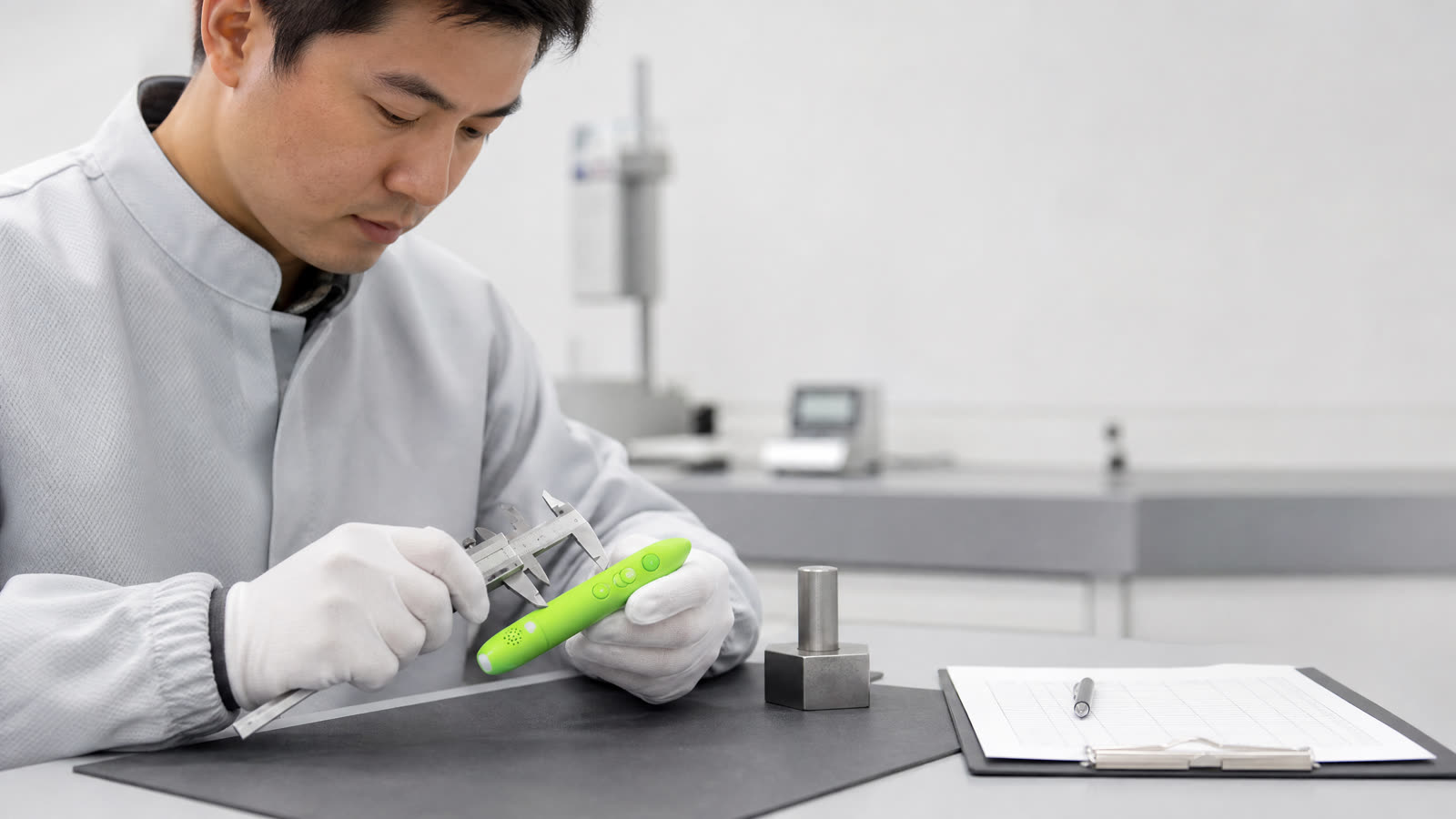
**Image Set 1: The Quality Control Benchmarking Process * Purpose: To visually demonstrate the side-by-side comparison of a Golden Sample and a production unit in a professional factory setting. * Article Position: Inserted after the "Hardware and Physical Specifications" section. * Caption: A quality control engineer performs a side-by-side physical inspection of a reading pen against the approved Golden Sample. * ALT Text: A close-up of a technician comparing two white reading pens on a clean, blue anti-static workbench in a modern electronics factory. * AI Prompt: A professional, realistic high-resolution photograph of a quality control engineer's hands in a modern electronics manufacturing facility. The engineer is holding two identical, sleek, white educational reading pens over a clean blue anti-static workbench. One pen is labeled "Golden Sample" with a small, professional tag. In the background, there are blurred out testing equipments and a brightly lit, clean factory environment. 16:9 aspect ratio, no text on the pens, no logos, sharp focus, natural lighting.
**Image Set 2: OID Technology and Interactive Learning * Purpose: To illustrate the functional application of the reading pen and the importance of OID recognition accuracy. * Article Position: Inserted within the "OID Technology" section. * Caption: High-precision OID sensors allow reading pens to interact seamlessly with specially printed educational materials. * ALT Text: A child's hand using a colorful reading pen to touch a page in a brightly illustrated children's book, showing the pen's tip interacting with the paper. * AI Prompt: A realistic, high-quality photograph of a child's hand holding a bright, ergonomically designed reading pen. The pen's tip is touching a page of a high-quality, colorful children's picture book that features illustrations of animals and nature. The lighting is warm and natural, suggesting a classroom or home learning environment. The focus is on the interaction between the pen tip and the paper. 16:9 aspect ratio, no visible text or brand names on the pen or the book, realistic photography style.
Continue your research
Related reading pen buyer guides
Use these related guides to compare the next product, content, sourcing or channel decision in your project.
- Quality ControlReading Pen Quality Control: A 12-Point Inspection Checklist for B2B BuyersRead this guide
- OEM GuideHow Should Distributors Care for Children’s Reading Pens in Humid Climates?Read this guide
- Quality ControlHow Can Buyers Verify a Press-Proof Interactive Book Still Scans Correctly with Its Reading Pen?Read this guide
Continue with ReadGlo
See product specifications and request model-specific documentation.
ReadGlo project support
Get a Project Quote
Request product specifications, sample guidance or a tailored proposal for your reading pen, interactive book or distributor program.