
Contents
Direct Answer
To validate OID audio mapping effectively, publishers should implement a multi-stage verification process that includes digital auditing of the mapping table for ID conflicts, laboratory testing of the K-layer (carbon black) ink for infrared absorption, and functional testing of "Blue-Paper" proofs using final pen hardware to ensure coordinate-to-audio synchronization. A responsible supplier should document these validation steps in a Technical Acceptance Report (TAR) before proceeding to mass production. This rigorous approach minimizes the risk of costly reprints and hardware-software misalignment in children's interactive learning products.
Introduction: The Critical Role of OID Mapping in Interactive Publishing
The global children’s book market has undergone a profound transformation, moving beyond static text toward multi-sensory, interactive experiences. As parents and educators increasingly seek screen-free alternatives to tablets and smartphones, the demand for tactile, interactive learning tools has surged. Central to this shift is OID (Optical Identification) technology, which bridges the gap between traditional print and digital audio. By embedding almost invisible dot patterns into the paper, publishers can transform a standard book into a dynamic learning tool that interacts with a child via a reading pen, providing immediate feedback and fostering independent learning habits.
However, the integration of hardware and software introduces new technical risks. Validation of OID audio mapping—the digital and physical link between the book's coordinates and the pen's audio database—is the single most critical step in the pre-launch phase. A single mapping error can result in a pen playing the wrong pronunciation or failing to respond entirely, leading to brand damage and expensive recalls. This guide provides a comprehensive framework for publishers to validate OID mapping, covering everything from initial digital templates to factory-level printing audits and safety compliance.
The Fundamentals of OID Technology and Audio Mapping
Understanding the underlying technology is the first step in effective validation. OID systems rely on a sophisticated interplay between optics, ink chemistry, and digital processing.
**How Dot Patterns and Infrared Sensors Interact
OID patterns are composed of micro-dots (0.01mm to 0.04mm) virtually invisible to the naked eye. Unlike standard QR codes, which require large, high-contrast squares that disrupt the visual design of a book, OID dots are integrated seamlessly into the background. These dots are precisely arranged in a 2D grid representing a unique ID. The technology utilizes carbon-based ink; while standard CMYK inks are visible to humans, OID ink is designed to be "visible" to infrared light.
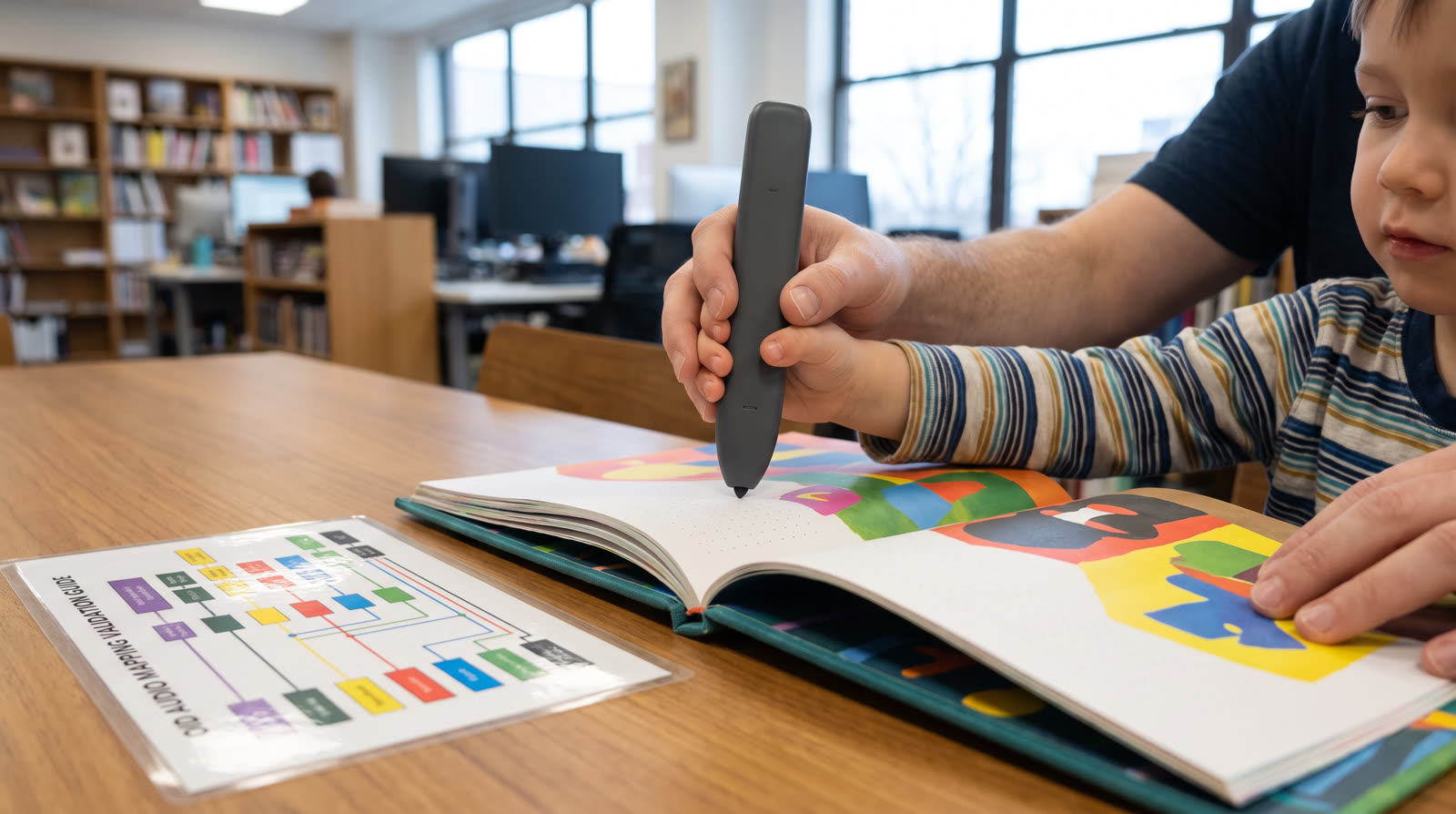
The reading pen contains a high-speed infrared camera that illuminates the page with IR light. The carbon dots absorb this light, creating a high-contrast pattern that the pen’s processor decodes in milliseconds. This allows for near-instantaneous audio playback. Validation must ensure the OID layer is printed with the correct carbon density to maintain this contrast. If the dots are too light, the pen will struggle to read; if they are too heavy, they may become visible to the human eye, detracting from the book's illustrations.
**The Audio Mapping Table: The Digital Backbone
The mapping table is the master database linking every unique OID coordinate to a specific audio asset. In a large-scale series, this table might contain thousands of entries. Validation begins at this digital level. If the table contains errors—such as duplicate IDs for different words—the project will fail regardless of printing quality. Publishers should ensure their mapping table follows a strict, hierarchical structure organized by ISBN, page number, and element type.
Pre-Production: Building a Fail-Safe Mapping Framework
| Metadata Element | Example Format | Purpose |
|---|---|---|
| **Project Identifier** | RG-2026-A | Unique code for the series |
| **Page Reference** | PG-012 | Prevents cross-page confusion |
| **OID Coordinate ID** | 20485 | The unique integer read by the pen |
| **Language Code** | EN-US / ES-MX | Critical for multi-language hardware |
Validation is a proactive process that must be integrated into the design and pre-press workflow. A robust framework prevents costly errors from reaching the production line.
**Standardizing File Naming Conventions and Metadata
Inconsistent file naming is a frequent cause of mapping failure. Publishers should mandate standardized naming conventions across all departments—editorial, audio production, and technical mapping—to ensure the pen’s firmware can correctly locate each asset.
**Creating and Reviewing Precise Coordinate Templates
During the layout phase, publishers should review a "Coordinate Overlay Map"—a semi-transparent layer showing OID dot placement relative to illustrations. Validation at this stage involves checking that interactive zones are large enough for a child’s motor skills (typically 5mm x 5mm) and placed away from the gutter to ensure reliable infrared readings.
**Coordinate Mapping Best Practices for Publishers
A responsible supplier should provide publishers with a set of design guidelines to optimize mapping accuracy. These guidelines often include:
- Avoidance of Gutter Zones: OID sensors require a flat surface for accurate reading; mapping too close to the book's spine can lead to inconsistent triggers.
- Illustration Alignment: Ensure that the visual "hit area" of an illustration matches the digital OID zone perfectly.
- Complexity Management: In dense educational textbooks, avoid overlapping OID zones, which can cause the pen to play the wrong audio if the user’s aim is slightly off.
- White Space Utilization: Even "empty" areas of a page can be mapped to ambient sounds or background music to enhance the immersive experience.
Technical Validation of the Printing Process
The most demanding phase of OID validation occurs at the printing press, where ink chemistry and optical properties are paramount.
**The "K-Layer" Rule: Managing Carbon Content in Ink
In OID printing, the black (K) layer MUST use specialized carbon-based ink for infrared absorption. Conversely, the Cyan, Magenta, and Yellow inks should be carbon-free. If color inks contain trace carbon, they create "optical noise" that the pen’s sensor cannot distinguish from the OID dots. Validation involves laboratory testing of ink batches before the print run to ensure they meet infrared reflectance targets.
CTA — Send Your Requirements: Planning a multi-language interactive series? A responsible supplier should provide a detailed OID printing specification sheet and ink compatibility report. Send your company name, target market, and content requirements to info@readglo.com to learn how we can support your technical validation process.
**The "Knock-out" Technique and Moiré Pattern Mitigation
Validation must also include a check for "Moiré patterns"—visual interference caused by the OID dot grid overlapping with halftone screens. Advanced printers use a "Knock-out" technique, removing CMYK black from areas directly underneath OID dots. Technicians use infrared viewers to ensure dots stand out with high contrast against background illustrations, even in dark or saturated areas.
Factory Quality Control (QC) and Acceptance Testing
Physical samples bridge the gap between digital files and real-world hardware.
**Digital Proofing vs. Physical "Blue-Paper" Proofs
Before mass production, publishers should request "Blue-Paper Proofs"—prints that accurately simulate the final offset result, including the OID layer. These must be tested using the final reading pen hardware. Digital-only validation is insufficient because it cannot account for real-world variables like ink spread, paper absorption, or the reflective properties of different paper coatings.
**The Comprehensive 5-Point Touch Test for Sensitivity
For every interactive zone, a technician should perform a standardized "5-Point Touch Test": 1. Center Point Validation: Verifies the correct audio trigger. 2. Boundary Testing: Ensures mapping covers the full illustration boundary. 3. Ergonomic Angle Test: Confirms readability at a 45-degree angle. 4. Trigger Latency Check: Ensures response within 200ms to 300ms. 5. Surface Durability Check: Verifies readability through final laminations or varnishes.
ReadGlo project support
Send Your Requirements
Share your target market, product scope, expected quantity and launch timing. Our team can prepare a relevant product, content or quality-control discussion.
Mitigating Common Risks in Multi-Language Series
Multi-language series add exponential complexity to the mapping validation process.
**Managing Audio ID Overlaps in Large Collections
In large series, human error can lead to "ID Overlap," where the same ID is assigned to different words in different books. Validation software must run a "Global Duplicate ID Check" across the entire database. If an overlap is detected, IDs must be re-assigned and both mapping tables and printing plates updated before the final run.
**Handling Content Updates and Firmware Sync
If audio is updated after printing, the OID mapping remains constant, but the pen’s memory must be updated. Validation ensures new audio files maintain the exact same filenames and ID mappings as the originals to preserve compatibility with already-printed stock.
**Linguistic Quality Assurance (LQA) in Mapping
For publishers targeting global markets, validation must extend to Linguistic Quality Assurance (LQA). This involves native speakers testing the pen on the printed book to ensure that:
- Tone and Inflection: The audio tone matches the emotional context of the page (e.g., a celebratory tone for a party scene).
- Pronunciation Accuracy: Technical terms or localized names are pronounced correctly, especially in educational content.
- Cultural Sensitivity: The audio content is culturally appropriate for the target region, avoiding idioms or sounds that might be misunderstood.
- Synchronization: The audio starts and ends exactly where intended, without cutting off the last syllable or having awkward silences at the beginning.
Compliance and Safety Standards for Global Markets
| Test Category | Standard / Method | Requirement |
|---|---|---|
| **Ink Durability** | ASTM D5264 (Rub Test) | No loss of readability after 500 cycles |
| **Optical Accuracy** | Factory Internal SOP | 99.5% success rate on first touch</strong> |
| **Chemical Safety** | CPSIA / REACH | Lead-free and Phthalate-free inks |
| **Electronic Safety** | EN71-3 / ASTM F963 | Compliance with toy safety sound levels |
Interactive books are both "printed matter" and "electronic toys," requiring compliance with two sets of global regulations.
**CPSC, ASTM F963, and EN71 Standards
In the U.S., the CPSC requires third-party testing for lead, phthalates, and mechanical safety. While OID mapping is technical, ink durability is a safety and quality concern. If the ink flakes or fades, the book loses functionality, which can be interpreted as a product failure under consumer protection laws.
**ISO 9001 and Printing Durability Protocols
A responsible supplier operates under ISO 9001 quality management. Validation includes "Rub Tests" to simulate thousands of finger swipes and "Lightfastness Tests" to ensure OID ink doesn't fade under UV exposure. If dots fade, the infrared sensor will fail, rendering the interactive features useless.
Enhancing Validation Through Automation and Performance Metrics
As scale grows, hybrid validation models combining automation with human intuition become essential.
**Automated OID Audit Software and Pre-flight Checks
Advanced OID authoring tools include "Pre-flight" modules that scan digital layout files for "Dead Zones," "ID Gaps," and "Coordinate Drift." Using these tools significantly reduces the human error rate in the pre-press phase by identifying technical flaws before plates are made.
**Human-in-the-Loop Content Logic Audits
Software cannot verify the *meaning* of content. Validation protocols should always include a "Human-in-the-Loop" stage, where a native speaker performs a functional audit. They ensure "Educational Logic"—verifying that an illustration of a "Lion" triggers a roar, not an incorrect sound. This is vital for STEM and language-learning series.
Image Plan
**Image 1: The OID Layer Visualization
- Purpose: Explains the "invisible" technology being validated.
- Insertion Position: Following the "How Dot Patterns and Infrared Sensors Interact" section.
- Caption: Split-view technical illustration showing a colorful illustration and the underlying OID dot pattern layer as seen by an infrared sensor.
- ALT Text: Side-by-side comparison of a colorful children's book page and its black-and-white OID dot mapping grid.
- AI Image Prompt: Professional studio photograph of an open children's book. Left page is in vibrant color; right page is shown through a translucent digital overlay, revealing a dense grid of tiny black micro-dots. Clean, educational style, no text.
**Image 2: The Factory Validation Process in Action
- Purpose: Demonstrates the "5-Point Touch Test" and factory QC.
- Insertion Position: Following the "The Comprehensive 5-Point Touch Test for Sensitivity" section.
- Caption: A QC specialist performing a functional audio mapping test on a "Blue-Paper" proof using a production-ready reading pen.
- ALT Text: Close-up of a technician's hand holding a reading pen and touching different areas of a printed book proof to verify response.
- AI Image Prompt: Close-up photograph of a hand holding a white and blue electronic reading pen, touching a colorful children's book page in a clean, bright factory QC station. Real photography, soft lighting, no text.
FAQ — Frequently Asked Questions about OID Validation
Q1: Can I use my existing local printing house for OID interactive books? A: Most standard printers are not equipped for OID. The process requires specialized knowledge of "Carbon-Free" CMYK inks and precise K-layer registration. Publishers should verify a printer's OID calibration certificates and review physical samples before committing to production.
Q2: What is the most common reason for an OID mapping failure? A: The most common reason is "K-Layer Interference," where black ink in illustrations contains carbon, making OID dots unreadable. This is why pre-production chemical testing and physical "Blue-Paper" proofs are so critical.
Q3: How long does the OID validation process typically take? A: For a 24-page board book, technical validation typically takes 7 to 10 business days. For complex multi-book series, publishers should budget 3 to 4 weeks to resolve potential cross-book ID overlaps and localization issues.
Conclusion: Protecting Your Investment Through Rigorous Validation
Launching an interactive book series is a significant investment. The bridge between content and hardware is OID audio mapping. By implementing a structured validation process—from digital audits and ink testing to physical functional checks—publishers can ensure a seamless experience for young readers. A responsible supplier acts as a partner, providing the documentation and QC reports necessary for long-term success. As the industry moves toward even more advanced features—such as video-linked OID and AI-driven personalized learning—maintaining a foundation of rigorous validation will be the key to staying ahead of the curve. By prioritizing quality today, publishers can build a legacy of interactive content that inspires and educates the next generation of readers.
CTA — Get a Quote: Ready to bring your interactive book series to life with world-class technical validation? Whether you need technical validation or a full OEM solution, our team is here to help. Send your company details, target market, quantity, and language requirements to info@readglo.com for a comprehensive quote.
References
1. Google Search Central: Creating Helpful, Reliable, People-First Content — Guidelines for authoritative technical writing. 2. U.S. Consumer Product Safety Commission (CPSC): Children's Product Certificate (CPC) Requirements — Official safety standards for children's electronic products. 3. International Organization for Standardization (ISO): ISO 9001:2015 Quality Management Systems — Global benchmarks for manufacturing quality. 4. Association of American Publishers (AAP): Best Practices for Digital and Interactive Content — Industry recommendations for integrating technology into publishing.
Continue your research
Related reading pen buyer guides
Use these related guides to compare the next product, content, sourcing or channel decision in your project.
- Publisher SolutionsWhat Should a Brand Include in a Talking Pen Voice-Recording Brief?Read this guide
- Supplier VerificationWhich B2B Platforms Besides Alibaba Offer Verified Optical Reading Pen Factories?Read this guide
- Publisher SolutionsHow Can a Brand Plan a Bilingual Talking Pen and Book Range?Read this guide
Continue with ReadGlo
See product specifications and request model-specific documentation.
ReadGlo project support
Get a Project Quote
Request product specifications, sample guidance or a tailored proposal for your reading pen, interactive book or distributor program.