
Contents
Quick Answer: The Best Reading Pen Is the One That Matches the Child and the Reading Goal
There is no single “best” reading pen for every child. The strongest choice depends on what the child needs from the tool. A young child who is learning with illustrated, age-appropriate books usually benefits most from a book-linked talking pen: touch a word, picture, or activity in a compatible book and hear a prepared audio response. A confident reader who needs help accessing unfamiliar printed text may benefit more from a scanner-based text-to-speech pen, which scans ordinary text and reads it aloud.
For most families, the most useful device is not the one with the longest feature list. It is the one that makes reading more frequent, more independent, and more enjoyable while fitting naturally into a broader reading routine. The International Dyslexia Association distinguishes tools that provide practice from assistive technology that gives access to tasks a learner cannot yet do independently. That distinction matters: a pen can support practice or access, but it is not a replacement for teaching. [1]
This guide answers common parent questions about talking pens, reader pens, reading challenges, dyslexia support, pricing, and ways to build a child’s reading habit. It is educational information, not a diagnosis. If a child has persistent difficulty with reading, spelling, or word-level decoding, speak with the child’s teacher and an appropriately qualified educational or clinical professional.
What Is a Reading Pen Called? Talking Pen vs. Scanner Pen
“Reading pen,” “talking pen,” “audio pen,” and “reader pen” are often used interchangeably, but they can describe two very different kinds of products. Understanding the difference is the fastest way to make a better purchase decision.
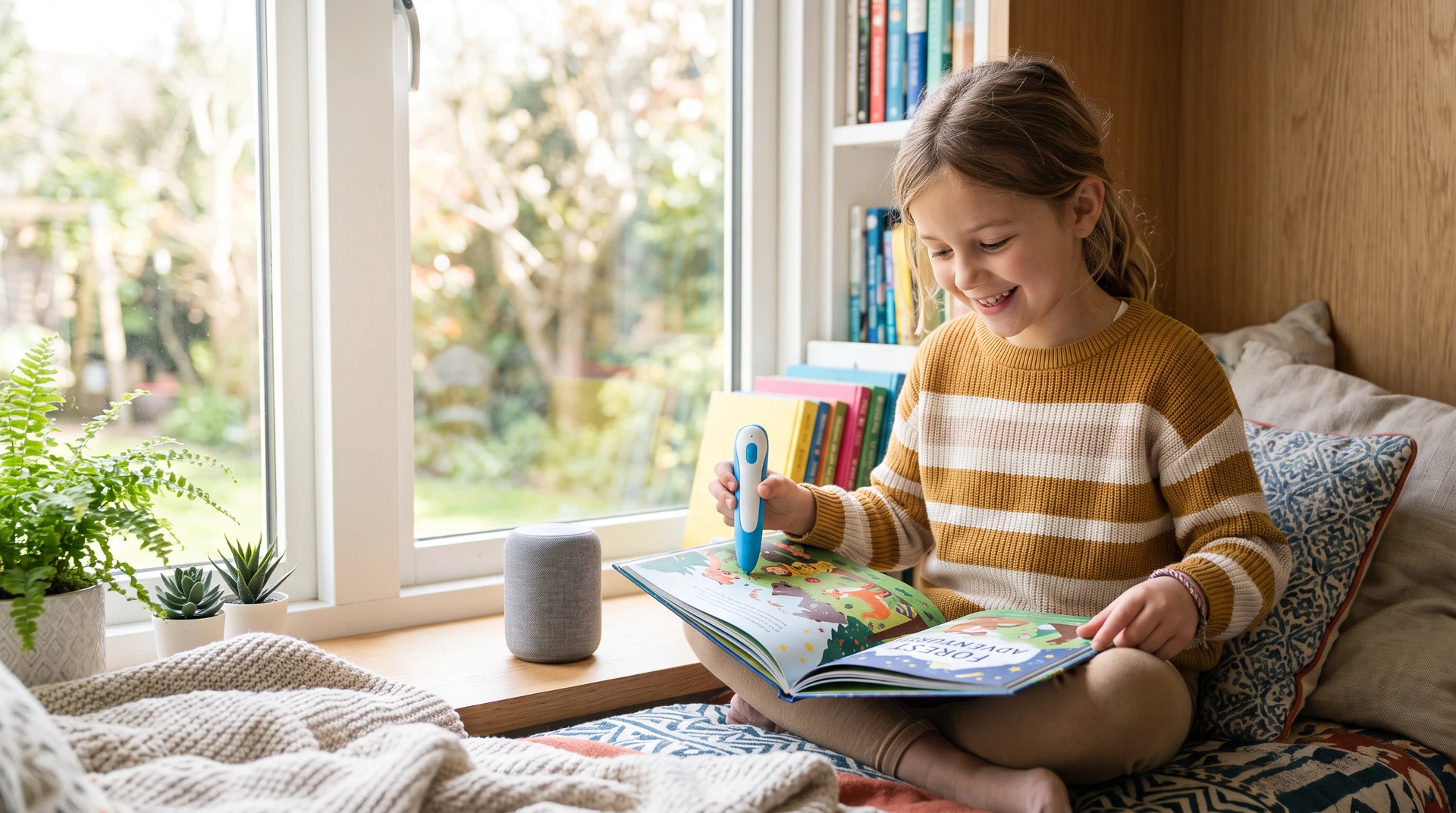
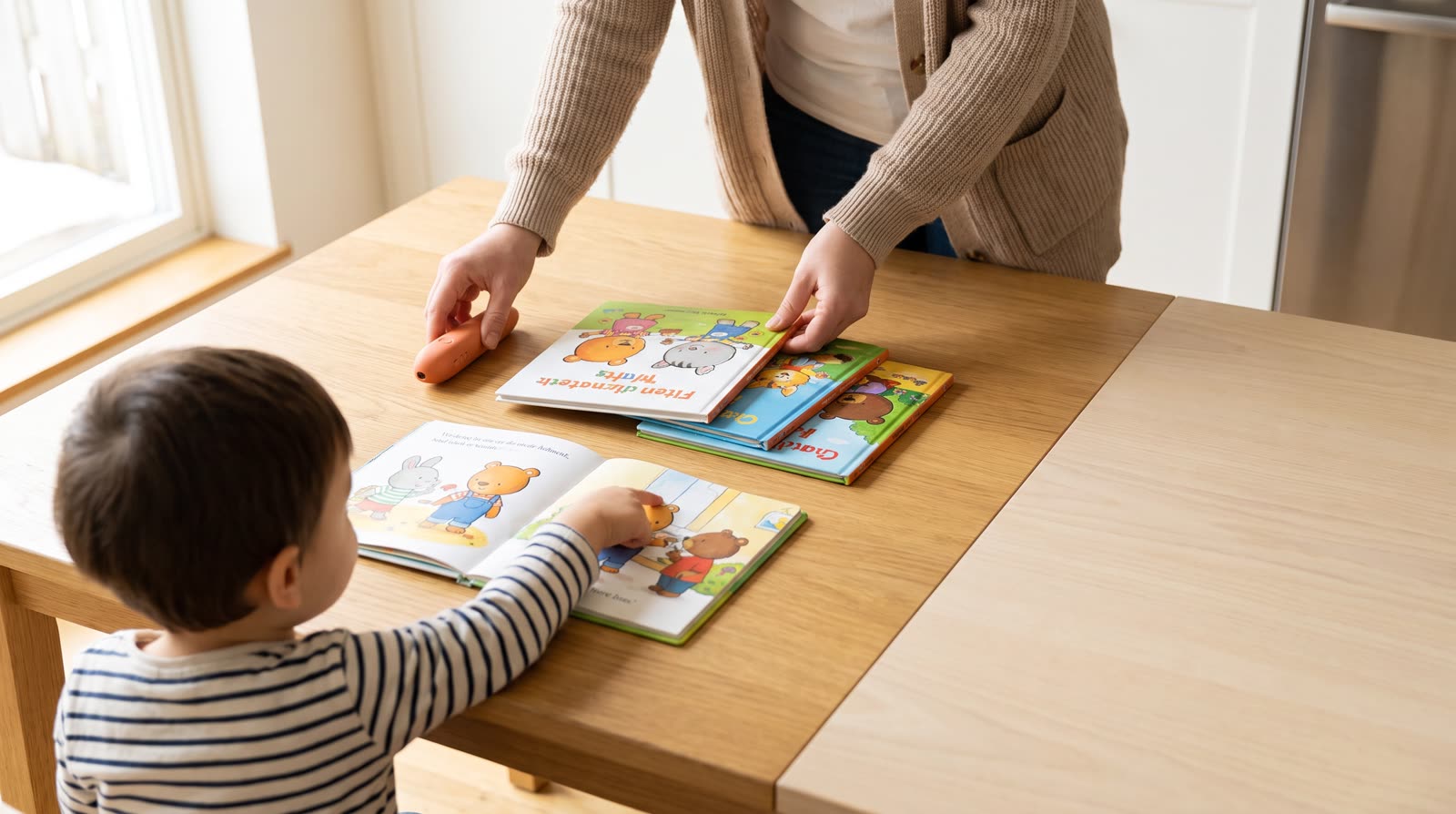
1. Book-linked talking pens These pens work with a dedicated collection of compatible books or activity cards. A child touches a printed area and hears professionally prepared audio such as a word, sentence, sound effect, song, pronunciation model, or question. The books normally use an invisible coded print layer that tells the pen which audio to play. This category is designed for early learning, vocabulary development, bilingual practice, story engagement, and independent repetition.
2. Scanner-based text-to-speech pens These devices scan a line of ordinary printed text, convert it to speech, and play it through a speaker or headphones. They are typically used to support access to textbooks, worksheets, labels, and other print materials. They are better understood as assistive technology than as a complete early-reading system. Their usefulness depends on scanning accuracy, language support, headphone options, school rules, and the learner’s specific task. [1]
The name ReaderPen is sometimes used informally when people mean a pen that reads text aloud; it may also refer to branded scanning-pen products. Before buying, focus on the actual product category and compatible content rather than the label alone.
What Is the Best Device to Help Kids Learn to Read?
The best device is one that supports a clear reading behavior. For preschool and early-primary children, that behavior might be listening to a story, pointing to vocabulary, repeating a word, or retelling what happened. For bilingual families, it may be moving between two languages without turning reading time into a test. For older learners, it may be hearing a difficult word while keeping the meaning of a sentence in view.
Use this decision table to turn a broad “What is best?” question into a practical choice.
Choose a book-linked talking pen when…
- The child enjoys picture books, songs, quizzes, or listening-and-pointing activities.
- You want a closed, age-appropriate library with content designed for the pen.
- The reading goal is routine, vocabulary, pronunciation models, or enjoyment.
Choose a scanner pen when…
- The child already works with ordinary printed text and needs occasional access to a difficult word or sentence.
- The device will be used under school or assessment rules that permit it.
- The child can independently handle scanning, audio output, and the relevant settings.
Choose neither as the first step when…
- The issue is a persistent struggle to decode, spell, or understand grade-level reading.
- A child needs a formal assessment or targeted instruction rather than another device.
- The device would become a way to avoid all active reading practice.
High-quality reading instruction remains central. The International Dyslexia Association describes structured literacy as explicit, systematic, and cumulative instruction in skills such as phoneme awareness, sound-symbol correspondences, spelling patterns, morphology, and connected text. [2]
What Makes a Good Book Reading Pen for Kids?
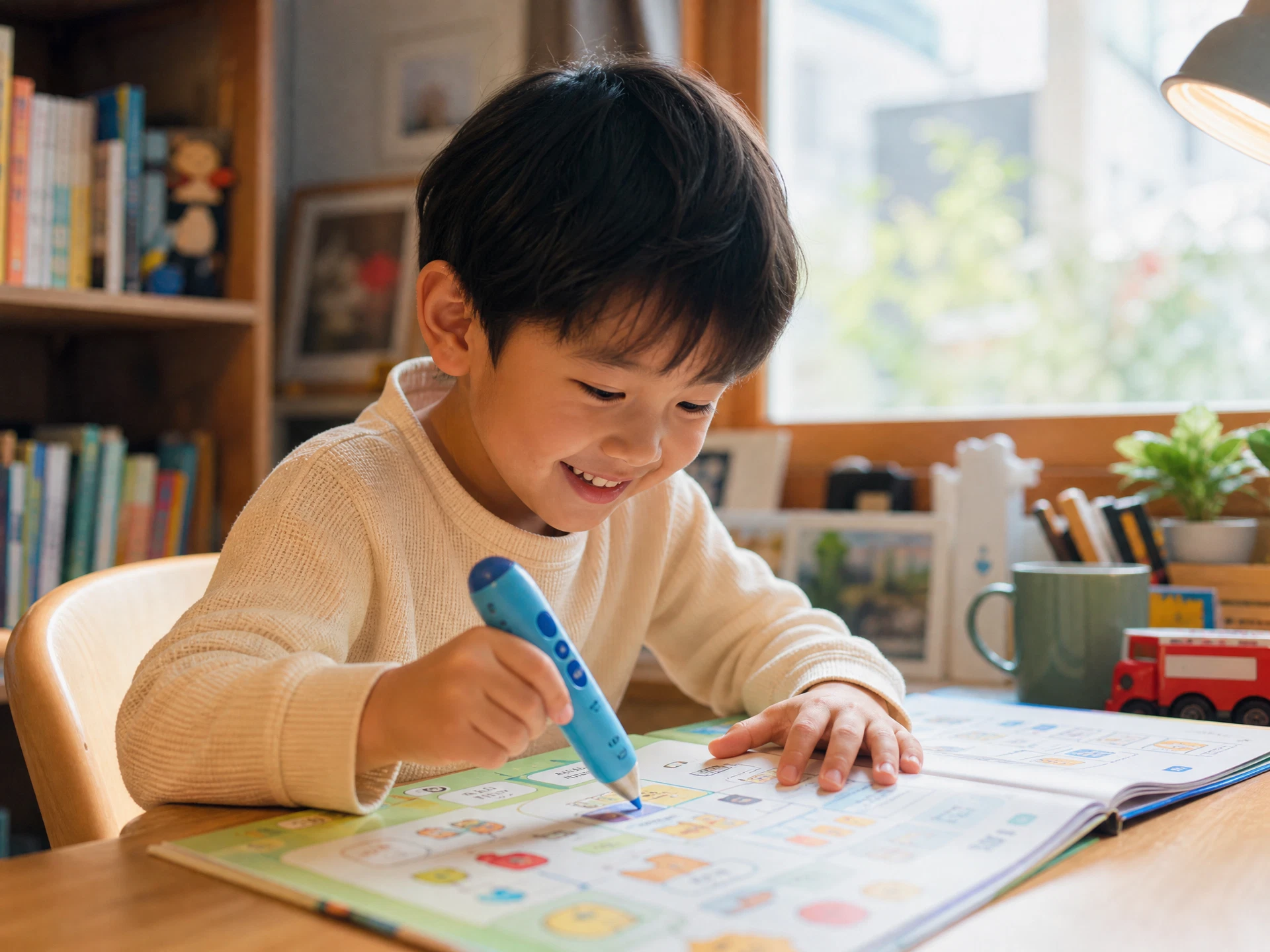
A good children’s talking pen is an ecosystem, not simply a piece of hardware. Start with the books. Look for stories and activities that the child will choose repeatedly, a progression that fits the child’s age and language level, clear voices, accurate pronunciation, and enough variety to avoid novelty wearing off after a week.
The device itself should be simple enough for the child to use without constant adult intervention. The most important checks are a comfortable grip, dependable touch response, clear sound at a safe and comfortable volume, long enough battery life for a real reading session, and a durable tip and housing. For younger children, physical simplicity generally beats extra menus and apps.
For a bilingual or language-learning set, assess the quality of both languages rather than accepting a token translation. Look for native-speaker audio, a logical language-switching method, parallel books where appropriate, and content that encourages meaningful use of both languages. For retailers and private-label brands, compatibility between the pen, coded books, and audio files must be tested as a complete system before shipment.
Finally, consider the family’s routine. A pen that lives beside a small, appealing book basket will likely be used more than a technically impressive device stored in a drawer.
Are Reader Pens Worth It? Use This Value Test
Reader pens are worth it when they remove a real barrier or create a repeated reading habit. They are not worth it when they are treated as a shortcut to literacy, a replacement for conversation, or a one-time gift with too little compatible content.
Ask five questions before purchasing. First, will the child use it with books they already like or are likely to like? Second, does it support a specific routine, such as ten minutes of independent story exploration after dinner? Third, will the audio invite active participation through repetition, pointing, prediction, or retelling rather than passive listening alone? Fourth, is the content library large enough to stay useful? Fifth, can parents or educators explain why they selected this tool for this child?
The most valuable outcome is not “the child owns a reading pen.” It is that the child comes back to books more often, can persist a little longer, and has more opportunities to connect print, speech, pictures, and meaning. When a device helps establish those behaviors, it can be a meaningful part of a home library or classroom resource collection.
What Reading Pens Are Good for Dyslexia? What They Can and Cannot Do
For a learner with dyslexia or suspected dyslexia, the best reading pen is the one selected for a specific access or practice task in coordination with the child’s support team. A text-to-speech scanner pen may help a learner access a difficult passage, check an unfamiliar word, or stay engaged with content while reading skills are still developing. A book-linked talking pen may provide repeatable listening, vocabulary, and print-to-sound experiences with carefully designed books.
However, no reading pen diagnoses dyslexia, treats dyslexia on its own, or replaces direct reading instruction. Reading Rockets notes that dyslexia is language-based and is not caused by intelligence, low motivation, hearing, or vision problems; it emphasizes explicit, systematic instruction and targeted support. [3] The most successful support plan is therefore a combination of appropriate instruction, accommodations when needed, and carefully chosen tools.
When selecting a device for a learner with reading difficulties, prioritize a calm interface, reliable audio, clear controls, and a setup that does not make the child feel singled out. Ask the school before buying a scanner pen for classroom or assessment use, because local policies vary. If the tool is being considered as an accommodation, identify the task it supports, the environments where it will be used, and whether the child can operate it independently — the same practical factors highlighted in the SETT framework for assistive technology. [1]
What Is the Best Program for Children Struggling to Read?
There is no universal “best program” that fits every struggling reader, and families should be cautious of any product that promises a quick cure. The evidence-informed direction is clear: children who have unusual difficulty learning to read and spell benefit from instruction that is explicit, systematic, cumulative, and responsive to their individual needs. The International Dyslexia Association calls this structured literacy and identifies it as the most effective approach for students with dyslexia and related reading difficulties. [2]
In practical terms, a strong program teaches the relationship between speech sounds and letters directly, gives guided practice, builds from simpler to more complex patterns, includes decoding and spelling, and checks progress so instruction can be adjusted. A quality program is delivered by a trained educator and is matched to the child’s assessment-informed needs. The right intensity, group size, and content sequence depend on the individual learner.
Parents can use a talking pen or scanner pen alongside this work, but should keep the roles clear. Instruction teaches skills; a reading device can make books more engaging, enable practice, or provide access while skills are developing. That partnership is more realistic and more helpful than expecting a device to do the work of a comprehensive reading intervention.
How to Encourage Kids to Read Books — Even When Reading Feels Hard
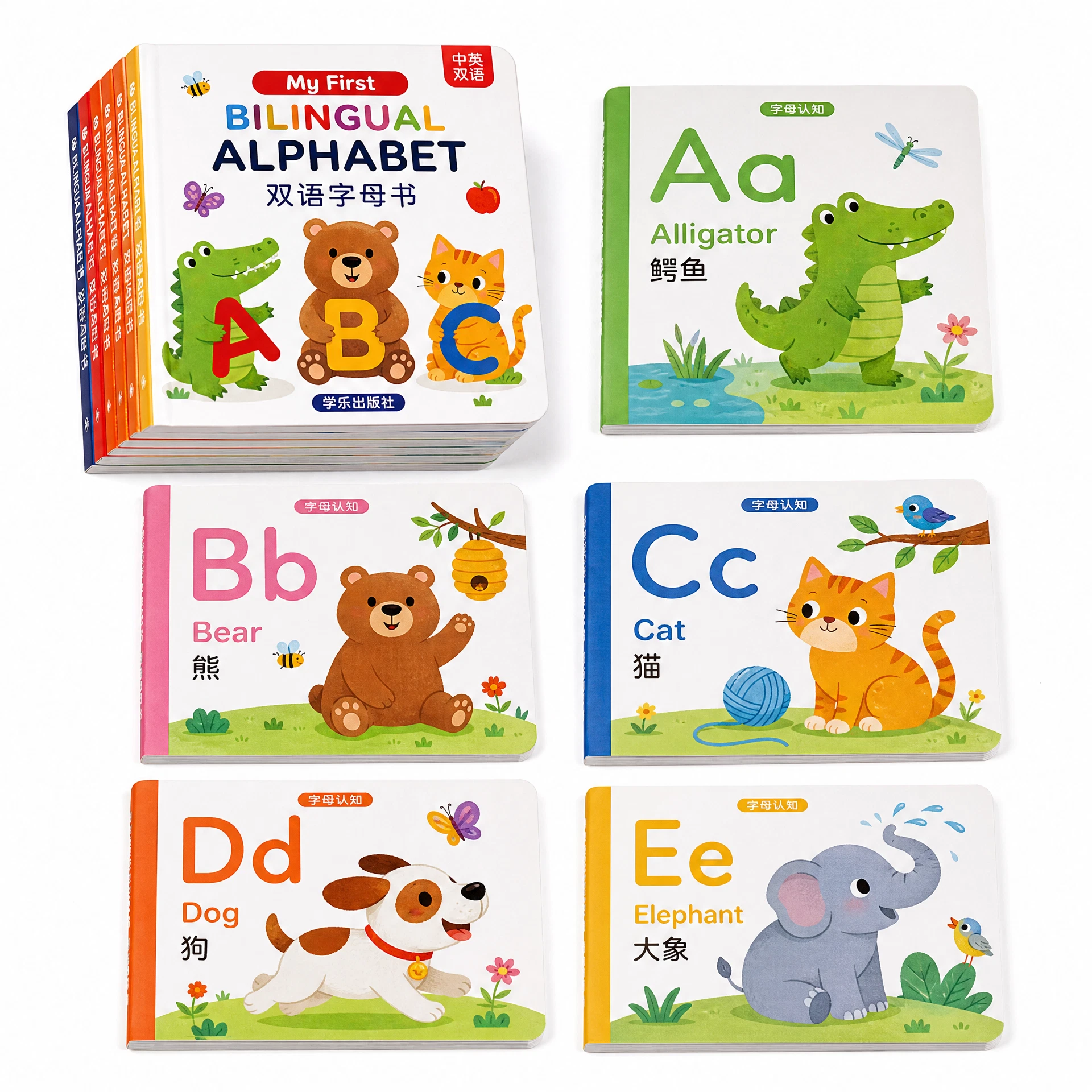
Encouraging reading is less about pushing a child to finish more pages and more about reducing friction around books. Give children regular chances to choose among genuinely interesting materials: picture books, comics, nonfiction, bilingual stories, joke books, graphic novels, magazines, or series books all count. Read aloud together beyond the stage when children can decode independently. When an adult reads a richer book aloud, the child can focus on vocabulary, plot, and the pleasure of a shared story.
Create a predictable, low-pressure reading moment. Ten enjoyable minutes that happens most days is more powerful than an occasional long session framed as homework. Let the child touch the pen, replay a favorite line, imitate a character, or explain a new fact. These small interactions turn audio from background noise into language practice.
For a child who loves reading, a thoughtful gift is usually one that expands choice: a new series, a bookshop or library visit, a personal book light, a comfortable reading corner, or a talking-pen set paired with a topic the child already loves. The best gift signals that their reading identity is worth celebrating.
What Is the Price of a Talking Pen? Compare the Whole Reading System
Talking-pen prices vary widely by country, audio language count, battery and speaker specifications, bundled books, licensing, and whether the pen is a simple book-linked model or a scanner-based text-to-speech device. For that reason, the sticker price of a pen on its own is not a meaningful comparison.
When comparing offers, calculate the cost of the whole usable system: the pen, compatible books, charger or cable, replacement or expansion content, warranty, and any app or download requirements. A low-cost pen with only one suitable book may offer less long-term value than a well-supported set with a broad, age-appropriate library. Conversely, a premium scanner pen may be unnecessary for a preschooler whose main goal is to enjoy illustrated stories.
For retailers and private-label buyers, unit price should be evaluated alongside book print quantity, coded-print setup, audio production, certification, packaging, content licensing, and after-sales support. ReadGlo can provide product and book-set quotations based on target age, language combination, order quantity, and customization requirements at info@readglo.com.
A Simple Checklist Before You Buy
Use the following questions to make a confident decision.
- Child and goal: Is the priority early reading enjoyment, bilingual exposure, general text access, or a classroom accommodation?
- Content fit: Are there enough compatible books at the child’s current and next reading level?
- Usability: Can the child hold, charge, and use the pen with minimal frustration?
- Audio quality: Is speech clear, natural, and available in the languages the family actually uses?
- Durability and support: Is there a warranty, a clear return policy, and replacement-content support?
- Learning plan: If the child is struggling, is the device one component of a wider plan involving explicit instruction and support?
The best reading pen is therefore not a universal model. It is a carefully chosen tool that fits the child, the books, and a daily habit of meaningful reading.
Continue your research
Related reading pen buyer guides
Use these related guides to compare the next product, content, sourcing or channel decision in your project.
- ProductsDoes It Usually Come with a Warranty? A Professional B2B Sourcing Guide for Phonics Book Sets with Talking PensRead this guide
- Product DevelopmentHow to Find Reliable Suppliers Offering SDKs for Bluetooth Reading Pens and iOS Integration?Read this guide
- ProductsHow Much Should I Spend on a Phonics Book Set with Pen? A B2B Procurement and Quality Evaluation GuideRead this guide
Continue with ReadGlo
See product specifications and request model-specific documentation.