Contents
Direct answer
Buyers should compare touch and talk books through a complete reading sequence: start the book, select a picture, hear the intended response, repeat it and move to another page. Choose the route that makes those actions clear for the intended children and adults, rather than the route with the largest sound count. Confirm the mechanism on a named sample; “touch” alone does not establish electronics, sensors or built-in audio.
Begin with the interaction, not the product label
A distributor ordering a first-words book and a publisher developing an animal title may use the same search phrase but need different products. One wants a self-contained unit for a retail shelf. The other wants illustrations linked to audio within a larger book system. A comparison is useful only when both describe what the child should do.
Write a short activity brief in ordinary language. For example: “A child opens an illustrated spread, selects one object, hears its name, chooses to hear it again and turns the page.” This is a proposed activity, not a claim about an available configuration. Add whether an adult begins the session, whether children share the book and whether the activity happens at a table or on a caregiver’s lap.
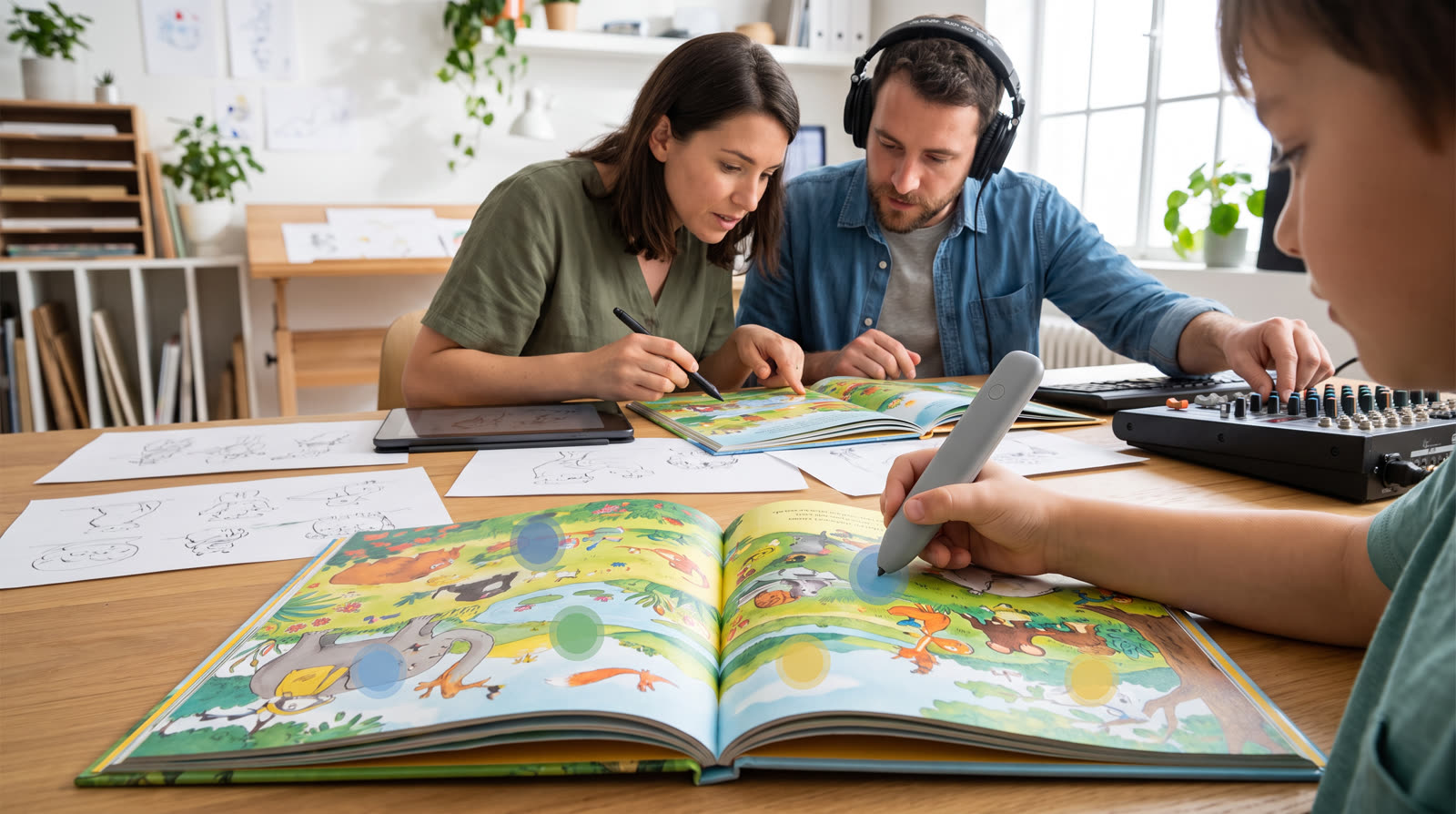
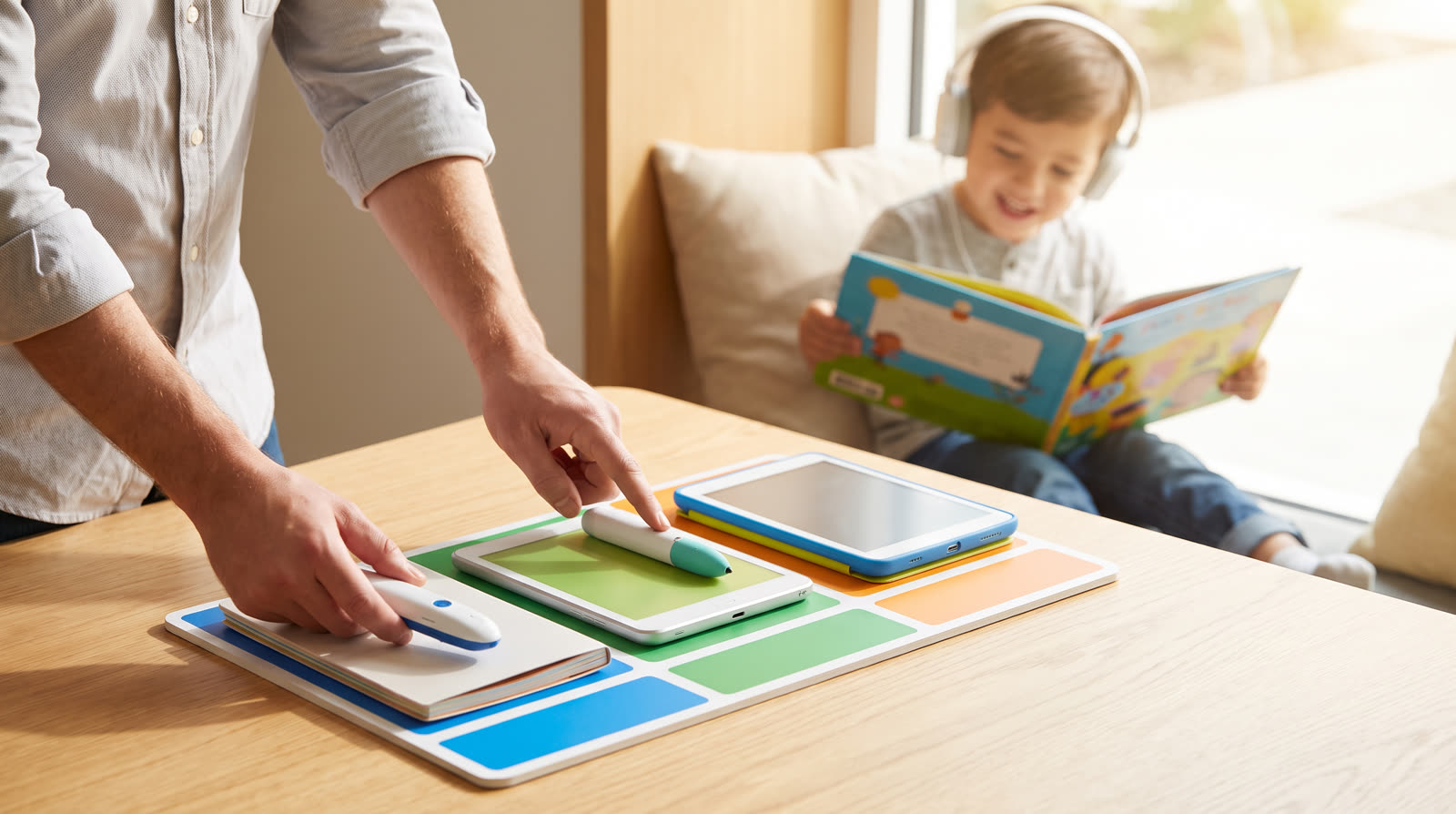
Separate three meanings of touch. A tactile printed book can invite fingers to explore textures without producing sound. A book with integrated controls can connect a press or page selection to audio. A pen-companion book requires a separate tool and a compatible printed edition. None of these descriptions establishes a screen, translation function or compatibility with unrelated materials.
ReadGlo’s Animal World Touch & Teach Book reference can help identify an animal-themed project direction. Its catalogue identity is not evidence of a particular page mechanism. Ask which physical sample could demonstrate the requested action and which elements would still require development or confirmation.
Choose where the child will make the selection
| Proposed route | Useful buying situation | Sample question that can change the decision |
|---|---|---|
| Tactile print without audio | Picture exploration and adult-led conversation | Does the activity remain meaningful without a recorded response? |
| Built-in page selection | A self-contained picture-to-response activity | Can the reader select, replay and change pages without confusing the active target? |
| Separate sound buttons | A limited set of clearly matched responses | Can the reader connect each page cue to the correct control? |
| Pen-companion book | A planned range of matched printed titles | What tool handling, preparation and edition matching are required? |
Buyer decision aid; confirm the proposed configuration and responsibilities separately.
Swipe horizontally to view all columns.
For touch and talk books, the important distinction is not simply “with audio” versus “without audio.” It is where the selection happens and how the reader understands the relationship between the page and the response.
With a proposed built-in page-selection interface, the desired action happens on or alongside the illustrated spread. Review whether the selected picture is actually active, whether page position matters and whether the child needs to learn a separate control convention. Do not infer how the mechanism works from the appearance of the page.
With a side-panel button arrangement, the reader may need to connect a printed symbol to a separate control. That can suit a short, deliberately structured activity, but the matching task is part of the product experience. With a pen-companion route, selecting a picture may be more direct visually, while holding, finding and preparing the tool add different demands.
These are comparison routes, not confirmed ReadGlo offers. Select the smallest route that completes the intended activity. Do not add modes or accessories merely to make a specification look more substantial.
Compare five moments in the reading sequence

1. Starting and returning to the activity
Begin with the sample closed and in the condition a customer would receive it. Ask the supplier to show every adult preparation step, including power preparation and any content loading, if applicable. Then examine what remains necessary at the next session. A successful demonstration after hidden preparation does not answer the first-use question.
If the proposed book is described as self-contained, establish what that means. It might mean no separate selection tool, but it does not automatically mean no adult setup or maintenance. Check whether the initial operating state is understandable and whether the reader can return to a familiar page after stopping. Keep power, account and connection requirements conditional until confirmed.
2. Selecting the intended picture
Review the complete spread, not just its easiest target. Try the intended centre, a reasonable off-centre contact and the boundary near a neighbouring illustration. Compare what the child sees with where selection actually works. If an adult must point to a tiny invisible spot every time, the apparent simplicity of the cover has not carried through to use.
For a built-in interface, also examine ordinary supporting-hand contact. Does holding the page activate something unintentionally? For separate controls, check whether the page cues remain visible while reaching toward them. For a pen route, observe the effect of tool position. These are sample questions, not assumed defects or universal technical rules.
3. Hearing a complete response
An accurate response can still be difficult to follow if an introduction, effect or melody obscures the requested word. Ask what the child should hear first and what marks the end. Review the recording in the relevant room, with the book held as intended, rather than judging an isolated audio file alone.
Record missing, wrong, truncated or unclear responses separately. Do not treat “it made a sound” as acceptance. If volume controls are demonstrated, review their usable settings and access. Listening impressions help assess the activity but cannot substitute for applicable acoustic safety evidence.
4. Choosing to repeat
Distinguish intentional replay from accidental repeated activation. Ask the supplier to demonstrate what happens when the same target is selected while audio is playing, immediately after completion and after another target has been used. The response might restart, wait, continue or change. Specify which behaviour the activity needs instead of assuming a universal replay function.
A naming activity may benefit from hearing the same response again. A longer story passage may need protection against accidental restarting. Neither behaviour is inherently the best choice for every title. What matters is whether the observed action supports the reading task and whether instructions explain it honestly.
5. Turning the page and recovering
Turn forward, return to the previous spread and reopen the book after a pause. Establish whether the current page is recognized automatically, requires a selection step or follows another demonstrated process. If page detection is unconfirmed, leave it unconfirmed; do not imply a sensor exists.
Observe whether an ordinary page turn produces stray audio or leaves the reader in an unexpected mode. Then try the documented recovery action. A supplier-assisted reset may prove that the sample can recover technically, but a buyer still needs to understand who could perform that action during normal use.
Judge repeat use by activity quality, not sound quantity
A long content list does not reveal whether children can return to a useful activity. For a vocabulary title, compare a small sequence such as selecting two familiar objects, revisiting one and finding it again on the spread. For a numbers title, examine whether the printed grouping and requested spoken response make sense together. These are proposed review activities, not evidence of improved learning outcomes.
If several modes are proposed, each should earn its place. A naming mode, a sound-exploration mode and a prompted finding activity make different demands. Ask whether the mode choice is visible, whether an accidental change is recoverable and whether adults can explain the difference without a long demonstration. More options can also mean more instructions, recordings and review work.
Consider what happens on the second encounter. Does the reader have a reason to select a different picture or talk about the illustration, or does the experience simply repeat an opening announcement? Do not invent a target engagement time. Observe voluntary choices and needed assistance without turning a short session into a durability, retention or sales-performance claim.
For a compact device direction, compare the Kids Touch Learning Device reference against the book activity rather than treating the two formats as interchangeable. The requested interface, content, power route and final hardware remain matters for project confirmation.
Preserve room for an adult and the printed page
Audio should serve the page activity rather than replace every conversation around it. The American Academy of Pediatrics encourages developmentally appropriate, language-rich shared reading and recommends back-and-forth interaction when audiobooks or digital reading activities are used.[1] That supports an adult-interaction review; it does not establish benefits for a particular electronic book.
Ask whether a caregiver can pause naturally to name an object, ask a question or follow the child’s interest. If every contact launches a long sequence, compare whether that conflicts with the proposed shared-reading routine. If stopping or silence is important, make it an explicit requested behaviour and verify it on the chosen sample.
Content review should remain specific. A picture may need a simple name, a short description or an instruction, but those are different editorial choices. Check pronunciation, wording and image-to-audio meaning in each requested language. A language-selection option, bilingual edition or translation function must not be inferred from the category name.
A publisher considering letters and quantities can use the Letters & Numbers Talking Book reference to discuss subject direction. Confirm the intended spoken units and page interaction separately. Do not promise independent reading, vocabulary growth or curriculum alignment merely because letters and numbers appear on the cover.
Mid-project CTA: To discuss an integrated page-selection goal alongside other routes, use ReadGlo’s sound-book project planning page or email info@readglo.com. Send the intended action, market, subject and open questions first. A discussion does not confirm that a mechanism, sample service or supply term is available.
ReadGlo project support
Scope Your Touch-Book Project
Share your target market, intended activity, content readiness and quantities. Product configuration, permitted content, samples and commercial terms need project-specific confirmation.
Open the related procurement routeRequest a sample that answers a purchasing question
Choose representative material deliberately. Include an ordinary spread, a more crowded spread and a page transition that matters to the activity. For a custom project, use only authorized evaluation assets. Ask which parts of the sample represent the proposed product and which are demonstrations. A stock demonstration can explain a route without proving that a buyer’s layout will work.
Start with adult reviewers. Give them the same instructions but let each attempt the activity without a running supplier explanation. Record the action, expected response, observed response and help needed. Then revisit the same sequence under the same documented conditions. Where child observation is appropriate, arrange consent, suitable supervision and a clearly bounded session; do not collect unnecessary personal information.
Agree decision criteria before interpreting observations. For example, the requested naming sequence may require a complete response for each intended target and a documented way to replay it. A recurring wrong-page response should be held for investigation rather than balanced against attractive packaging. Difficulty understanding a cue may call for revised artwork or instructions rather than a hardware change.
Repeat-use observation is not a mechanical life test. A buyer can notice loose pages or inconsistent activation during review, but cannot infer years of service from a few sessions. Request any durability methods, sample basis and results separately when they are needed, without inventing cycle counts or acceptance rates.
Keep usability, safety and content ownership separate
A book that is easy to operate has not thereby passed a destination-market safety review. Ask the responsible importer or compliance specialist to determine the applicable requirements for the actual construction, intended age, power arrangement and market. For U.S. toy projects, CPSC guidance identifies sound-producing toys and battery-operated toy instructions among relevant review areas.[2] The guidance is context, not evidence that a ReadGlo configuration is compliant.
Likewise, thick-looking pages do not prove tear resistance, and “wipeable” is not a complete care instruction. Request the permitted cleaning method and inspect the specified materials and assembly. Keep destructive or safety testing with appropriate professionals; a buyer usability session should not ask children to stress battery compartments or damaged parts.
Confirm ownership of illustrations, manuscripts, narration, music and effects before adapting content. WIPO explains that protected works generally require authorization unless a relevant exception or licence permits the use; online availability does not itself provide permission.[3] Match permissions to the intended uses and obtain written clarification where needed. This article’s route comparisons do not authorize copying a reference book or recording.
Buyer checklist before selecting a route
Use a short purchasing checklist alongside the sample observations:
- Describe one complete activity and the adult’s role.
- Separate tactile print, built-in selection, separate controls and pen-companion routes.
- Identify all first-use and return-use preparation.
- Review intended targets, supporting-hand contact and page transitions.
- Record complete playback, replay, mode changes and recovery as observed.
- Check requested languages and authorized evaluation content.
- Keep usability findings separate from durability and market evidence.
- Request written confirmation of available configuration, quantities, sample work, pricing and timing.
An unresolved mechanism is a reason to request clarification, not to fill the gap with assumptions from another product.
Frequently Asked Questions
1. Do touch and talk books always have electronic pages? No. The phrase can describe tactile printed books that encourage conversation as well as books or systems with recorded audio. Confirm what physical action produces a response, where it occurs and what equipment is required. A textured illustration or touch-themed title does not prove an electronic interface, page sensor or built-in speaker.
2. Is a built-in page interface always better than a separate pen? No. An integrated route may suit a self-contained activity, while a pen-companion route may suit a planned range of compatible titles. Compare the complete sequence, including preparation, tool handling, selection and returning to the activity. Treat catalogue routes as discussion inputs until a named sample demonstrates the relevant construction and behaviour.
3. What should repeatable interaction mean in an RFQ? Describe an action and the required response. Specify whether selecting the same picture should replay identical audio, restart a passage or behave differently during playback. Include what should happen after changing pages or modes. This is more useful than “supports repetition,” which leaves the supplier and buyer with different possible interpretations.
4. How can buyers compare crowded pages fairly? Use representative spreads from each proposed route and the same activity instructions. Examine whether illustrations, active targets and controls remain understandable when the book is held normally. Record accidental activation and the help needed to recover. Do not declare a universal target size or apply web-screen dimensions directly to a physical book.
5. Does a successful child session prove learning value? It demonstrates only the observations made in that session. A child’s interest or ability to replay a word does not establish vocabulary improvement, independent reading or a clinical benefit. Separate usability questions from educational claims, and require suitable evidence and responsible review for any outcome language intended for packaging or retail listings.
6. Can buyers assume the selected book works without setup? No. Request a first-use walkthrough and a return-use walkthrough. Establish any required power preparation, adult action, separate equipment or content loading for the named configuration. A supplier-prepared demonstration does not prove the customer can begin immediately. Do not assume internet access, accounts or downloads are either required or absent before confirmation.
7. What should we send ReadGlo before discussing a sample? Send a non-confidential summary of the market, intended age context, subject, requested languages, activity and route alternatives. Include the purchasing question the sample must answer and estimated quantities if available. Confirm available sample work, authorized files, commercial terms and timing in writing; a product reference or inquiry does not establish those details.
Conclusion: buy a reading sequence that can be understood
The strongest comparison of touch and talk books follows the reader from opening the book to choosing another activity. A clear picture-to-response relationship, deliberate replay and understandable page transitions matter more than a headline sound count. Choose the demonstrated route that fits the activity, keep adult conversation possible and leave unverified features out of the purchase brief.
Final CTA: Bring your proposed reading sequence to ReadGlo’s sound-book project planning page, or email info@readglo.com, to request a route discussion. Ask for configuration-specific confirmation before proceeding to sample or quotation decisions.
Continue your research
Related reading pen buyer guides
Use these related guides to compare the next product, content, sourcing or channel decision in your project.
- Publisher SolutionsHow Can Publishers Review Illustration, Page Layout and Touch-Zone Accessibility Before Printing Interactive Books?Read this guide
- Publisher SolutionsHow Can a Publisher Align Picture-Book Illustration, Audio and Touch Zones?Read this guide
- Buyer GuideHow Should Buyers Separate Sound Book and Reading Pen System Deliverables Before an RFQ?Read this guide
Continue with ReadGlo
Review product or project scope, then confirm the proposed configuration and relevant documentation separately.
ReadGlo project support
Request a Project Discussion
Describe the purchasing decision you need to make. Confirm the final configuration, rights, evidence and supply terms before placing an order.
Open the related procurement route