Contents
Direct answer
Publishers should source interactive talking books as a coordinated print, device and authorized-audio project—not as a pen purchase with books added later. Define the reading experience, choose a feasible book–pen pairing, prepare rights-cleared assets, and evaluate a physical sample before comparing complete quotations. The right purchase route depends on your existing editions, content ownership, intended markets and plans for additional titles.
Decide what the interactive edition should add
A publisher's first question is editorial: what will a reader gain by touching the page? A book may offer continuous narration, selected vocabulary, additional dialogue or an activity response. These are different production requests, even when the finished products look similar. Choose the useful interaction before choosing the device appearance.
For example, an original picture book about visiting a community garden could use audio to identify tools, explain a scene or narrate a page. The publishing team should decide which response helps the intended reader. Adding every possible sound may complicate navigation and increase recording and review work without improving the edition. This is an illustrative planning example, not a released product or learning-effect claim.
Separate pen-linked books from other audio formats
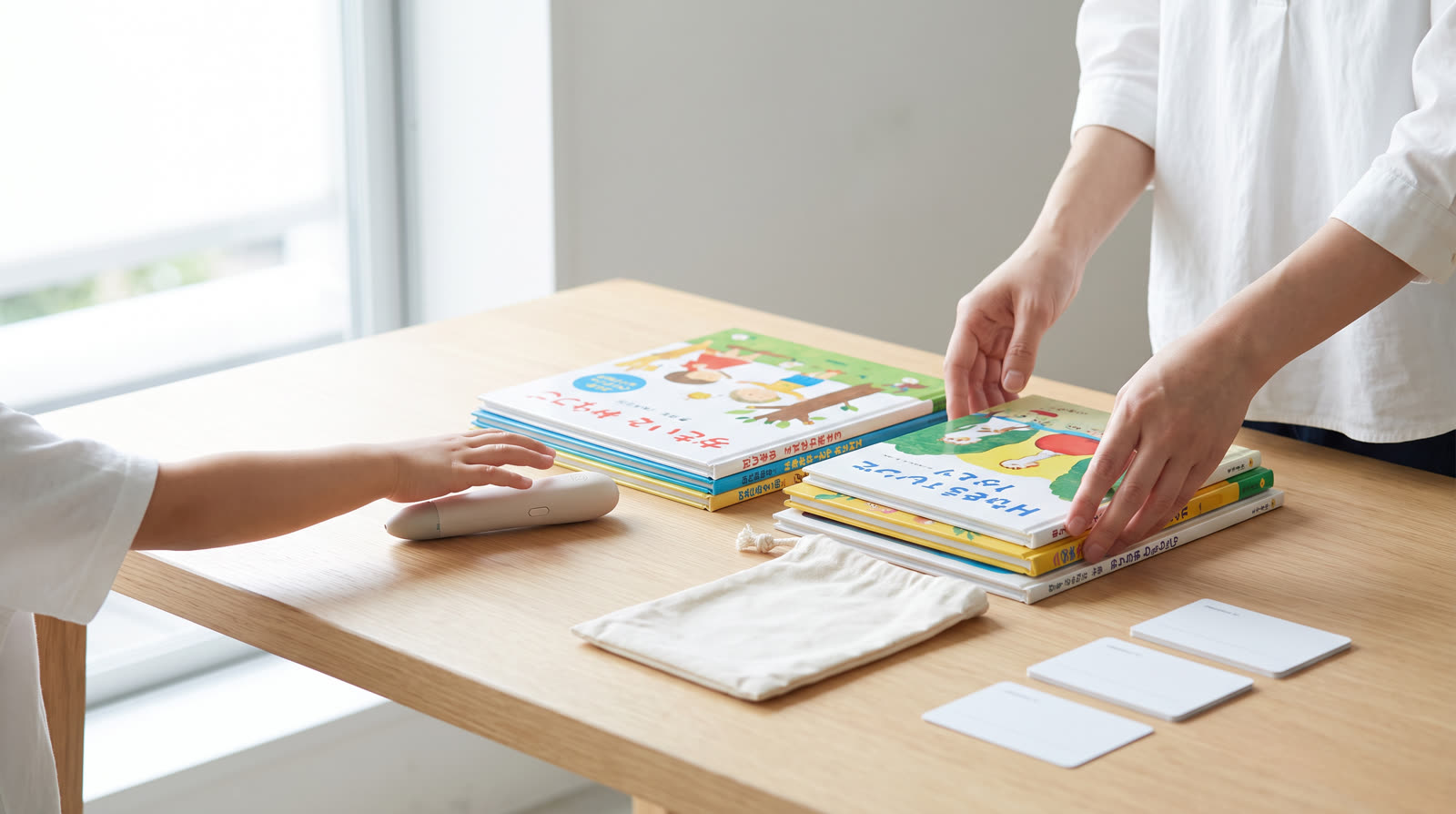
A book with integrated sound buttons, an app-based ebook and a coded book with a separate pen solve different interaction needs. This guide concerns the last route. In a compatible optical-code system, a printed region identifies a mapped, prepared audio response. It does not mean the device recognizes any ordinary text or understands the visible illustration.
If the existing edition has no compatible coding, ask what revised printing or other explicitly supported preparation would be needed. A catalogue description cannot establish that already-printed stock will work. Conversely, owning a coded edition does not establish that another manufacturer's pen can activate it.
The ReadGlo book–device compatibility review helps organize the exact pairing question. Its register is a planning aid, not an automatic test or approval.
Choose a purchase route before asking for a unit price
| Publisher starting point | Purchase decision | Evidence to request before commitment | Main commercial exposure |
|---|---|---|---|
| New original title | Develop a matched print–audio edition | Permitted layout, proposed interactions and feasibility response | Editorial preparation and integration work |
| Existing ordinary printed book | Review a revised interactive edition | Exact stock/edition identity and proposed preparation route | New printing may be needed; existing stock may not qualify |
| Existing coded title and pen | Retain or change the pairing | Authorized device, print and audio references plus practical assessment | Access restrictions and compatibility gaps |
| Licensed title or recording | Confirm the permitted interactive use | Asset-specific permission covering the proposed markets and medium | Rights fees, approval dependencies and restricted reuse |
| Additional language or collection title | Extend an agreed platform | New script/audio review and title-specific pairing evidence | Added preparation, loading and acceptance work |
Buyer decision aid; confirm the proposed configuration and responsibilities separately.
Swipe horizontally to view all columns.
Suppliers cannot meaningfully quote the same project when one receives a manuscript, another receives final recordings, and a third assumes you want stock books. Compare routes by the remaining work and the rights you can actually use.
This table is a buyer decision aid, not a ReadGlo service menu. Confirm whether each proposed activity can be considered and who will perform it. A new title, a language edition and a reprint should not silently become interchangeable quote lines.
Decide the sellable structure too: complete starter set, books supplied separately for an identified installed pen, or another agreed bundle. Count pens, books by title and edition, accessories, instructions and packaging separately. A pen shown next to a book is not evidence that both are included or compatible.
Design audio around real page choices
A useful interaction brief translates an editorial idea into observable actions. For each selected region, identify the page, what the reader touches, the intended recording and how that response should end. Identify any repeat, stop, language selection or activity behavior as a request requiring feasibility confirmation.
Make navigation understandable
Look beyond whether a tap produces sound. Can the reader tell which areas respond? Is a narration control distinguishable from an illustration? What should happen if another region is touched while a recording is playing? Different interruption rules create different listening experiences, so ask to review the requested behavior on the proposed device.
Use child-focused observation only under an appropriate buyer-arranged protocol and supervision. Record whether users can locate intended regions and operate the agreed controls. Such observations inform usability decisions; they do not prove literacy improvement, therapeutic benefit or suitability for every child.
Brief recording and language reviewers separately
Written text, spoken script and performance direction are not identical assets. A narrator should not have to decide whether a caption is spoken, how an unfamiliar name is pronounced or whether a character's remark belongs in the audio edition. Resolve these questions editorially before full recording.
For bilingual talking books, identify the written languages, spoken variants, territories and buyer-appointed language reviewers. Agree how readers select the requested recordings. This is prerecorded playback, not instant translation. Review a permitted audition or narration excerpt for clarity and style, then evaluate the agreed playback version on the actual sample.
Use the existing interactive-book narration approval guide for the detailed script handoff rather than duplicating that specialist task in the purchase order.
Ask what the proposed platform can repeat
A successful demonstration is only part of a publishing decision. Ask whether the proposed configuration can support the actual edition and what would be required to add another title. The answer should connect print preparation, identifiers, mappings, recordings and device behavior—not merely list hardware features.
Identify the authorized party responsible for coding and content preparation. Ask which inputs that party needs and which outputs the publisher will receive. Editable source files, compiled playback packages and a review copy may serve different purposes and carry different access restrictions. Delivery of one does not imply delivery of the others.
For audio capacity, provide the proposed package and ask the technical owner to assess it against the selected device/build's usable space and supported formats. Do not convert a headline memory figure into promised book counts or recording hours. File size, format, system use and other content affect that decision. Loading, updates, expansion and backup methods remain unconfirmed until agreed for the project.
For future publishing continuity, clarify whether approved files can be retained, revised, reprinted or passed to an authorized production partner. Identify any proprietary dependency and the contact needed for later work. Do not assume that payment transfers coding tools, firmware, source files or unrestricted modification rights.
Have a title direction but an incomplete production brief? Use the ReadGlo publisher project page and email info@readglo.com with a non-confidential title, market, language and asset-status summary. Ask what your first sample should establish; preparation services, deliverables and commercial terms require project-specific confirmation.
Clear content permissions before production sharing
A publisher may control the printed edition without controlling every proposed audio use. Text, translation, illustration, narration performance, recording, music and effects can involve different rightsholders. WIPO explains that reproduction, recording, translation and adaptation are distinct uses within copyright, and related rights can involve performers and recording producers.[1]
Build an asset-by-asset permissions record containing rightsholder, territory, medium/use, language, term, attribution and written permission. Match those elements to the planned sample, manufacturing activity and distribution. Record who may send each file to the selected partner and whether proposed edits or translations are covered. Online availability, a paid recording invoice or possession of an audio file is not sufficient evidence of all required rights.
For a proposed Quran-related edition, first ask whether the scope can be considered. Check the seven elements separately for the text, translation, recitation/performance, recording and layout, alongside other applicable assets. Use buyer-appointed editorial or religious reviewers where needed. No ownership, authorization, religious approval or technical capability is implied by this guide. Unresolved permissions remain outside production release, and legal questions belong with qualified advisers.
Turn your book and audio brief into a publisher project
Organize title and edition references, manuscripts, audio preparation, permissions and sample-acceptance questions in one publisher inquiry.
ReadGlo project support
Discuss Your Publisher Project
Share a non-confidential summary of your market, intended activity, content readiness and quantities. Requested capabilities, samples and commercial terms require project-specific confirmation.
Open the related procurement routeUse physical samples to test the purchase decision

Choose sample material for the uncertainties it can resolve. A permitted spread with close neighboring regions, a curved page near the binding or contrasting artwork may reveal issues that a carefully selected demonstration region does not. Agree the test conditions with the responsible technical parties instead of inventing universal printing tolerances or acceptance thresholds.
Distinguish three types of evidence
Editorial proof: Review the visible layout, script and intended responses. This can reveal an omitted narration item or an unclear instruction, but a screen proof cannot establish recognition on finished paper.
Representative functional sample: Review the identified pen, coded print and audio together. Observe requested regions, neighboring selections, controls and language behavior within agreed conditions. Keep untested pages and functions explicit.
Production-intent reference: Confirm what the later supply is expected to match, including finished print, loaded content, device references, pack contents and instructions. Decide what further checks are required for the collection and production order.
During sample review, a buyer should compare expected and observed responses rather than write only “works well.” If a region plays the wrong recording, note the region, expected response, observed track and circumstances. Ask the responsible party to investigate; do not infer that printing, firmware or audio is necessarily the cause. Keep corrections and relevant retests attached to the affected references.
Technical playback acceptance, editorial accuracy, rights clearance and destination-market review are separate decisions. For U.S. projects, CPSC guidance explains applicable toy-safety testing and certification responsibilities; whether particular requirements apply needs review of the final product.[2] Battery air transport also depends on the identified configuration and relevant ratings, as IATA explains.[3] Neither source establishes approval of a proposed ReadGlo SKU.
Compare complete project costs and approval dependencies
Request quotations with separate lines for repeat goods and one-off work. Repeat goods may include pens, books by edition, accessories and packaging. Requested preparation may include layout adaptation, coding, mapping, recording, loading, samples or other agreed activities. Confirm availability and inclusions rather than assuming a turnkey package.
Ask each supplier to identify quantities by line, currency, quotation validity, payment basis and delivery terms. Confirm MOQ, sample charges, production timing and shipping arrangements in writing. A retail bundle price is not a publisher-project estimate, and a pen-only quotation cannot be compared directly with a complete collection.
Evaluate the business case using your own title forecasts, channel requirements and cost assumptions. Compare the launch investment with the work required for a later language edition or reprint. Do not rely on a generic claim that interactive editions deliver a particular margin or repeat-purchase rate.
Build the schedule around dependencies. Unapproved translations, incomplete recordings, inaccessible coding files or unresolved sample findings can affect the next step. Ask which activities can proceed in parallel and which require completed inputs. Reserve time for review and revisions without treating an indicative launch date as a confirmed production slot.
Buyer RFQ and pre-order checklist
Use the existing publisher handoff checklist to organize a first discussion. Before sending an RFQ or authorizing an order, check that it includes:
- Publishing purpose: audience, supervised-use context, territories, channels and the interaction the edition should add.
- Title quantities: books by title, language and edition, with device quantities and bundle components counted separately.
- Asset readiness: permitted sample material, layout/script/audio status and named editorial and language reviewers.
- Permissions: the seven rights elements for each applicable work, performance and recording, including authorized partner sharing.
- Pairing request: proposed device, print/coding and audio references, with unknowns explicitly pending.
- Sample questions: selected interactions, expected responses, exclusions and the evidence needed for the next purchase decision.
- Commercial comparison: one-off versus repeat lines, inclusions, exclusions, ownership terms and approval-driven timing.
- Release responsibilities: final-market documents, instructions, packaging, battery/transport review and owners for later edition changes.
Send a summary first. Agree a permitted transfer route before sharing confidential production assets. An organized checklist should reduce ambiguity, not encourage the buyer to declare unfinished work approved.
Frequently Asked Questions
1. Can our existing picture books become interactive talking books? Possibly, but conversion is not automatic. Identify the exact edition and permitted production files, then ask what print preparation and device pairing could be considered. Already-printed stock and a revised coded edition may require different purchase decisions. Confirm feasibility through agreed evidence and samples.
2. How many books should a publisher launch with? There is no universal minimum catalogue size. Start with the titles your editorial resources, rights and channel forecasts can support. Keep prototype coverage separate from launch quantities, and confirm commercial minimums with the supplier. A future collection plan does not approve untested volumes.
3. Can one pen work with all our language editions? Only an assessed, agreed configuration can answer that question. List the relevant editions, recordings, selection behavior and device/build. Request evidence for each intended pairing, including later content additions. A multilingual webpage or a successful demonstration in one language does not prove other language support.
4. Do more audio touchpoints make a better book? Not necessarily. Choose touchpoints that serve the reading task and remain understandable on the page. Additional regions create more mapping, recording and review work. During sample review, assess useful selection and navigation rather than treating hotspot quantity as a quality score.
5. Can we supply our own recordings? You can propose them for review. Provide permission status, script references and recording versions, and ask which formats and preparation steps the selected system requires. Technical acceptance does not clear performer, recording or underlying-work rights. Do not assume supplied files can be loaded unchanged.
6. What should happen when the book is reprinted? Compare the intended reprint with the approved edition, including artwork, pagination, coding, audio and device dependencies. Ask which changes require practical checks and revised instructions. An unchanged commercial title or ISBN does not establish that every technical relationship stayed unchanged.
7. Does ReadGlo provide recording, coding and printing as standard? Do not assume a standard package. Describe the work you need through the publisher project route and request confirmation of feasibility, responsibilities, deliverables, ownership, exclusions and terms. Sample availability, supported functions, languages, prices and timing depend on the final agreed project.
Conclusion: buy an edition that can be supplied coherently
A sound purchase decision connects editorial value with the practical system that delivers it. Choose the interaction, resolve the rights, evaluate the named physical pairing and compare the full commercial scope. Preserve the evidence needed for the next edition, not just the first demonstration.
Ready to scope your interactive edition? Visit the ReadGlo publisher project page or email info@readglo.com with your proposed titles, languages, markets, asset readiness and next decision. Start with a non-confidential summary; confirm capabilities and terms before committing production files or an order.
Sources and further reading
Continue your research
Related reading pen buyer guides
Use these related guides to compare the next product, content, sourcing or channel decision in your project.
- Publisher SolutionsHow Can a Publisher Prepare a Talking Pen Content Archive for Team Handover?Read this guide
- Publisher SolutionsHow Can a Publisher Map Talking Pen Book Bundle Components Before Production?Read this guide
- Publisher SolutionsHow Should a Brand Plan Talking Pen Book-Edition Change Notices?Read this guide
Continue with ReadGlo
See product specifications and request model-specific documentation.
ReadGlo project support
Request a Project Discussion
Describe the purchasing decision you need to make. Confirm the configuration, permitted content, required evidence and supply terms before an order.
Open the related procurement route