Contents
Direct Answer
Custom reading pen boxes should be requested against a specific contents list, separate quantity units, current files and a named target market. First establish whether the request concerns empty boxes, boxes with inserts or packed retail sets; separate empty-box supply needs written confirmation. Then agree what the dieline, print proof, structural sample and actual pack-out sample must demonstrate. Artwork approval alone does not establish fit, labelling suitability or shipment readiness.
The framework below is for buyer planning, not a statement of an established ReadGlo production procedure. Its output is a packaging record that connects the quotation to the files and physical contents being reviewed.
Which contents and quantity units define the packaging request?

Empty boxes and packaging components
An empty-box request is different from an assembled product order. Specify whether it means flat boxes, erected boxes or boxes accompanied by separately counted inserts and leaflets. Ask whether standalone supply falls within the proposed project scope before seeking bulk terms. Do not assume that a reading-pen supplier also offers an independent empty-box wholesale service.
Give each packaging component its own line reference. Record the requested quantity, revision, delivery condition and intended receiving party. If your team will pack the devices locally, identify which party supplies the component dimensions and checks the locally assembled configuration. A box supplied without contents cannot, by itself, establish that a later combination fits.
Packed retail sets
For packed sets, start with what goes inside one sellable pack. Identify the proposed pen reference, book or card edition, accessory references and instruction language. Count copies and items per pack separately from the requested number of retail packs. List any loose spares outside that total.
State exclusions clearly. A photographed cable, pouch or book is not an agreed inclusion. If two language editions use the same box artwork, retain separate contents rows until the responsible reviewers confirm that the shared file describes both accurately. Shared branding does not establish shared dimensions, compatibility or permission.
Do not add a waste allowance without explaining it. If extra packaging is requested for local assembly or replacement stock, show it as a buyer-selected additional quantity and ask how it will be supplied and counted. It should not silently become additional device demand.
Shipping cartons
A carton quantity is not a retail-pack quantity. State the proposed number of retail packs per inner or master carton, identify whether mixed editions are requested, and mark provisional dimensions and weights accordingly. Keep carton artwork and packing instructions distinct from the retail box.
Ask the packing owner to reconcile the proposed totals and identify any partial cartons. Detailed pallet and receiving decisions belong in the separate carton, inner-pack and pallet planning guide. Here, the purchasing task is to prevent unlike packaging units from being quoted as though they were interchangeable.
Which box and insert details belong in the RFQ?
An RFQ, or request for quotation, should describe the required outcome before asking about decorative finishes. For custom printed reading pen boxes, specify shelf orientation, opening direction, proposed contents layout and the information the buyer wants visible before purchase. Identify retailer constraints as supplied requirements, not assumptions about every sales channel.
Define dimensions and structure without guessing specifications
State whether each dimension is internal, external or a preliminary estimate. Include the measurement unit and the orientation used for length, width and height. Attach the relevant component references rather than deriving final dimensions from a catalogue photograph.
Describe the requested box format, material direction and finish preferences as proposed. Ask the responding party to confirm feasibility, measurement references, tolerances and the sample route for the actual configuration. Do not insert an invented paper grade, thickness, protective rating or standard tolerance to make the brief appear complete.
For the proposed retaining insert, identify where the pen, books and accessories sit. Ask how the contents can be removed and returned without the reviewer forcing them into place. Distinguish a shaped retaining insert from a printed instruction leaflet; calling both an “insert” can obscure two different deliverables.
Separate artwork inputs from production instructions
List the current dieline, artwork, brand assets, image references, barcode data and instruction files with revision dates and owners. A dieline is the layout reference for the intended cuts, folds and related structural features. Ask the packaging partner to identify which version should carry the artwork and what file preparation is required.
Provide colour references and requested print or surface treatments as review inputs. Ask which proof can address which concern, including colour appearance, placement or a proposed finish. Neither a digital mock-up nor a file name establishes the available production method.
For identification data, name the owner who supplies and approves it. Keep fixed artwork separate from fields intended to vary by edition or production run. Mark missing data as pending; do not let a placeholder become a released instruction.
How should dielines, print proofs and pack-out samples be reviewed?
| Review record and input version | Check purpose | Evidence boundary | Responsible owner | Pending item to complete |
|---|---|---|---|---|
| Contents list: ___; pen, print and accessory refs: ___ | Establish what each packaging line must contain | A list does not prove availability or pairing | Configuration owner: ___ | Missing inclusion or reference: ___ |
| Box dieline: ___; dimension status: ___ | Review panel arrangement, opening and structural references | Layout approval does not approve printed copy or actual fit | Structural reviewer: ___ | Dimension or closure question: ___ |
| Artwork / print proof: ___; label language: ___ | Review text, images, placement and the agreed proof characteristics | Print approval does not establish retention, market compliance or transport suitability | Brand / copy reviewer: ___ | Claim, colour or data question: ___ |
| Structural sample: ___; material differences: ___ | Assess the proposed box and retaining-insert arrangement | Substitute contents or materials limit what can be concluded | Packaging reviewer: ___ | Difference requiring later review: ___ |
| Actual pack-out sample: ___; contents revision: ___ | Review the named contents in the intended arrangement | One configuration is not evidence for every edition or shipping route | Pack-out approver: ___ | Missing component or fit issue: ___ |
| Carton specification: ___; packs per carton: ___ | Reconcile retail packs with outer packing | Retail-box approval does not release the shipment | Packing / route owner: ___ | Quantity or route question: ___ |
Buyer-fillable packaging review record: input versions, review purposes, evidence boundaries, responsible owners and pending items.
Swipe horizontally to view all columns.
Keep structural, artwork and actual-content review separate, even when the project combines them in one physical sample. Before commissioning a proof or sample, define its purpose, supplied versions and known differences from the intended order. Agree arrangements, charges and responsibilities rather than assuming every stage is included.
Use the following buyer-fillable decision table. Replace the blank references and owners with current records; the boundaries are questions to preserve, not automatic approvals.
How should buyers record approval and review the actual loaded pack?
Next step: Use the completed scope and review rows to send your OEM project brief through the existing ReadGlo form. State whether separate packaging supply is requested and list unresolved items. This starts a scope discussion; feasibility, sample work, quotation and release remain separate written decisions.
Give each approval a precise meaning
A useful approval statement names the file or sample, scope, reviewer and date. “Artwork approved for the recorded print-review scope; pack-out pending” is more informative than “box approved.” If approval depends on a correction, record the correction and how its closure will be evidenced. Do not treat silence in an email chain as a release.
For the print proof, compare the current content list with pictured and named inclusions. Check language, exclusions, approved copy and identification data against their source records. Detailed comment ownership belongs in the separate packaging artwork approval-comments guide; this guide connects that decision to the purchased box and sample scope.
Review the actual loaded pack
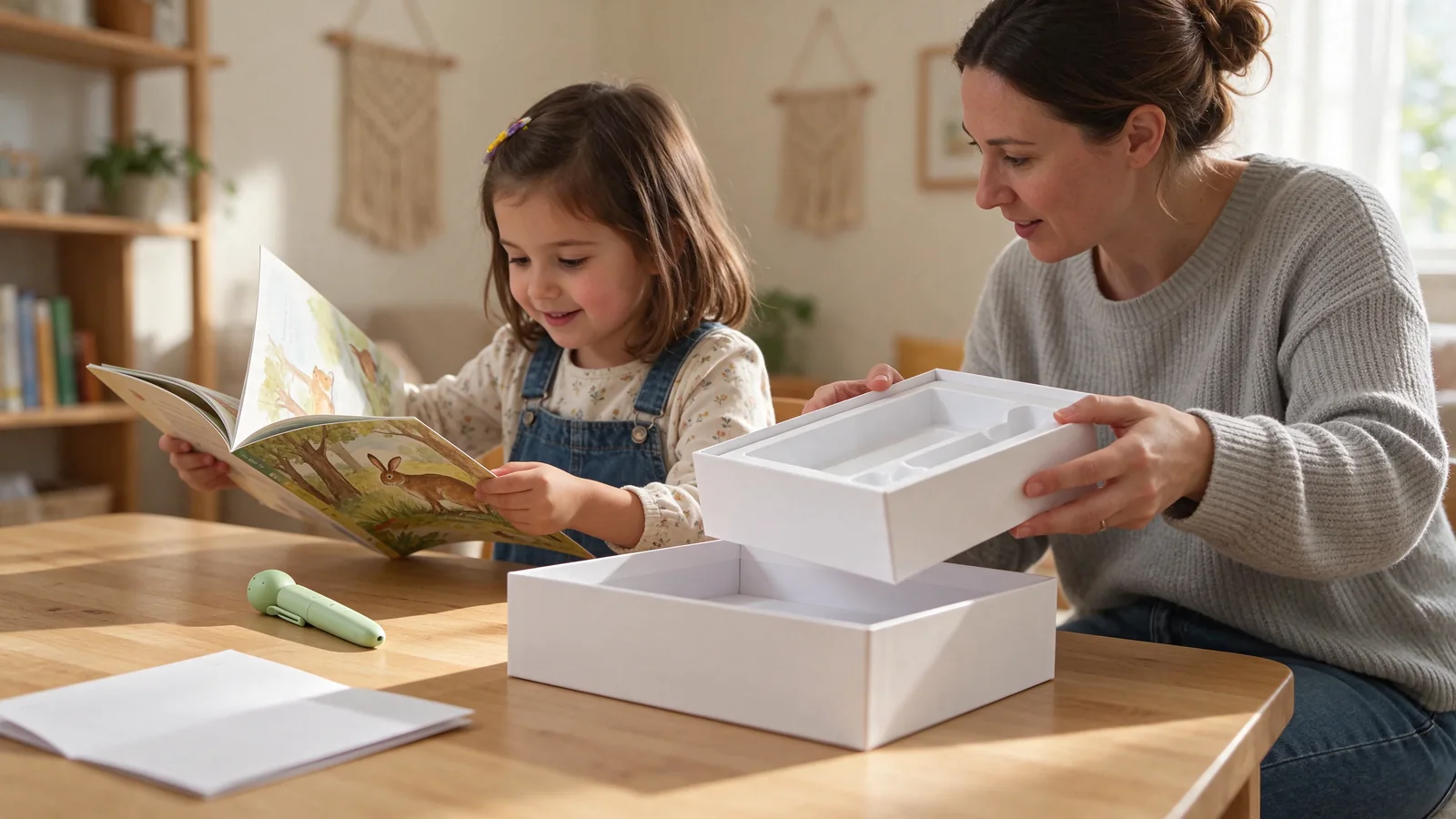
Ask the reviewer to record component identity, placement, closure and removal observations against the agreed checklist. Note whether books, leaflets or cables interfere with the proposed arrangement. Photograph relevant observations with the sample reference, while retaining the agreed physical reference where appropriate.
If the sample uses a substitute device, different book thickness or an unfinished insert, state that difference beside the observation. Decide what remains open for the final pack. A successful closure observation is not a drop-test result or a claim of transport protection; any requested protective evaluation needs its own agreed scope and evidence.
Build one RFQ without losing individual SKU details
Select catalogue references and specify quantities, languages and versions per line. A combined inquiry does not confirm pooled MOQ, stock or shipping arrangements.
ReadGlo project support
Send Your Packaging Scope
Send your completed contents list, separate quantity units and review rows through the existing ReadGlo OEM form. State whether separate packaging supply is requested and list unresolved items. Feasibility, sample work, quotation and release remain separate written decisions.
Open the related procurement routeHow can quotes separate one-time work from repeat packaging?
Request separate commercial lines rather than an unexplained “customization” total. Ask each respondent to classify proposed activities as included, separately charged, excluded or pending. A useful comparison preserves the quantity unit and revision for every line.
Identify setup deliverables and reuse conditions
Ask whether artwork preparation, structural design, dieline preparation, physical tooling and sample work are required for this request. For each applicable activity, identify the deliverable, charge basis, approval dependency and ownership or licence terms. Do not assume all such work is one-time, or that paying a fee transfers editable files and tooling rights.
For reusable work, ask what “reuse” permits. Which unchanged configuration can use the asset again? Who retains it, for how long, and on what terms? Can another approved party use the supplied file or tool? What happens if the box structure, print method or supplier changes? Record the answers rather than inferring them from a setup line.
Identify recurring components and packing work
Separate retail boxes, retaining inserts, instruction leaflets, inner packs, master cartons and agreed packing labour where applicable. Name the unit for each charge: component, retail set, carton or an expressly defined batch. Ask whether sample dispatch, assembly, packing or storage is included instead of treating these activities as incidental.
For repeat orders, quote against the retained revisions and disclose changes. Confirm currency, validity, delivery basis, named place and freight or tax treatment. Ask for quantities, timing and commercial terms against that scope; this article provides no standard price, MOQ or schedule. The wider OEM quotation-scope guide covers pilot and repeat device orders. The task here is the narrower packaging cost and reuse record.
What changes reopen packaging approval?
Record a proposed change before sending revised files onward. Identify the old and new references, reason, affected quantities, decision owner and the checks requested. The responsible parties should decide the impact; neither “everything must be retested” nor “the old approval always applies” is a sound blanket instruction.
A book-edition change may alter the proposed pack thickness. An accessory substitution may affect its allocated space. A leaflet-language change may affect page count and folding. A box-artwork change may introduce different claims or identification data. Treat these as review prompts, not assumptions that every change has the same consequence.
Keep retail-box, retaining-insert, leaflet and carton revisions independently visible. If only carton data changes, ask which packing and route records need updating. If contents change, reconcile the box description and the actual pack-out reference as well as the quotation.
Before release, assemble the current component list, approved packaging files, sample references, accepted differences and unresolved decisions. State who may authorize production and who may authorize dispatch. A proof reviewer should not inherit both responsibilities merely because they approved an artwork file. The release note should identify what is authorized now and what remains on hold.
Which claims, rights and market records must remain separate?
Use packaging statements that describe the approved configuration. Device appearance, a pictured book or a generic category name does not establish arbitrary-book compatibility, a particular feedback mechanism or a learning outcome. If a proposed card activity needs a specific interaction, verify it in the product-and-content record before reflecting it on the box.
WIPO explains that copyright owners can authorize or prevent uses including reproduction and translation, and that protected-work use generally requires authorization, subject to relevant exceptions or licence conditions.[1] For packaging assets, maintain a buyer register identifying the rightsholder, file version, territory, medium, language, term, attribution and written permission or other documented basis. Brand acceptance of a layout is not a substitute for those records.
For a proposed U.S. children's product, CPSC's guidance calls for visible, legible distinguishing marks on the product and packaging, permanently affixed to the extent practicable, with identifying information about source and production.[2] Assign the responsible reviewer to determine the applicable implementation for the final configuration. Keep the approved data source and placement decision connected to the artwork revision; a tracking-label draft is not a product certificate.
For other destinations, identify the market reviewer and the records they request before approving customer-facing labels. Keep battery and shipment questions with the final SKU and intended route. Do not copy warnings, certification marks or reports from another product to fill an empty panel.
Frequently Asked Questions
1. Can custom reading pen boxes be ordered without devices? Ask ReadGlo to confirm whether separate supply is within the proposed scope. Distinguish empty boxes, boxes with retaining inserts and packed retail sets. Standalone availability, minimum quantities, delivery condition and commercial terms are not established by this guide.
2. What files should buyers provide for printed reading-pen packaging? Provide current artwork and dieline references, permitted brand assets, approved image and copy sources, identification data and instruction-language files. Mark drafts and missing permissions. Ask the responding packaging partner to confirm required production-file preparation rather than assuming a universal format.
3. How should empty-box, packed-set and carton quantities be compared? Keep separate line units. State items per retail pack, requested pack counts and proposed packs per carton. List spare components and partial cartons explicitly. Compare quotations only after both parties have confirmed the same contents, revisions and counted units.
4. Does an approved print proof establish fit or product compliance? No. It covers the recorded print-review scope. Structural and actual pack-out review answer different questions, while market and transport records need separate responsible review. Record any sample substitutions and unresolved issues instead of extending proof approval to the whole project.
5. What should change control cover after pack contents are revised? Log the component change and affected box, insert, leaflet and carton references. Ask the responsible owners which proof, sample, quotation or market records need renewed review. Attach the resulting decisions to the current release rather than relying on an earlier approval email.
6. Are tooling charges always one-time costs? No universal treatment should be assumed. Ask what the charge buys, who owns or licenses the deliverable, and which unchanged repeat configuration may reuse it. Storage, replacement, transfer and revised-work terms need written agreement where relevant.
Conclusion: quote and approve the same packaging scope
A useful custom reading pen box brief ties quantities to real proposed contents, files to named approvals, and costs to defined deliverables. Keep artwork acceptance separate from actual pack-out and shipment release. Before proceeding, reconcile the current revisions and assign every open decision.
For consumer-facing composition and presentation, send a retail gift-set brief through the existing ReadGlo procurement page, or email a non-confidential version-and-open-items summary to info@readglo.com. Include the proposed contents, market, separate quantities and next approval needed. Quotation, services and release require their own written confirmation.
Sources and Further Reading
[1] WIPO Frequently Asked Questions: Copyright
[2] CPSC Tracking Label Business Guidance
ReadGlo OEM / ODM project planning — Existing procurement route for a scope discussion; not evidence of an available configuration, certification or confirmed service.
ReadGlo retail gift-set planning — Existing procurement route for a scope discussion; not evidence of an available configuration, certification or confirmed service.
Continue your research
Related reading pen buyer guides
Use these related guides to compare the next product, content, sourcing or channel decision in your project.
- Private LabelHow to Manage Reading Pen Product Information Across Marketplace ListingsRead this guide
- Product DevelopmentCan Chinese Manufacturers Custom Build Reading Pens with Type-C Charging and 1000mAh Batteries?Read this guide
- Private LabelWhite Label vs OEM vs ODM Reading Pens: What Is the Difference?Read this guide
Continue with ReadGlo
See product specifications and request model-specific documentation.
ReadGlo project support
Submit a Retail Gift-Set Brief
Submit the proposed contents, market, separate quantities and next approval needed through the existing retail gift-set procurement page. For a non-confidential version-and-open-items summary, email info@readglo.com. Quotation, services and release require their own written confirmation.
Open the related procurement route