
Contents
Introduction
Building a consistent daily reading habit in young children is one of the most effective ways to foster early literacy, language acquisition, and cognitive development. However, maintaining children's engagement requires more than passive listening; it demands active participation, scaffolded dialogue, and multisensory learning tools. Guided questions, when paired with advanced interactive reading pen technology and talking picture books, transform traditional storytelling into an interactive dialogue. This comprehensive B2B guide examines the pedagogical frameworks, daily routine structures, and hardware integration strategies that publishers, educational distributors, and toy brands can leverage to support parents and educators in cultivating lifelong reading habits. By adhering to human-centered design, age-appropriate scaffolding, and rigorous safety standards, stakeholders can deliver high-value educational products that resonate with modern families and institutional buyers alike.
Pedagogical Foundations of Guided Questioning in Early Literacy
The Cognitive Role of Proactive Prompts in Language Acquisition
Language acquisition in early childhood thrives on interactive social engagement rather than one-way communication. Proactive prompts and guided questions encourage children to move beyond simple word recognition into semantic comprehension and critical thinking. According to developmental research highlighted by the American Academy of Pediatrics (AAP), children who engage in dialogic reading—where adults ask open-ended questions about illustrations, character motivations, and storyline predictions—exhibit accelerated vocabulary growth and enhanced narrative comprehension. When integrated with talking picture book sets, guided questions provide structured mental scaffolding that helps young learners connect printed symbols with spoken phonetic sounds and real-world concepts.
Transitioning from Passive Audio Listening to Active Verbal Response
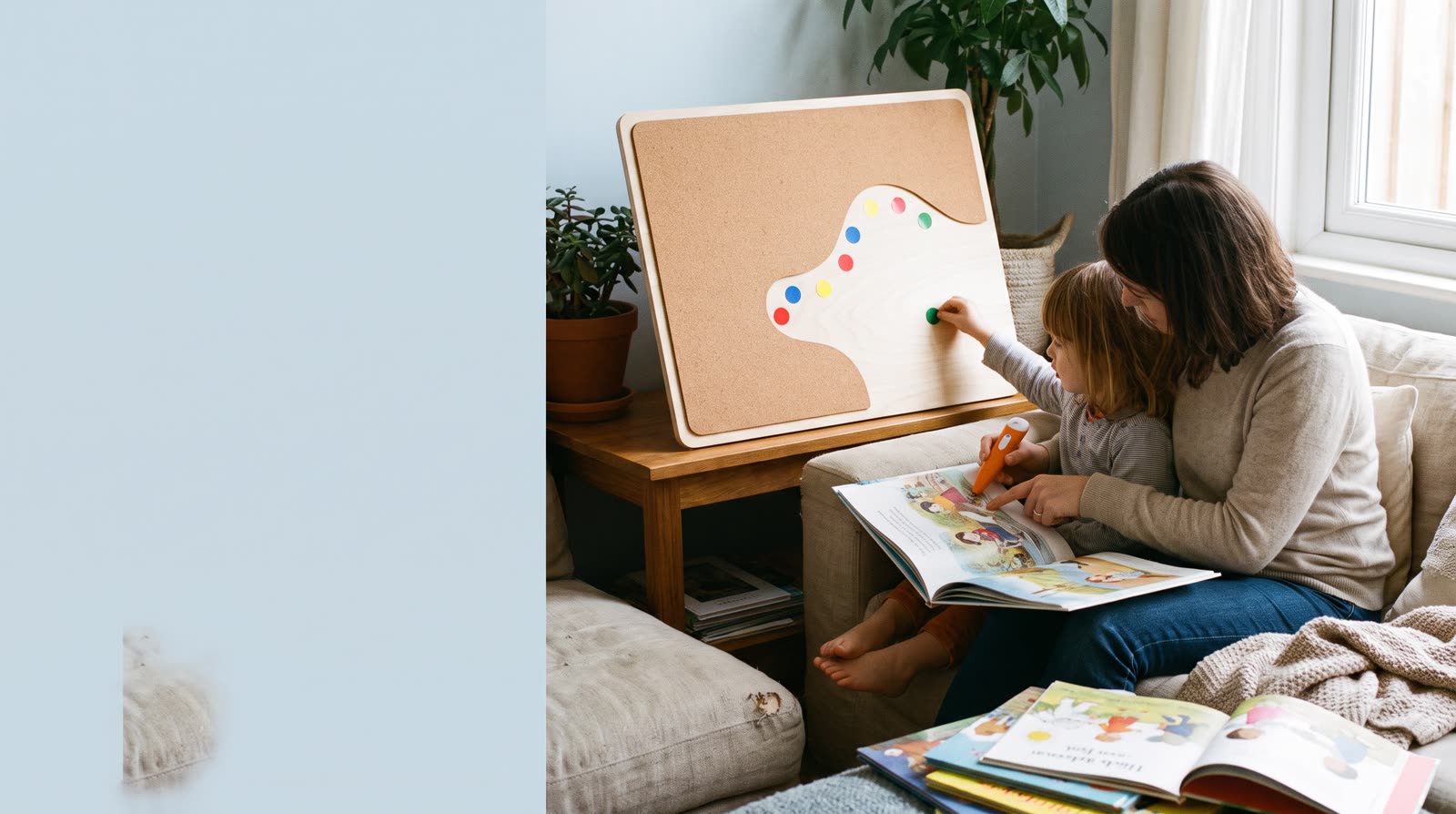
While audio players and pre-recorded stories offer auditory exposure, they can sometimes foster passive listening habits where children consume sound without cognitive processing. Guided questions counteract this tendency by prompting children to articulate their thoughts, make predictions, and answer contextual inquiries. Interactive reading pen systems equipped with optical sensor technology allow children to trigger specific audio responses, sound effects, or character dialogues by touching designated icons or text areas. When parents or educators pair these tactile touch-points with verbal prompts such as 'What do you think happens next?' or 'Why did the character feel happy?', the child transitions from a passive listener to an active participant in the narrative journey.
Scaffolding Techniques for Parents and Early Childhood Educators
Effective scaffolding involves adjusting the level of adult support to match the child's current developmental stage, gradually withdrawing assistance as competence increases. Parents and educators can utilize guided questions across different tiers of complexity, starting with simple identification questions ('Point to the red apple') and progressing to inferential reasoning ('Why is the bear sharing his honey?'). In a B2B publishing context, embedding guided question prompts directly into the margins of talking picture books or within companion parent guide booklets ensures that non-specialist caregivers feel confident facilitating rich, meaningful literacy sessions without requiring advanced pedagogical training.
Integrating Talking Pens and Guided Prompts into Daily Routines
Designing 10-to-15 Minute Structured Reading Blocks
Consistency is critical when establishing daily reading habits in early childhood. Research and practical educational guidelines suggest that short, focused reading sessions lasting between 10 and 15 minutes are significantly more effective for toddlers and preschoolers than infrequent, extended reading marathons. By scheduling these micro-sessions at predictable times—such as during morning quiet time or as part of the bedtime wind-down routine—parents create a stable psychological anchor. The portability and instant startup capability of interactive reading pens make them ideal tools for these concise reading blocks, eliminating setup friction and maintaining child engagement.
Balancing Tactile Book Exploration with Auditory Feedback
A successful interactive reading session strikes a deliberate balance between tactile exploration of physical book pages and auditory feedback from the talking pen. Children need physical interaction—turning sturdy board book pages, tracing embossed illustrations, and tapping optical code spots—to develop fine motor skills and spatial awareness. The audio feedback delivered by the reading pen should complement, rather than overwhelm, the physical reading experience. Publishers and educators must ensure that audio clips are crisp, paced appropriately, and interspersed with natural pauses that invite the child to speak, ask questions, or respond to parental prompts.
Mitigating Audio Over-Reliance Through Parent-Child Dialogue
To prevent children from becoming overly reliant on pre-recorded audio or treating the reading pen as an electronic toy rather than a literary tool, adult facilitation is essential. Parents and educators should use the pen's audio output as a springboard for further conversation rather than an endpoint. For instance, after hearing a narrated sentence or sound effect from the pen, the parent can pause and ask a guided question related to the theme. This hybrid approach—combining optical reading technology with human interaction—ensures that children develop deep comprehension, emotional resonance, and genuine enthusiasm for reading.
B2B Editorial and Hardware Design for Interactive Book Publishers
Optical Identification (OID) Code Mapping and Touch-Point Layout
For publishers and brand owners developing interactive book series, precise OID (Optical Identification) code mapping is the foundation of reliable reading pen performance. OID dots are micro-printed patterns embedded invisibly beneath or alongside illustrations and text, allowing the optical sensor inside the pen to instantly recognize coordinates and trigger corresponding audio files. Editorial teams must carefully design touch-point layouts to avoid cluttering visual aesthetics while ensuring that active targets are large enough for developing motor skills. Pre-press quality control workflows must verify that printing presses maintain high optical contrast and dot fidelity across mass production runs.
Multi-Language Audio File Architecture and Firmware Optimization
Global educational markets demand flexible hardware and software architecture capable of supporting bilingual or multi-language learning. Modern talking pen firmware allows users to switch between different language packs or book series by downloading compressed audio data onto internal flash memory or external TF cards. Publishers must structure audio file directory naming conventions and data formatting rigorously to ensure seamless compatibility across different pen firmware versions. Collaborative specification reviews between publishers, firmware engineers, and hardware manufacturers help eliminate audio latency, memory overflow errors, and cross-language mismatch issues.
Collaborative Workflows for Content Review and Pre-Press Quality Control
Developing successful interactive talking book sets requires close coordination among authors, instructional designers, sound engineers, and printing manufacturers. The workflow typically begins with manuscript creation and guided question mapping, followed by professional voice talent recording and audio editing. Sound files are then linked to specific OID coordinates during layout design. Before mass production, comprehensive sample evaluations and pre-shipment documentation checks are conducted to verify that audio synchronization, optical reading accuracy, and physical material safety meet international standards.
ReadGlo project support
Explore OEM Solutions
Partner with ReadGlo to develop customized interactive reading pens and talking book sets tailored to your educational market.
Product Care, Safety Compliance, and Regulatory Standards
Low-Risk External Inspection and Physical Maintenance Protocols
Ensuring the longevity and safety of interactive reading pens and talking books requires proper maintenance and routine external inspection. Parents and institutional buyers should perform periodic checks of the reading pen casing, optical lens tip, and USB charging ports for signs of wear or accumulation of dust and debris. Cleaning should be restricted to low-risk external wiping using a soft, slightly damp microfiber cloth without harsh chemical solvents or abrasive cleaners. Users must strictly avoid attempting to disassemble the housing or tamper with internal electronic components.
CPSC Guidelines and Child Safety Compliance for Electronic Toys
Children's electronic learning devices and books distributed in commercial markets must comply with stringent international safety regulations, such as those established by the Consumer Product Safety Commission (CPSC) in the United States and equivalent bodies globally. Compliance encompasses mechanical hazards (small parts, sharp edges, drop-test durability), chemical safety (non-toxic soy-based inks, phthalate-free plastics), and electrical safety (battery compartment security, thermal regulation). B2B buyers should request complete test reports and compliance documentation from manufacturers to verify adherence to standards such as ASTM F963 and EN71.
Battery Safety, Charging Best Practices, and Environmental Durability
Most modern talking pens utilize rechargeable lithium-ion batteries for portability and convenience. Proper battery care is essential for safety and product lifespan. Users should charge devices using certified standard DC 5V USB adapters and avoid leaving devices connected to power sources indefinitely after a full charge. If a reading pen exhibits signs of abnormal heating, swelling, casing distortion, unusual odor, or leakage, users must immediately cease operation, disconnect power, and contact the manufacturer or qualified service channels. Devices should be stored in moderate temperature environments away from excessive moisture and direct sunlight.
Commercial Procurement and Quality Evaluation for Distributors
Key Criteria for Evaluating Reading Pen Acoustic and Sensor Quality
When educational distributors, retailers, or institutional buyers evaluate talking pen and book bundles for wholesale procurement, acoustic fidelity and optical sensor responsiveness are paramount. High-quality speakers should deliver clear, distortion-free pronunciation without harsh treble or muffled bass, supporting auditory discrimination in young learners. The optical camera sensor must maintain high scanning speed and reading accuracy even under low ambient lighting conditions or slightly angled contact. Requesting functional samples for rigorous internal testing before placing volume orders is an indispensable step in commercial procurement.
Assessing Supplier Specifications, Documentation, and Sample Review
Navigating B2B sourcing for educational technology requires thorough assessment of supplier capabilities, production specifications, and quality assurance documentation. Buyers should examine technical datasheets covering memory capacity (ranging from 8GB to 32GB), battery mAh ratings, supported audio formats (WAV, MP3), and firmware update mechanisms. Reviewing pre-production physical samples allows procurement teams to evaluate book binding durability, paper weight (e.g., heavy-duty coated board stock), lamination quality, and overall tactile feel prior to finalizing supply agreements.
Scalable Distribution Models for Retailers and Educational Institutions
Successful distribution of interactive reading pen sets depends on tailored go-to-market strategies that address the unique needs of retail consumers versus institutional classrooms. Retail channels benefit from vibrant packaging, consumer-friendly starter bundles, and clear age-grading labels. Institutional channels—such as kindergartens, language learning centers, and special education programs—prioritize durability, rechargeable docking stations, easy audio content management, and bulk replacement accessories. Establishing clear communication channels between manufacturers, distributors, and end-users ensures continuous product refinement and long-term market success.
Frequently Asked Questions
How long should a daily reading session with a talking pen be for a toddler?
For toddlers aged 2 to 4, optimal daily reading sessions range between 10 and 15 minutes. This duration aligns with their natural attention span and prevents cognitive fatigue while building a consistent daily habit.
Can reading pens replace adult involvement in early childhood literacy?
No. Reading pens and interactive talking books are designed to supplement, not replace, adult engagement. Parental guidance, open-ended questioning, and shared conversation are essential for emotional bonding and deep language comprehension.
What safety standards should B2B buyers verify when sourcing reading pens?
B2B buyers should verify compliance with major international safety standards such as CPSC/ASTM F963 in the United States, EN71 in Europe, and RoHS/CE certifications, ensuring non-toxic materials, mechanical durability, and electrical safety.
How should parents handle a reading pen that shows signs of battery swelling or overheating?
If a reading pen exhibits abnormal heating, casing swelling, leakage, or unusual odor, users must immediately stop using the device, disconnect it from any charging source, and contact the manufacturer or authorized service channels.
Are talking picture books compatible with reading pens from different brands?
Generally, optical reading pens are brand-specific because their OID code decoding algorithms and audio file structures are tailored to proprietary software. Buyers and publishers must ensure that books and pens are coded under matching specifications.
Conclusion
Building a sustainable daily reading habit in early childhood requires a harmonious blend of engaging literature, tactile exploration, interactive technology, and thoughtful adult guidance. By utilizing guided questions to transform passive listening into active verbal dialogue, parents and educators unlock the full cognitive potential of young learners. For publishers, distributors, and educational brands partnering with ReadGlo, delivering superior interactive reading pen systems and talking book sets involves rigorous attention to pedagogical design, optical precision, and uncompromising safety compliance. We invite industry partners to connect with our team to explore tailored OEM/ODM solutions, review product specifications, and discuss collaborative opportunities in the global early literacy market.
Continue your research
Related reading pen buyer guides
Use these related guides to compare the next product, content, sourcing or channel decision in your project.
- Early LearningBuilding Daily Reading Habits with a 10-Minute Routine: Comprehensive Strategies for Early Literacy and Interactive Book ProgramsRead this guide
- Early LearningHow can parents make parent-child reading more interactive using a 10-minute routineRead this guide
- Early LearningHow Can Parents Build a Daily Reading Habit Using a Reward Chart?Read this guide
Continue with ReadGlo
See a DOT-code picture-book set designed for guided early-learning programs.
ReadGlo project support
Request Product Catalog
Contact our B2B team today to review our latest talking pen specifications, sample evaluation protocols, and wholesale partnership options.