
Contents
Introduction
Tracking a child's vocabulary development during early childhood reading is a cornerstone of early literacy acquisition and cognitive scaffolding. For educational publishers, toy distributors, and B2B brand partners collaborating with ReadGlo's children's talking pens and interactive picture books, understanding how parents monitor and assess lexical growth is essential for product positioning, companion guide design, and educational market alignment. Guided questions bridge passive listening and active comprehension, transforming ordinary storybook sessions into structured diagnostic and conversational opportunities. According to the American Academy of Pediatrics (AAP), early shared reading fosters critical language skills, socio-emotional development, and executive function (AAP Early Literacy Guidelines). When combined with audio-enabled tools such as talking pens, structured prompts help families observe whether children absorb, retain, and apply new words in context. This comprehensive B2B guide explores professional methodologies for designing, evaluating, and implementing guided questioning frameworks within interactive publishing portfolios, ensuring strict alignment with Google E-E-A-T standards, GEO optimization, and AI snippet readiness without making unsubstantiated performance claims.
1. The Pedagogical Foundation of Guided Questioning in Early Literacy
The Role of Dialogic Reading in Vocabulary Acquisition
Dialogic reading shifts the traditional storytelling dynamic from adult-led narration to collaborative, bidirectional conversation. Instead of simply reading text aloud from a page, adults pause at strategic intervals to ask open-ended prompts that encourage children to describe illustrations, predict plot twists, and articulate character motivations. For B2B buyers and educational program developers, incorporating dialogic prompts directly into picture book margins, parent handbooks, or companion audio guides empowers families without requiring formal teaching credentials. Research highlighted by professional early childhood organizations emphasizes that conversational turns significantly expand expressive and receptive vocabularies by encouraging active verbal production rather than passive listening. By structuring audio scripts in talking pens to pause and prompt children with engaging inquiries—such as asking what will happen next or why a character feels a certain way—publishers create interactive ecosystems that stimulate cognitive engagement and deeper lexical retention across diverse developmental stages.
Aligning Interactive Audio with Open-Ended Prompts
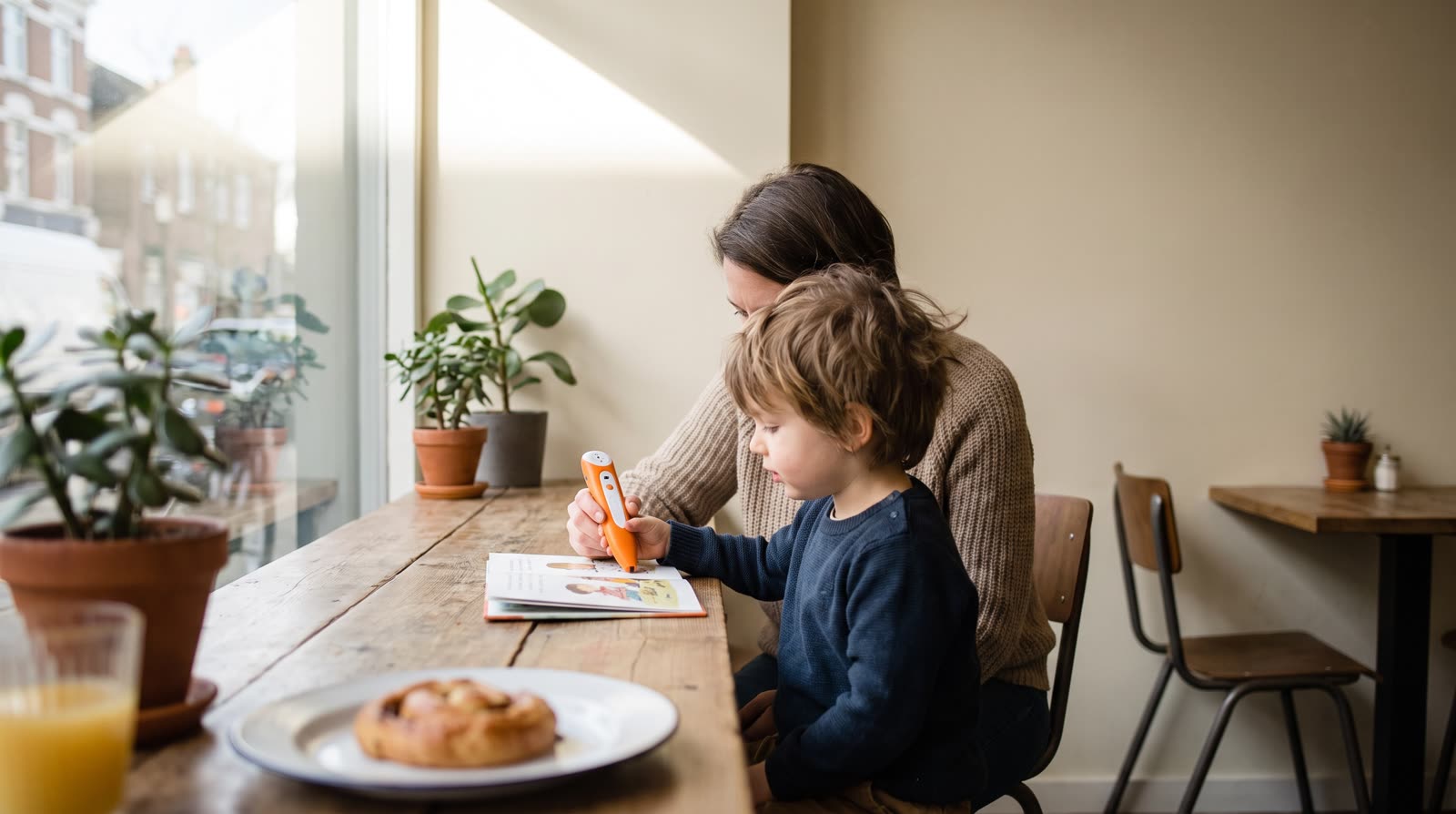
Talking pens utilize sophisticated optical sensor technology to read invisible dot-code grids printed on paper surfaces, instantaneously triggering pre-recorded audio files, sound effects, or character dialogue. When designing these interactive learning ecosystems, instructional designers and product developers must carefully balance autonomous exploration with structured adult scaffolding. If an interactive book relies solely on automated audio playback, children may experience sensory overload or cognitive passivity, wherein they listen to sounds without processing semantic meaning. Integrating guided questions into both the physical book layout and the talking pen's audio track—such as prompting the child to touch a specific illustration and subsequently asking the parent to discuss the word's meaning in everyday life—creates a powerful hybrid learning model. B2B stakeholders must evaluate how hardware specifications, acoustic clarity, and prompt pacing support collaborative reading routines, ensuring an optimal balance between technological convenience and meaningful human interaction.
2. Frameworks for Tracking Lexical Growth Through Daily Reading
Observational Markers and Contextual Usage
Tracking vocabulary progress in early childhood is fundamentally different from standardized academic testing or rigid memorization quotas; rather, it involves observing functional language use in natural, everyday contexts. Parents can effectively track a child's lexical growth by monitoring four key behavioral indicators: comprehension (responding appropriately to a newly introduced vocabulary word during conversation), spontaneous production (using the word correctly in a novel sentence outside the original story context), morphological adaptation (applying suffixes or prefixes learned through story exposure), and conceptual breadth (recognizing and applying the word across different thematic settings). Educational toy manufacturers and publishers can actively support this observational process by including structured parent reflection logs, milestone tracking charts, or detachable activity cards in product packaging, providing gentle, non-intrusive prompts for weekly vocabulary reviews and conversational check-ins.
Designing Structured Checkpoints Without Academic Pressure
Excessive testing can induce performance anxiety and diminish a child's intrinsic enjoyment of reading, which runs counter to long-term literacy goals. Consequently, tracking frameworks must prioritize low-stakes, play-based engagement. B2B publishers designing companion guides should emphasize qualitative observation over quantitative scoring. For example, rather than asking parents to administer formal vocabulary quizzes, guided questions can encourage natural conversational reflection: 'Can you remember where we encountered a word like courageous earlier this week?' This approach aligns closely with guidance from Google’s helpful content standards (Google Creating Helpful Content), ensuring that product documentation, marketing materials, and supplementary educational guides genuinely serve the user's need for practical, stress-free insights that foster healthy developmental habits.
3. Hardware, Software, and Safety Considerations for B2B Partners
Ensuring Ergonomic Safety and Battery Compliance
When sourcing children's electronic learning aids such as talking pens and interactive picture books, international B2B distributors, wholesalers, and retail buyers must maintain rigorous adherence to global safety standards. Electronic devices intended for young children must secure, tamper-resistant battery compartments secured with mechanical fasteners, non-toxic food-grade ABS plastics, and rounded ergonomic profiles to prevent physical strain during extended gripping and handling. As outlined by the Consumer Product Safety Commission (CPSC Children's Products Guidelines), manufacturers must ensure third-party laboratory verification for electrical safety, small parts hazards, and chemical composition limits. End users should perform low-risk external inspections prior to each reading session; if any electronic device exhibits structural damage, battery overheating, moisture ingress, or unusual odors, operation must cease immediately without attempting unauthorized disassembly or modification.
Software Compatibility, Book Code Integrity, and Version Control
Interactive reading systems depend entirely on seamless synchronization between optical dot codes printed on paper and firmware data stored within the talking pen. B2B buyers evaluating manufacturing partners must verify that firmware update protocols, audio file management systems, and dot-code printing resolutions adhere to strict quality assurance benchmarks. Variations in printing density, paper stock absorbency, or coating thickness can disrupt optical sensor recognition, leading to playback errors, audio lagging, and user frustration. Establishing clear specifications for book code compatibility, multi-language audio packs, and memory expansion prevents supply chain bottlenecks and ensures consistent, reliable end-user experiences across competitive international retail markets.
ReadGlo project support
Send Your Requirements
Looking to integrate customizable talking pens and interactive picture books into your publishing or retail catalog? Share your project specifications with our engineering team today.
4. Special Considerations for Diverse Learners and Developmental Needs
Adapting Guided Questions for Children with Language Variations
Every child develops language skills at an individualized pace. For children experiencing speech delays, attention differences, or reading difficulties, standardized developmental milestones can sometimes prove misleading or discouraging. It is vital to emphasize that educational tools, talking pens, and guided questions are designed to support engagement and shared reading enjoyment rather than diagnose or treat medical or developmental conditions. When children exhibit persistent difficulties in expressive language, auditory processing, or social communication, parents and educators should consult qualified pediatric specialists, speech-language pathologists, or educational psychologists. Publishers and manufacturers must incorporate clear, transparent disclaimers in user manuals and packaging, noting that interactive tools serve as supplementary learning aids and do not replace professional clinical intervention.
Multilingual and Dual-Language Learning Support
In increasingly interconnected global markets, dual-language and multilingual households represent a rapidly expanding demographic. Talking pens equipped with multi-audio switching capabilities allow children to hear stories in both their native language and a target foreign language, reinforcing cognitive flexibility and linguistic breadth. Guided questions can be specifically tailored to encourage cross-linguistic comparison—asking children to identify cognates, compare narrative themes, or discuss how different cultures express specific emotional concepts. B2B brands partnering with ReadGlo benefit from flexible firmware architectures that accommodate multi-language sound banks, enabling seamless product localization for diverse geographic regions and educational institutions.
5. Supply Chain Verification, Sourcing Protocols, and Customization
Evaluating Manufacturing Competence and Quality Control
For B2B importers, toy distributors, and educational suppliers, selecting a reliable manufacturing partner involves auditing production workflows from raw material sourcing to final packaging. Key evaluation criteria include optical dot-code printing precision, speaker acoustic clarity, firmware stability, and environmental durability testing under simulated transport conditions. Buyers should request comprehensive technical data sheets, inspect physical golden samples, and verify compliance with regional toy safety regulations such as ASTM F963, EN71, and RoHS. Establishing transparent communication channels regarding custom artwork integration, OEM/ODM packaging requirements, and firmware localization ensures long-term commercial success and brand trust.
Best Practices for Sample Review and Pre-Shipment Inspection
A disciplined sample review process protects brand reputation and minimizes post-sale return rates across international supply chains. B2B procurement teams should implement a multi-stage evaluation protocol covering functional testing (battery charging cycles, optical sensor responsiveness, volume control limits), tactile evaluation (button durability, plastic texture, grip comfort), and content verification (audio synchronization, translation accuracy in guided question prompts). By conducting thorough pre-shipment inspections against agreed-upon master samples, international buyers safeguard product quality and maintain consumer trust across global distribution channels.
Frequently Asked Questions
How do guided questions enhance vocabulary acquisition during interactive reading sessions?
Guided questions encourage active cognitive processing by prompting children to explain concepts, predict narrative outcomes, and apply new words in conversational contexts rather than passively listening to audio playback.
Can talking pens and picture books replace professional speech therapy for children with language delays?
No. Talking pens and guided reading materials are designed as supplementary educational aids. They do not diagnose, treat, or cure speech disorders or developmental delays. For persistent concerns, parents should consult qualified healthcare professionals or speech-language pathologists.
What safety guidelines should B2B buyers review for electronic children's products?
Buyers should verify compliance with international toy safety standards such as CPSC, ASTM F963, and EN71, ensuring secure battery compartments, non-toxic materials, and robust electrical insulation. Routine external inspections should be conducted, and damaged devices must be taken out of service immediately.
How can international distributors ensure book code compatibility with talking pen firmware?
Distributors must coordinate closely with manufacturers to maintain precise optical dot-code printing resolutions, strict version control for audio data packets, and rigorous pre-shipment sample testing to prevent sensor misalignment.
What factors should be considered when localizing guided questions for different linguistic markets?
Localization requires adapting not only vocabulary translations but also cultural nuances, syntax structures, and age-appropriate comprehension levels to ensure the guided questions resonate naturally with target family demographics.
Conclusion
Tracking a child's vocabulary progress using guided questions represents a powerful synthesis of interactive technology and evidence-based pedagogy. For B2B partners, publishers, and educational distributors collaborating with ReadGlo, offering well-designed talking pens and picture books equipped with thoughtful questioning frameworks provides immense value to families and educators worldwide. By prioritizing safety compliance, ergonomic design, flexible multi-language firmware, and stress-free observational tracking, industry stakeholders can deliver exceptional educational solutions that foster lifelong reading enjoyment. We invite prospective partners, distributors, and educational institutions to connect with our team to discuss customized manufacturing, OEM/ODM solutions, and collaborative product development opportunities.
Continue your research
Related reading pen buyer guides
Use these related guides to compare the next product, content, sourcing or channel decision in your project.
- Early LearningHow can parents track a child's vocabulary progress using a 10-minute routine?Read this guide
- Early LearningHow Can Parents Use Reading Pen Books at a Restaurant During Morning Routines?Read this guide
- Early LearningHow Can Parents Track a Child's Vocabulary Progress Using a Reading Pen and Picture Books Together?Read this guide
Continue with ReadGlo
See a DOT-code picture-book set designed for guided early-learning programs.
ReadGlo project support
Get a Quote
Contact our B2B specialist team to request product samples, catalog details, and tailored manufacturing proposals for your educational brand.