
Contents
Introduction
Navigating public dining environments with young children often presents a complex challenge for parents who strive to balance family connection, table manners, and peaceful social atmospheres. In an era dominated by glowing digital screens and passive mobile video consumption, families increasingly seek tactile, screen-free alternatives that keep children calmly engaged while stimulating cognitive and linguistic growth. For B2B distributors, educational toy brands, and publishing houses, interactive reading systems—comprising optical reading pens and specially coded talking books—represent an ideal portable learning solution. This comprehensive guide examines how parents can effectively integrate talking pen books into restaurant routines, the operational and structural considerations for B2B procurement partners, and best practices for product handling, acoustics, and adult supervision. Drawing from established child development frameworks and consumer product safety standards, this article outlines actionable strategies for fostering early literacy during out-of-home dining experiences without relying on unverified claims or exaggerated commercial promises.
The Role of Portable Audio Literacy in Out-of-Home Settings
Why Screen-Free Alternatives Matter During Public Outings
Modern family outings frequently involve extended waiting times at restaurants, family gatherings, and cafes before meals are served. While digital tablets and smartphones are commonly deployed to pacify young children, educators and developmental psychologists increasingly caution against passive screen dependency. Unlike digital video viewing, which isolates the child behind a glowing display, interactive reading systems combine physical touch, visual tracking, and synchronized audio narration. This multi-sensory engagement stimulates vocabulary acquisition, phonemic awareness, and narrative comprehension while keeping the child anchored in the physical environment. For B2B distributors, educational toy brands, and publishing houses, designing products that bridge home-based learning with portable, out-of-home utility represents a high-value market segment. When children interact with optical code-enabled paper using an ergonomic talking pen, they actively decode words, sound effects, and musical snippets, fostering independent exploration and active concentration without the neurological overstimulation associated with fast-paced video content.
Designing Lightweight, Travel-Friendly Talking Pen Hardware for Families
The hardware architecture and industrial design of a talking pen intended for restaurant or travel use must prioritize ergonomics, portability, and robust durability. Manufacturers collaborating with B2B clients must engineer compact, lightweight form factors that slip effortlessly into diaper bags, travel backpacks, or stroller compartments without adding burdensome bulk. Key mechanical considerations include textured anti-slip exterior grips, recessed optical sensor lenses protected against scratching from tabletop debris, and tactile physical buttons for power and volume adjustment that resist accidental actuation in crowded bags. Furthermore, integrating standardized USB-C charging ports or accessible battery compartments ensures long-term usability and universal compatibility with modern charging accessories. Educational brands and retail buyers sourcing such hardware must evaluate supplier capabilities in drop-resistance testing, mold engineering, and strict adherence to international safety standards such as CPSC guidelines for children's products.
Preparing and Organizing Reading Pen Books for Restaurant Use
Pre-Loading Audio Files and Managing Storage Systems
A successful restaurant reading session depends heavily on preliminary preparation by parents or caregivers before leaving home. Before embarking on family outings, adults must ensure that the appropriate audio files—typically structured in specific folder directories or OID optical identification formats—are correctly loaded onto the talking pen's internal flash memory or expandable TF card. If a talking pen model supports multiple book titles, organizing a compact playlist or selecting a single, highly engaging storybook prevents decision fatigue and table clutter. Retailers, publishers, and hardware manufacturers providing these systems should supply clear, multilingual instruction manuals and intuitive desktop or mobile companion software that simplifies audio package downloads and firmware management for end-users. Ensuring seamless file management and clear folder structures reduces user friction, minimizes technical frustration, and enhances overall product satisfaction.
Selecting Durable, Spill-Resistant Board Books and Laminated Pages
Restaurants present unique physical hazards for paper products, including accidental spills of water, juice, milk, or food condiments such as sauces and syrups. Consequently, selecting the correct book format and paper grade is critical for out-of-home usage. Sturdy board books constructed with multi-layer heavy cardboard, rounded safety corners, and matte anti-glare lamination withstand restaurant environments far better than standard softcover paperbacks. The optical dot codes printed beneath or alongside illustrations must remain scannable even under variable restaurant lighting conditions, ranging from dim romantic dining areas to bright patio settings. B2B buyers, educational publishers, and printing partners should prioritize advanced printing technologies that utilize eco-friendly, non-toxic UV coatings and scratch-resistant soy inks, ensuring that interactive pages maintain optical readability and structural integrity despite frequent handling.
Step-by-Step Strategies for Restaurant Quiet Time Engagement
Establishing Clear Expectations Before Arriving at the Venue
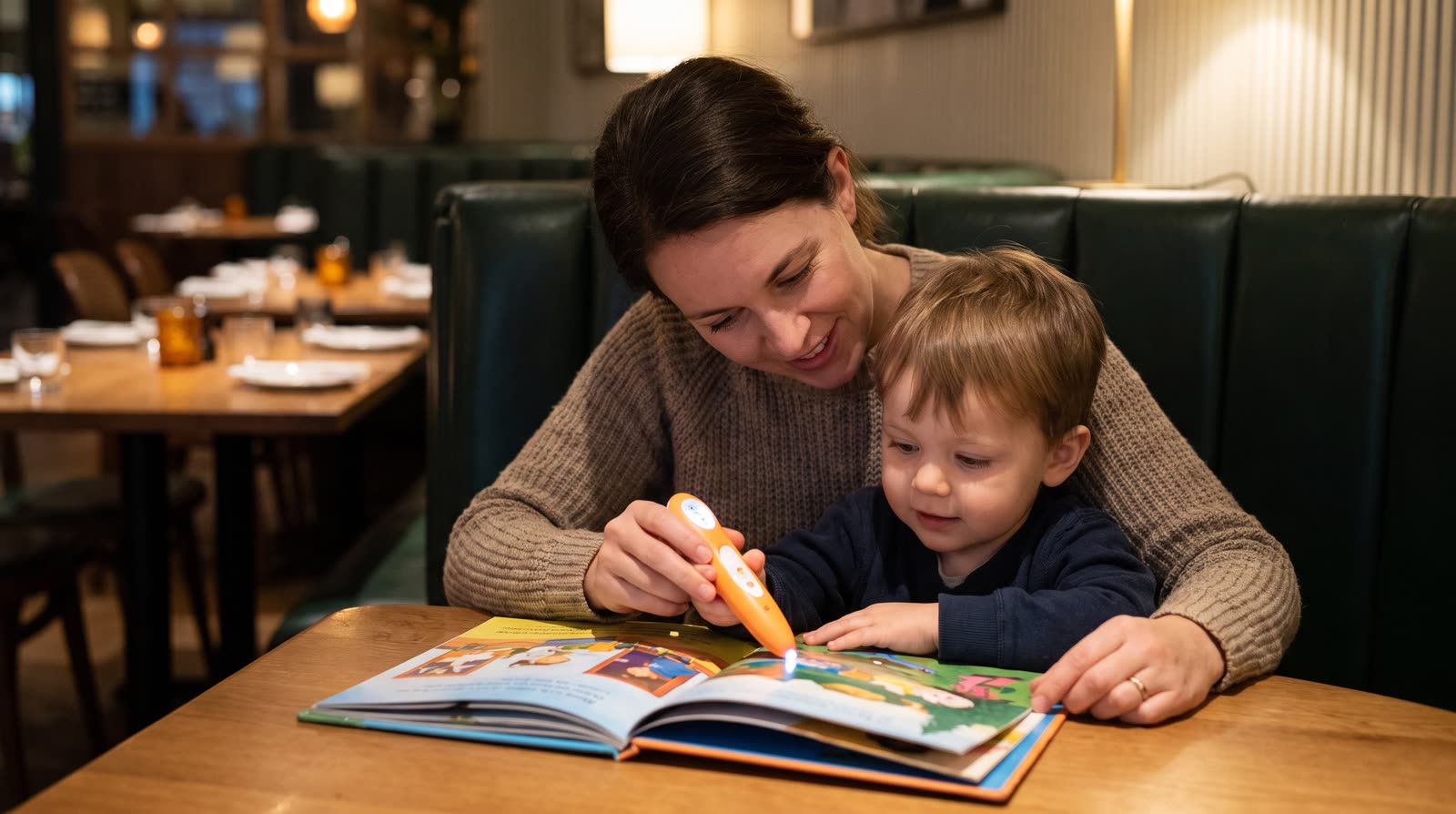
Transitioning from active play or travel transit to seated quiet time at a restaurant requires deliberate communication and proactive expectation-setting between parents and children. Caregivers can introduce the talking pen book as a special 'restaurant travel companion' before entering the establishment. By establishing clear behavioral routines—such as opening the book only after sitting down at the table and using the pen in a gentle tapping motion rather than pressing aggressively—children learn respectful behavior in shared public spaces. Educators recommend pairing these physical tools with gentle adult scaffolding, where parents take turns pointing to pictures, asking open-ended questions about story characters, and encouraging children to imitate spoken sounds, dialogue, or songs in subdued tones.
Utilizing Headphone Accessories and Low-Volume Settings in Public Spaces
Polite dining etiquette in shared public spaces requires constant mindfulness regarding ambient noise levels. While modern talking pens feature high-definition built-in speakers optimized for clear speech reproduction, restaurant dining rooms can amplify sound or cause unnecessary disturbances for neighboring patrons. To address this, manufacturers and retail brands should offer compatible 3.5mm wired or Bluetooth headphone accessories equipped with built-in volume-limiting technology designed specifically to protect children's sensitive hearing health. Alternatively, parents can configure the pen's default speaker volume to its lowest audible setting or utilize dedicated headphone splitters when siblings share a reading session at the table. Providing comprehensive guidance on acoustic management adds substantial value to B2B product offerings across the hospitality and family-dining sectors.
Structuring Short, Interactive Touch-and-Listen Sessions Between Courses
Waiting for food orders to be prepared and served is universally recognized as the most challenging interval during restaurant dining with young children. Rather than expecting continuous, uninterrupted independent reading for an hour, caregivers can structure this waiting period into manageable 10-to-15-minute interactive learning segments punctuated by conversation. Parents can guide children through specific book activities—such as locating hidden sound triggers, listening to vocabulary lists in foreign languages, or participating in simple rhyming games encoded on the page. According to early literacy research and developmental guidelines highlighted by organizations such as the American Academy of Pediatrics (AAP), shared parent-child verbal interactions around books significantly boost language acquisition, emotional regulation, and cooperative behavior during daily transitions.
ReadGlo project support
Request Product Catalog
Explore ReadGlo's complete range of customizable talking pens, interactive board books, and OEM/ODM manufacturing solutions for your brand.
Safety, Durability, and Product Care Guidelines for Portable Electronics
External Inspection and Battery Safety for Portable Electronics
Portable electronic learning devices utilized by young children in public settings must meet rigorous product safety protocols and quality assurance standards. Parents and caregivers should perform routine external inspections of the talking pen housing, checking for hairline cracks, loose battery compartment doors, or worn charging cables. Under no circumstances should end-users attempt to disassemble, modify, or repair electronic learning devices independently. If a device exhibits abnormal heating during charging or operation, unusual plastic odors, casing discoloration, or battery swelling, usage must be suspended immediately. The unit should be safely disconnected from all power sources and kept away from flammable materials in accordance with standard electrical safety protocols. Following guidelines established by the Consumer Product Safety Commission (CPSC) for children's products ensures that hardware compliance remains a top priority across the entire manufacturing and supply chain.
Managing Moisture, Spills, and Proper Storage After Outings
Accidental liquid exposure is widely recognized as one of the primary causes of electronic failure in restaurant and cafe settings. If water, juice, or other beverages are accidentally spilled onto the talking pen or interactive board books, parents must act swiftly: immediately power off the device, remove removable batteries or disconnect charging cables, and gently wipe exterior surfaces dry with a clean, lint-free cloth. Electronic devices should never be placed in high-heat appliances such as microwaves or ovens, nor should they be left exposed to direct blazing sunlight for rapid drying. B2B manufacturers can support product longevity by engineering splash-resistant acoustic mesh covers, ultrasonic-welded casing seams, and conformal nano-coatings on internal circuit boards to protect against humidity and minor liquid ingress.
B2B Procurement and Customization Considerations for Retailers and Educators
Evaluating Audio Sound Quality and Speaker Clarity in Noisy Environments
For B2B buyers, toy importers, and educational distributors, selecting the appropriate talking pen hardware involves rigorous evaluation of acoustic performance under real-world operating conditions. Ambient background noise in restaurants, cafeterias, airports, or transit stations places heavy demands on speaker clarity and audio output. Manufacturers must integrate premium audio decoding chipsets, low-distortion amplifiers, and precision speaker drivers capable of delivering crisp, natural human-voice narration and multi-language support. When sourcing manufacturing partners, brands should request detailed acoustic testing reports, frequency response charts, and functional sample prototypes to verify speech intelligibility and acoustic fidelity across diverse vocabulary sets and musical soundtracks before committing to bulk production orders.
Partnering with Manufacturers for Custom Content Integration
Publishing houses, educational institutions, and toy brands frequently require custom content localization, including regional dialects, bilingual audio packages, and proprietary storybook integration. A robust B2B partnership model involves close collaboration between content creators and hardware developers to ensure optical dot code synchronization (such as OID v2, v3, or v4 standards) matches printed book layouts with microscopic precision. Qualified manufacturing partners must offer secure data encryption for audio compilation files, flexible firmware customization, and scalable production schedules that accommodate seasonal retail demands. By streamlining the workflow from manuscript creation to optical printing and pen programming, manufacturers enable global brands to bring reliable, engaging interactive learning tools to market efficiently and securely.
Frequently Asked Questions
Can toddlers use talking pens independently at a restaurant without adult supervision?
While talking pens are designed for intuitive touch interaction, young children require adult guidance—especially in public settings like restaurants—to ensure proper device handling, volume control, and respectful dining etiquette.
How can parents prevent the talking pen from disturbing other restaurant patrons?
Parents can set the device volume to its lowest level before entering the restaurant, utilize volume-limited headphones or earplugs, or engage in quiet, close-range listening sessions where only the child and parent lean in to hear the narration.
What book materials withstand food spills and frequent handling during family dining?
Heavy-duty board books constructed with multi-layer cardboard, rounded corners, and spill-resistant matte lamination are ideal for restaurant outings, as they resist bending, tearing, and minor liquid contact.
What should parents do if a talking pen gets wet from a spilled drink at the table?
Immediately power off the device, remove any external cables or removable batteries, wipe away surface moisture with a dry cloth, and allow the unit to air dry completely before attempting further use or charging.
What factors should B2B buyers consider when sourcing talking pens for portable educational kits?
B2B buyers should evaluate ergonomic form factors, drop resistance, speaker clarity in noisy environments, storage capacity for multiple audio files, and strict compliance with international children's product safety standards such as CPSC and EN71.
How do optical reading pens recognize printed dot codes on interactive book pages?
Talking pens utilize an integrated optical sensor camera at the tip that captures microscopic dot patterns printed beneath the ink, instantly decoding the coordinates and playing the corresponding audio file.
Conclusion
Integrating talking pen books into restaurant routines offers families a balanced, screen-free method to maintain engagement and support early literacy during public outings. By combining thoughtful parental preparation, appropriate book material selection, and adherence to product safety guidelines, caregivers can transform waiting times into enriching learning opportunities. For B2B manufacturers, brand owners, and educational distributors, delivering durable, ergonomically optimized hardware and reliable optical audio systems meets the growing global demand for high-quality, portable educational tools that bridge home and community environments.
Continue your research
Related reading pen buyer guides
Use these related guides to compare the next product, content, sourcing or channel decision in your project.
- Early LearningBridging Home and Classroom: Integrating Interactive Reading Pens into Kindergarten Morning RoutinesRead this guide
- Early LearningHow Can Parents Use Reading Pen Books at a Restaurant During Travel?Read this guide
- Early LearningBridging Home and Kindergarten: How Portable Reading Pen Systems Support Mobile Learning and TransitRead this guide
Continue with ReadGlo
See a DOT-code picture-book set designed for guided early-learning programs.
ReadGlo project support
Get a Custom Quote
Partner with ReadGlo to develop high-quality, safe, and engaging interactive literacy products tailored to your educational market requirements.