

Contents
Quick Answer: Where Can You Find a Reliable Children’s Talking Pen Factory in China?
You can build a reliable shortlist through specialist trade-fair exhibitor lists, established B2B supplier directories, product-category referrals, and direct outreach to factories in China’s consumer-electronics and educational-toy supply chain. But a supplier profile, a marketplace badge, or a polished website is only a starting point — not proof that the business can manufacture a safe, repeatable children’s talking-pen system.
The most reliable path is to shortlist several candidates and verify each one in the same order: legal entity and factory address; relevant product experience; quality-system certificate; model-specific compliance documents; factory audit; functional sample; and clear commercial terms. A talking pen is a system, not only a plastic device. It combines electronics, firmware, audio, printed coded books, packaging, batteries, and age-appropriate content. Your due diligence needs to test that entire system.
For overseas buyers, Shenzhen and the broader Pearl River Delta are practical places to begin because electronics, tooling, audio hardware, printing, and export logistics are concentrated there. However, location alone does not make a supplier reliable. The evidence a factory can show — and the way it responds to your verification requests — matters much more than a city name.
Four Practical Places to Build Your Shortlist

| Channel | Best use | What it proves | What it does not prove |
|---|---|---|---|
| Trade-fair exhibitor lists | Find product-focused factories and arrange in-person meetings | The company participates in a relevant commercial event | That it owns the factory, can meet your spec, or has valid documents |
| B2B supplier directories | Create a broad first shortlist and compare stated capabilities | The company has an active commercial profile | That claims, audits, product photos, or certificates are current and model-specific |
| Industry referrals | Find candidates with experience in a known market or language pair | Someone has worked with the supplier before | That your project, quality level, and target-market rules are the same |
| Direct factory outreach | Test responsiveness, technical understanding, and document readiness | How a candidate handles your real requirements | That the factory has been independently audited |
Use discovery channels to find candidates; use due diligence to choose among them.
Start broad, then narrow quickly. Ask every candidate the same first-round questions: “Are you the legal manufacturer or a trading company?”, “Which talking-pen models and compatible book systems do you currently produce?”, “Which markets do you serve?”, “Can you share the factory address, legal company name, and an overview of your quality process?”, and “Can you support the target language, coded-book workflow, and compliance path for our market?”
Do not eliminate trading companies automatically; a capable trading partner can be useful for consolidation or a portfolio of products. However, do not confuse a trader with a factory. If direct production control, firmware collaboration, sample iteration, and long-term product ownership matter to your brand, you need transparent access to the actual manufacturing site and technical team.
A strong first response is specific. It identifies the proposed product platform, asks focused questions about your age grade, languages, book quantity, order forecast, and destination market, and explains what must be confirmed before quoting. A vague response that promises every feature, every certificate, and every MOQ without questions is a risk signal.
How Do You Tell a Real Factory from a Trading Company?
The question is not whether a company has a showroom, a sales office, or professional product photography. The question is whether it controls the steps that determine your product’s quality and repeatability. For a children’s talking pen, those steps often include supplier control for electronic components, firmware loading, audio and code-file management, plastic assembly, functional testing, battery handling, book-code compatibility testing, final inspection, and export documentation.
Ask for evidence that is difficult to fake at scale: a video call from the production floor; a walk-through of incoming inspection, assembly, aging or functional test stations, and finished-goods storage; photos or video showing the factory name at the site; a process flow for your proposed model; and the identity of the engineer who will own technical questions. The goal is not to conduct an adversarial interview. It is to establish whether the people quoting your project understand and control the work.
Also check commercial transparency. The legal entity on the quotation, purchase contract, bank account, certification, and export paperwork should be explainable. If names differ, ask why and document the relationship before paying a deposit.
How Should You Verify ISO 9001, Test Reports, and Compliance Claims?
| Claim to verify | Request from the supplier | Independent check | Decision rule |
|---|---|---|---|
| ISO 9001 quality system | Legal company name, site address, certificate number, scope, expiry date | Search the company or certificate in IAF CertSearch | Confirm the certified site and scope match the factory that will produce your order |
| EU toy compliance | Risk assessment, technical file index, test reports, Declaration of Conformity, CE-marking artwork | Match the model, age grade, components, and target market to your product specification | Do not accept a generic ‘CE certificate’ from a different model |
| U.S. children’s-product compliance | CPSC-accepted-lab reports and draft Children’s Product Certificate (CPC) | Check the CPC fields and lab status against CPSC guidance | Confirm the documents identify your final product and applicable rules |
| Battery, charger, or wireless features | Applicable reports and component specifications | Review with your laboratory or compliance adviser for the destination market | Treat changed batteries, chargers, radio modules, or enclosures as potential retest triggers |
A document is useful only when it matches the factory, model, market, and current production configuration.
A quality-system certificate is not a product safety certificate. ISO 9001 may be a useful signal that the factory has an audited quality-management system, but it does not prove that a particular talking pen meets the rules in your destination market. Verify the certificate independently. IAF CertSearch lets buyers look up certificates by company name or certificate details, including validity, relevant sites, scopes, and certificate status. [1]
For the EU, all toys sold on the market must carry CE marking. The European Commission explains that this is the manufacturer’s declaration that the toy satisfies the essential safety requirements; the applicable framework covers physical, mechanical, chemical, electrical, hygiene, and other risks. [2] For a talking pen, review the finished system rather than only the pen shell: include battery, charging method, electronics, intended age grade, book set, packaging, warnings, and any radio feature.
For U.S.-bound children’s products that are subject to CPSC rules, the importer or domestic manufacturer must issue a Children’s Product Certificate based on applicable third-party test results. CPSC guidance specifies the information that must be tied to the product, rules, certifying firm, manufacturing location, testing, and laboratory. [3] Ask for model-specific evidence, not a folder of unrelated PDFs.
What Must a Children’s Talking Pen Factory Be Able to Control?
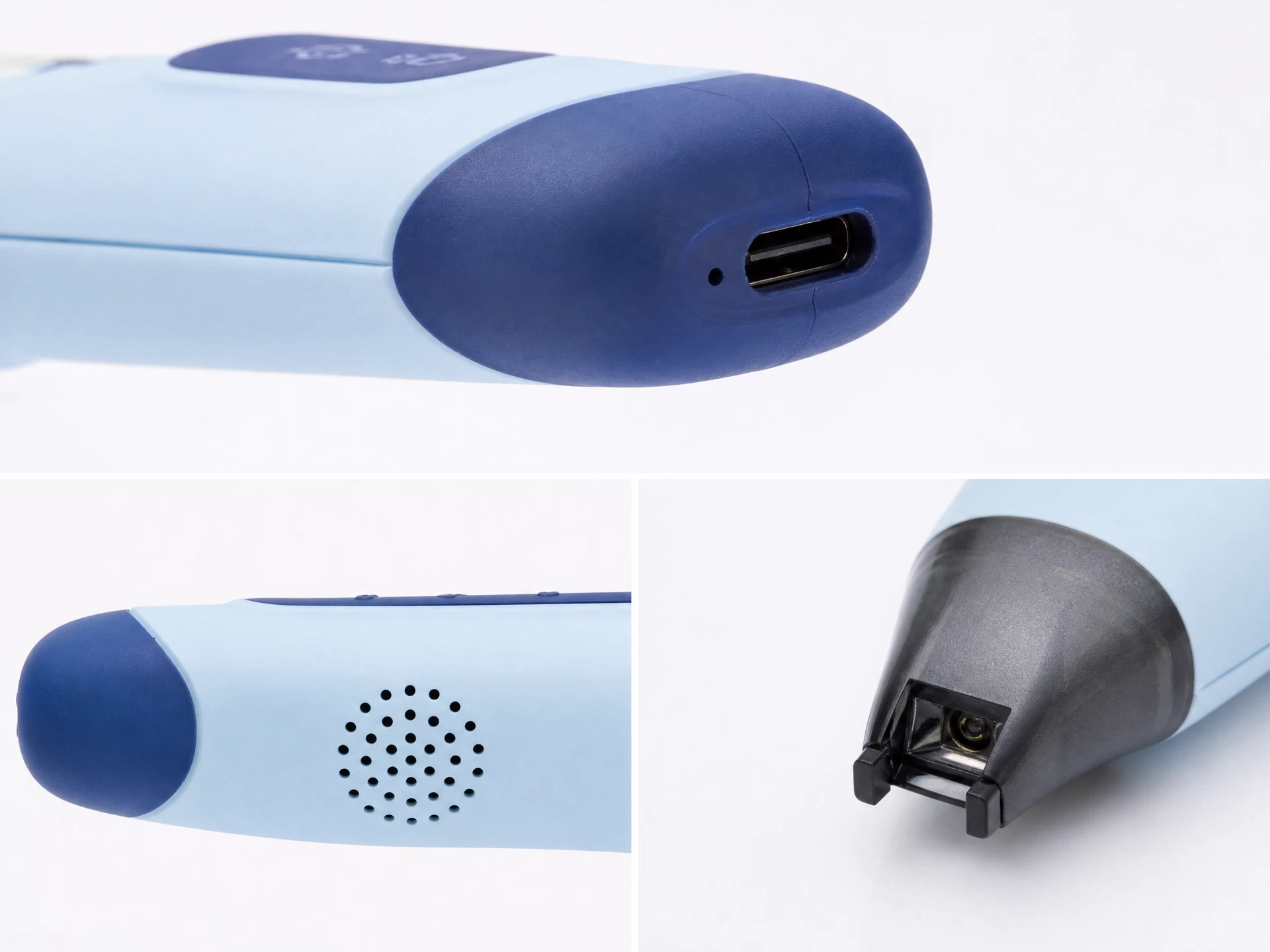
A talking pen factory should be able to explain the complete interaction from a child touching a book to hearing the correct audio. That means the supplier needs a controlled method for coded-print generation, audio-file naming and loading, firmware version management, language switching, volume and playback checks, and final compatibility testing with the exact books in your set.
Ask who owns each element. Is the firmware written in-house or by an external party? Who creates and validates the code map for books? How are audio revisions approved? Can the supplier preserve your project files and release notes? How does it prevent the wrong audio pack from being loaded into a production batch? These questions reveal whether the supplier has a real content-and-firmware workflow or is only assembling generic hardware.
For a custom program, ask for a written interface between your team and the factory: content-delivery format, file-naming convention, audio acceptance standard, design sign-off stages, language review responsibility, and a defined process for firmware updates after launch.
How Should You Audit a Factory and Evaluate Samples?

A factory audit can be completed in person or through a structured remote visit, but it should follow a checklist. Confirm the legal site, production layout, key processes, incoming material control, traceability, functional testing, quality records, rework control, and finished-goods handling. Ask to see normal work in progress, not only a prepared sample room. If your order is significant or your product is highly customized, use an independent third-party inspection before deposit, during production, and before shipment.
The sample stage is where a shortlist becomes a commercial decision. Test every claimed feature with the real book files and intended language pack. Check touch accuracy near page edges, audio clarity, volume limits, battery charging, sustained playback, button feel, drop resistance, case fit, book durability, packaging, labels, and whether the pen reacts correctly after repeated use. Record defects in a shared sample-approval file.
Once approved, turn that sample into a golden sample. The golden sample, approved artwork, firmware version, audio package, book files, bill of materials, inspection plan, and carton markings should all be frozen in writing before mass production.
A Simple Scorecard for Comparing Talking-Pen Suppliers
| Evaluation area | 0 points | 1 point | 2 points |
|---|---|---|---|
| Factory identity | Unclear legal entity or site | Address supplied but site proof limited | Legal entity, production site, and roles transparently verified |
| Talking-pen system capability | Generic product claims only | Working samples but weak documentation | Controlled pen, firmware, audio, and book-code workflow demonstrated |
| Quality and compliance | Generic or expired PDFs | Some relevant documents but gaps remain | Current, model-specific, independently checkable evidence |
| Sample quality | Features fail or vary | Works with minor issues | Passes written functional and user-experience tests |
| Commercial discipline | Unclear scope, ownership, or terms | Quote is complete but assumptions are vague | Clear scope, ownership, lead time, change control, and after-sales plan |
Score each candidate from 0 (no evidence) to 2 (clear, independently checkable evidence). Use the total to guide the next step, not to replace judgment.
Do not select a factory solely because it quoted the lowest unit price. A lower number can hide omitted testing, lower-grade components, unstable firmware, weak book-code control, or an impractical post-launch support model. The best commercial choice is usually the supplier with the clearest evidence, the least ambiguity, and the lowest total risk for your market launch.
For each shortlisted supplier, keep a single comparison folder containing the quotation, bill-of-material assumptions, technical answers, certificate checks, audit notes, sample report, timeline, and negotiation record. This creates an audit trail for internal approval and prevents teams from making a decision based only on memory or sales messages.
Seven Red Flags That Should Slow the Buying Process
A reliable supplier may not be perfect, but it should be candid about gaps and willing to close them. Pause and investigate when you see the following patterns.
- Generic documents: The report image, company name, model number, battery, or test date does not match the product being quoted.
- No factory transparency: The candidate will not provide a legal company name, factory address, audit access, or a live production walkthrough.
- Unrealistic promises: Every language, certification, function, MOQ, and lead time is approved immediately without technical questions.
- No ownership clarity: The supplier cannot explain who owns firmware, audio, book files, tooling, and source materials after payment.
- Sample-to-production gap: The sample is assembled manually, but the factory cannot explain how the same configuration will be controlled in mass production.
- Compliance treated as an add-on: The supplier says “CE/FCC available” but cannot identify the target-market rules or finished-product documentation needed.
- Payment pressure before proof: The business asks for a large deposit before documents, a sample plan, or basic commercial terms are agreed in writing.
Each red flag is a reason to request more evidence, not an automatic accusation. A well-managed manufacturer will usually welcome a buyer who has a disciplined approval process.
Looking for a Children’s Talking Pen Supplier? Start with a Transparent Technical Discussion
If you are sourcing a private-label children’s talking pen, begin with a documented requirement set: destination market, target age, language combination, book quantity, audio format, expected annual volume, target retail channel, customization level, and proposed launch date. This gives every factory a fair basis for a comparable quotation.
ReadGlo supports OEM and ODM talking-pen and interactive-book programs from Shenzhen, China. We can discuss product platforms, custom firmware and audio workflows, compatible coded-book production, samples, compliance planning, and the documentation your team needs to evaluate a factory relationship. Contact us at info@readglo.com with your target market and product brief.
The right factory is not simply the one that says yes first. It is the one that can prove — step by step — how it will deliver a safe, consistent, and market-ready talking-pen system for your brand.
Continue your research
Related reading pen buyer guides
Use these related guides to compare the next product, content, sourcing or channel decision in your project.
Continue with ReadGlo
See product specifications and request model-specific documentation.