Contents
Direct answer
Choose a children's reading pen by evaluating the complete book-and-audio experience, not the device alone. Confirm which printed editions it supports, whether children can control it comfortably, how authorized content is prepared, and what evidence covers the final market configuration. Then compare suppliers on the same bundle, sample checks, responsibilities and commercial terms before committing to a wholesale or custom project.
Start with the activity your customer will buy
A publisher, retailer and school may all request a talking pen while expecting different products. The publisher wants reliable interaction with its own titles. The retailer needs an understandable set that works as customers expect after opening the box. The school needs a manageable resource for a defined activity, with adult preparation and support accounted for.
Describe that activity before selecting a housing or requesting prices. Specify the intended age group, language, setting, adult involvement and learning materials. State whether the child should explore illustrations, replay vocabulary, listen to a story or respond to a prepared activity. These are design requirements, not promises of educational improvement.
Separate launch essentials from optional requests. If picture-led listening is the core activity, a display, wireless connection or user-recording feature should earn its place by solving an identified problem. Added functions can change controls, content preparation, support and market review. Their availability must be confirmed for the selected configuration.
Establish what the pen can actually recognize
Coded-book playback is not ordinary-text scanning
For the coded-book category discussed here, the pen identifies an intended printed code or region and plays mapped, prepared audio. It does not follow that an uncoded paperback, worksheet or book from another system will work. Nor does prepared bilingual playback establish automatic translation.
Reading Rockets' expert explanation distinguishes system-specific audio-pen books from scanning devices.[1] Its named product examples are historical, not a current compatibility catalogue. The practical buying lesson remains useful: ask which system you are buying before asking how many books it can read.
Request proof on the editions you intend to sell
List each launch title and language edition alongside the proposed device and content package. Include print revisions where available. Ask what book preparation, mapping and loading are required, who provides them, and what evidence can demonstrate the intended pairing.
During sample review, select interactions that represent the actual book design: different illustration areas, adjacent targets and page layouts. Compare the intended response with what plays. Distinguish no response, incorrect audio and ambiguous touch placement; each presents a different buyer problem. Record untested titles rather than assuming one successful demonstration validates the collection.
If you already have books or pens to retain, use ReadGlo's book–device compatibility review. It organizes a named pairing question; it is not a universal retrofit, cross-brand integration or compatibility promise.
Review the child-facing experience before the feature list

Handling and controls
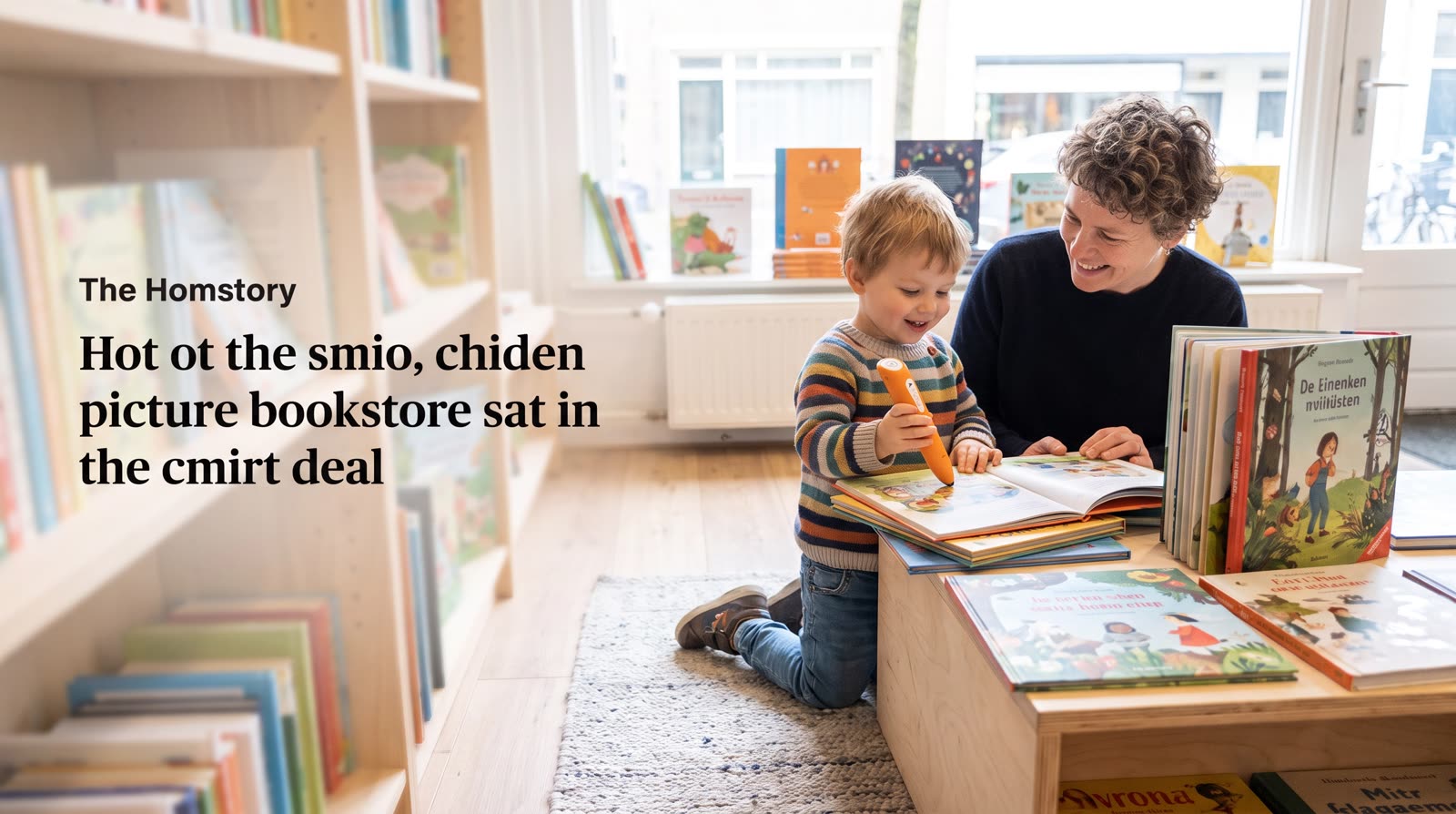
During an appropriately supervised evaluation, observe whether the intended users can hold the sample, place its tip on a target and discover the controls. Consider the combined effect of grip, weight distribution, button placement and printed target size. A playful shape can attract attention while still making pointing awkward.
Check how children recover after an accidental button press or unintended tap. Can an adult explain the operation simply? Are volume changes understandable? Does switching an approved language require an action that users can find? Agree evaluation conditions and criteria before comparing samples; do not invent a universal response-time or usability threshold.
Speech, prompts and power
Listen to speech at the intended listening position and across the proposed volume settings. Evaluate pronunciation, clipping, distracting effects and whether prompts are understandable. Loudness is not a substitute for intelligibility, and subjective listening does not establish acoustic safety compliance.
Examine first use, shutdown and low-power behavior against the intended instructions. Clarify the charging connector, supplied cable, permitted power source and whether a charger is included. Charging and data transfer are separate functions even when a connector looks familiar. Runtime, battery capacity, headphone support and charging behavior need confirmation on the final device and accessories.
Buy a useful content programme, not a large library claim
A long title list has limited value if the books do not fit the intended readers or cannot be supplied in the required editions. Review subject matter, language difficulty, illustration clarity and the relationship between printed content and narration. Ask which titles are included at launch, which are optional, and which are merely proposed.
For your own books, choose one representative spread to define the interaction. Specify which regions should play a word, explanation or longer recording. Do not assume every printed sentence is independently selectable. ReadGlo's publisher project route provides an existing starting point for title, asset and audio-mapping questions.
Size memory from approved content
Ask for a content inventory showing the recordings, languages, prompts and proposed additions. Request an estimate based on the agreed encoding and loading route. A memory figure by itself does not explain usable capacity, how content is installed or whether future packages will remain compatible.
Differentiate supplier-loaded publisher audio from user recording. If recording is requested, define who records, how recordings are accessed or deleted, and any consent or data-handling responsibilities. Do not assume recording stickers, an app or a microphone are included.
Keep editorial acceptance separate from permissions
A language reviewer should check scripts, pronunciation and narration against the intended edition. A rights reviewer must separately establish permission for text, artwork, translations, performances, music and recordings. WIPO explains that reproduction, translation and recording can involve distinct rights, and online availability is not general permission.[2]
For any proposed Quran content, check each relevant text, translation, recitation or recording, and layout asset against seven elements: rightsholder, territory, medium/use, language, term, attribution and written permission. Obtain appropriate buyer-appointed editorial or religious review separately. Neither technical playback nor a supplied file establishes rights clearance or religious approval; seek qualified advice where needed.
Compare suppliers through purchasing decisions
| Your purchasing situation | Evidence or clarification to request | Sensible next decision |
|---|---|---|
| You want an existing set with your branding | Exact contents, permitted branding changes, instructions and a representative packed sample | Compare the defined private-label route before requesting redesign |
| You own books and authorized audio | Proposed print–pen pairing, mapping responsibilities and sample coverage | Establish feasibility before committing the whole collection |
| You need a different interaction or housing | A response to the design problem, development deliverables and ownership terms | Compare development scope separately from repeat production |
| You are evaluating mixed-language bundles | Edition list, language-selection behavior and reviewer-approved audio | Resolve language and pack-content differences before comparing totals |
| Your reference sample fails an essential action | Recorded symptom, affected items, proposed correction and repeat-check evidence | Pause the affected commitment until the issue is resolved |
| You expect expansion titles after launch | Future-content process, access dependencies and support responsibilities | Decide whether the proposed lifecycle arrangement fits your business |
Buyer decision aid; confirm the proposed configuration and responsibilities separately.
Swipe horizontally to view all columns.
A talking pen manufacturer should explain how the proposed product will be delivered, not merely repeat catalogue features. Identify the contracting party and the parties responsible for hardware, printing, coding, audio preparation, packaging and export. A supplier label or factory photograph does not establish ownership of every production activity.
Use the following table to decide what to request next. It is a buyer-created decision aid, not a supplier ranking or an automatic approval system.
Ask each shortlisted supplier to distinguish confirmed answers from feasibility questions. An honest limitation can be more useful than an attractive specification sheet that leaves the printer or buyer responsible for integration.
Planning a custom project? Use ReadGlo's OEM/ODM project page or email info@readglo.com with your intended users, market, reference direction, titles and requested changes. Feasibility, deliverables, quantities and commercial terms require separate written confirmation.
Move from sourcing research to a scoped OEM inquiry
Share the proposed device, branding, book or card scope and target market. Requested configurations and commercial terms need separate confirmation.
ReadGlo project support
Send Your Reading-Pen Requirements
Share a non-confidential summary of your market, intended activity, content readiness and quantities. Requested capabilities, samples and commercial terms require project-specific confirmation.
Open the related procurement routeMatch safety evidence to the product being purchased
Safety review concerns the complete sellable configuration: device, materials, battery, accessories, printed materials, packaging, intended users and claims. Ask the responsible importer and qualified reviewers to identify applicable requirements for the destination rather than treating a list of certification acronyms as approval.
For U.S. children's toys, CPSC identifies ASTM F963 as a mandatory consumer product safety standard and explains that applicable sections must be determined for the specific product.[3] Its guidance addresses issues including sound-producing and battery-operated toys. This does not mean every reading-pen bundle has the same classification or test scope.
Request the report's model references, photographs, relevant component information, laboratory identity, standard edition and coverage. Ask whether the actual proposed battery, accessories, materials and construction match. A similar-looking pen's report is not automatically evidence for your custom set.
Keep three reviews distinct: a functional sample evaluation, a durability or quality programme, and regulatory assessment. A pen that survives a buyer's handling trial has not thereby passed all required safety tests. Inspection criteria and test methods should be agreed with the appropriate parties; no universal drop height, sound limit or battery specification is assumed here.
Understand the cost of a working, supportable set
Compare the same deliverables
Request separate lines for devices, books by edition, accessories and retail packaging. Identify one-off activities such as artwork preparation, mapping, recording, development, tooling and sample work where requested. Mark each as included, separately charged, excluded or awaiting clarification.
Use a common quantity basis and delivery place. Confirm currency, quotation validity, payment terms and freight, tax or clearance assumptions. Different book counts or omitted content preparation can make a lower headline price misleading. The existing quotation-scope guide supports deeper comparison without turning this article into another RFQ-only page.
Minimum quantities and timing belong to the actual configuration. Ask which buyer inputs drive the schedule: approved artwork, authorized recordings, materials, samples or packaging decisions. A requested launch date is not a shipping commitment. Identify dependencies and allow for review and correction rather than treating production as the only stage.
Define support before customers need it
Ask how a distributor or retailer should distinguish a charging problem, missing content and an incompatible book. Request instructions appropriate to the agreed product and identify the escalation contact, evidence needed for a claim and available remedies.
Discuss warranty duration, exclusions, claim handling, replacement logistics and responsibility for customer communication in writing. Do not assume a competitor's warranty or a catalogue statement applies to ReadGlo. Clarify how replacement devices will match existing books and whether additional content preparation carries separate costs.
For new titles, ask who maintains authorized files and supplies compatible content packages. Agree what happens if a platform, component or loading method changes. Future compatibility and support should be explicit business arrangements, not inferred from unused memory or a broad expansion promise.
Prepare a first RFQ that exposes the real differences
A useful first brief can be provisional. Send a non-confidential summary before sharing full manuscripts, recordings or personal information about children. Mark unknowns honestly so suppliers can explain their assumptions.
Use this buyer checklist:
- Identify your company, buyer role, destination, channel and intended user group.
- Describe the core child activity and expected adult preparation.
- Name the reference device or concept and separate essential from optional functions.
- List titles, editions, languages and quantities independently from device quantities.
- State available artwork, scripts, recordings and the status of rights permissions.
- Specify requested book preparation, mapping, loading and packaging responsibilities.
- Define what the first sample must demonstrate and what remains outside its coverage.
- Request final-configuration market evidence and identify the responsible importer.
- Separate recurring supply, one-off work, excluded activities and delivery assumptions.
- Ask for support, replacement and future-content arrangements before order approval.
Review responses by unresolved purchasing risk, not by the number of boxes ticked. A missing answer about launch-book compatibility matters more than an optional feature you do not need.
Frequently Asked Questions
1. Can a children's reading pen read any ordinary book? Do not assume so. A coded-book audio pen needs the appropriate printed interface and mapped content for its system. Ordinary-text scanning is a different category. Ask about the exact editions and device you intend to use; ownership of a book does not establish technical compatibility.
2. Should we select the pen or the books first? Start with the learning activity and content direction, then evaluate both together. Publishers may begin with their titles, while retailers may begin with an existing set. Neither route removes the need to verify the proposed print, device and audio combination before committing to the bundle.
3. Is more memory always a better purchase? No. Compare usable capacity against the agreed library, languages, encoding and future-content plan. Also confirm loading and access arrangements. Extra storage does not create more authorized titles, guarantee new-book compatibility or establish a recording feature.
4. What should happen if the sample plays the wrong recording? Record the affected page or region, intended response, observed response and sample identity. Ask the responsible parties to investigate the relevant print, mapping and content references. Require evidence from the agreed repeat checks before accepting a correction; an assurance that it is fixed is not a demonstrated result.
5. What is the difference between OEM, ODM and private label? Use these labels to begin a scope discussion. Private label can start from a selected reference, OEM from defined requirements, and ODM from a design concept. Confirm the actual deliverables, exclusions, development responsibilities, tooling and reuse rights; the label itself does not settle the contract.
6. Is an existing certificate sufficient for our order? Not by itself. Have the responsible reviewer determine whether the evidence covers the final product, applicable requirements and destination. Changes to construction, materials, battery or accessories may affect the review. A supplier's general certification statement is not a substitute for matching documents to the configuration.
7. Can we add multilingual or Quran audio supplied by another party? Only after technical feasibility and permissions are reviewed. Identify each script and recording, language reviewer and intended playback behavior. For Quran assets, verify rightsholder, territory, medium/use, language, term, attribution and written permission separately; do not infer religious approval, rights ownership or automatic translation.
Conclusion: choose the system you can explain and verify
The strongest purchasing choice is a children's reading pen system whose intended activity, supported editions, content, usability, evidence and support arrangements are clear. Compare essential behavior before optional features, and complete-bundle responsibilities before headline prices. Keep learning claims proportional to the evidence rather than treating audio playback as proof of educational outcomes.
Ready for the next discussion? Send a concise project summary through ReadGlo's OEM/ODM project page or to info@readglo.com. Include your target market, titles or cards, requested languages, provisional quantities and the decision you need to make. Requested capabilities, samples, rights, pricing and timing remain subject to project-specific confirmation.
Continue your research
Related reading pen buyer guides
Use these related guides to compare the next product, content, sourcing or channel decision in your project.
- Buyer GuideHow Can I Write a Reading-Pen RFQ That Produces Comparable Supplier Quotes?Read this guide
- ProductsWhere Is the Best Place to Buy A Bilingual Talking Book Bundle? A B2B Procurement and Sourcing GuideRead this guide
- Buyer GuideHow Should a Brand Plan a Talking Pen Channel-Price Information Boundary?Read this guide
Continue with ReadGlo
See product specifications and request model-specific documentation.
ReadGlo project support
Request a Project Discussion
Describe the purchasing decision you need to make. Confirm the configuration, permitted content, required evidence and supply terms before an order.
Open the related procurement route