Contents
Direct answer
Retailers should curate educational gift sets around one identifiable recipient and one achievable first activity, then include only the materials needed to start, repeat and put that activity away. Compare the complete customer experience, not the number of pieces. Before buying, check the proposed contents, language editions, any device–book pairing and shopper explanation together; confirm supply terms, permissions and destination-market requirements separately.
Begin with the recipient, not the gift occasion
A holiday campaign tells the buyer when a set might sell; it does not explain who can use it. Start with the child’s proposed age range, interests, language context and available adult help. Keep intended positioning separate from the final age recommendation and warnings, which require appropriate product and market review. A birthday label cannot make a difficult activity easier or an unsuitable component acceptable.
Gift buyers may know less about the child than a parent does. A grandparent might know that the recipient likes animals but not which learning materials the household owns. A bookstore shopper may want a reading-centered present without understanding an electronic component. Your proposition should answer what the child will do and what the receiving adult must arrange, without relying on specialist knowledge.
Write a short recipient sentence before selecting items: “For a child interested in everyday stories, with an adult available to introduce the included materials.” Add language and operating assumptions only when they can be checked. If the offer relies on an existing device, say so explicitly. A complete starter gift and an add-on gift solve different needs and should not share an ambiguous description.
Give every component a job in the same experience
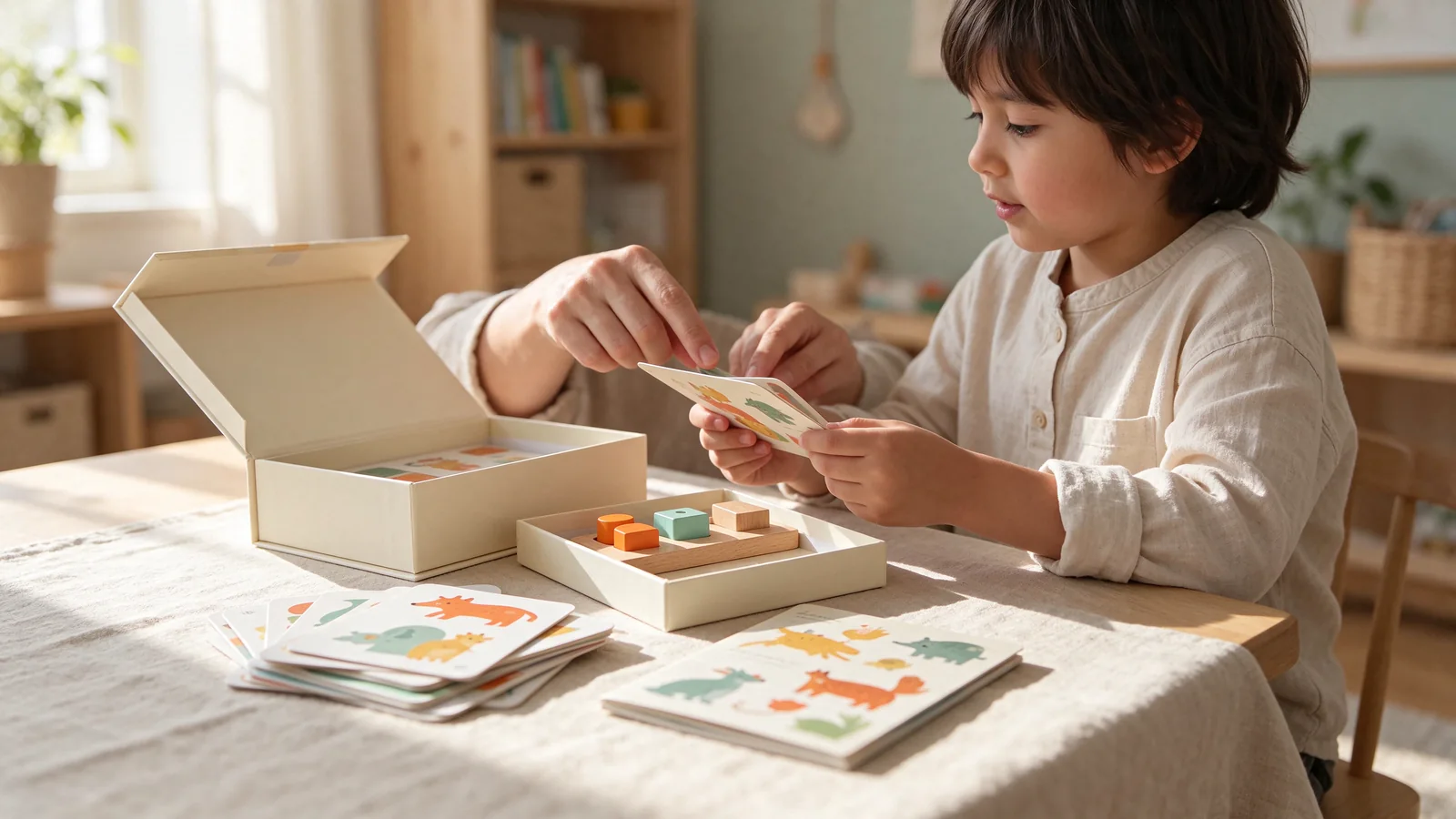
Choose an anchor activity that makes the gift understandable. For a book-centered bundle, that could be exploring an illustrated story with an adult. Other proposed activities might involve matching pictures or revisiting a topic. These are curation directions, not claims that a named product includes a particular function or delivers a learning result.
Then ask what each additional item contributes. A second book might offer another session with the same materials. An activity card might connect to the story. An instruction insert might help an unfamiliar adult begin. An accessory might be necessary for operation or storage. If an item adds neither usable activity nor practical support, consider removing it rather than treating it as proof of value.
Avoid a bundle in which the books, cards and device each require unrelated explanations. Shared artwork is not enough: the parts should make sense together during use. Check whether language, vocabulary, interaction steps and adult guidance remain consistent. A complicated bonus can distract from an otherwise clear gift, especially if its purpose is not evident from the opening instructions.
ReadGlo’s Complete Learning Kit reference can help identify a possible project starting point. It is not evidence of the exact pack you will receive. Ask for the proposed book selection, device reference, accessories and user guidance to be identified individually; final inclusions, configurations, languages and availability need written confirmation.
Choose a composition the channel can explain
| Recipient and channel situation | Curation priority | Question to resolve before buying |
|---|---|---|
| First-time household, online gift purchase | A self-contained first activity and visible exclusions | Can the receiving adult start without an unmentioned device, supply or account? |
| Book-interested child, staffed bookstore | A clear story-led anchor with relevant follow-up material | Can staff explain why the extra item belongs with the book? |
| Household with an existing device | A clearly labelled add-on edition | Is the exact existing device paired with every proposed title? |
| Proposed sibling gift | A realistic shared-use arrangement | Can children participate together, or is the activity explicitly turn-taking? |
| Limited-space gift display | A concise contents explanation and manageable pack | Does the shelf presentation describe the same set the family opens? |
Buyer decision aid; confirm the proposed configuration and responsibilities separately.
Swipe horizontally to view all columns.
Different channels create different information gaps. A staffed bookstore may explain the activity before purchase. An online gift listing must carry that explanation without a demonstration. A seasonal gift counter may have limited room for details. The receiving family still needs a usable introduction even when the buyer heard a good explanation in store.
Use the table to choose the next composition question, not to assign automatic age suitability or product capabilities.
A larger pack is not automatically better suited to gifting. Compare the space, explanation and handling needed for each candidate. If the channel cannot explain the difference between two configurations, simplify the choice or make the distinction more concrete. Do not use packaging decoration to conceal differences in included materials.
Evaluate the opening, first session and return to use
Walk through the unopened pack
Request a sample discussion that includes the proposed consumer pack, not only loose components. Sample arrangements, costs and coverage remain subject to agreement. If some packaging is representative, record what differs from the intended retail version. Let a reviewer unfamiliar with the project read the outside explanation before providing additional guidance.
Ask the reviewer to identify the contents, intended activity, adult role and any separately needed item. Then open the pack and compare those expectations with the actual contents. Keep decorative props out of the inclusion count. Where a power supply or charging item is relevant, confirm the exact provision and preparation steps rather than assuming it is included or ready to use.
Observe a bounded first activity
Define a small evaluation journey: find the starting material, follow its introduction, carry out the proposed interaction and stop or put it away. Record where the reviewer needed help and what information was missing. An adult-only walkthrough can reveal instruction gaps without involving children. Any child observation should be appropriately supervised and planned; it is not a learning-outcome study.
If the bundle includes a reading pen, evaluate its proposed pairing with each included book edition. Working with one demonstration title does not establish that all packed titles work. Specify the device/build, printed edition and content references before agreeing checks. The book–device compatibility review route addresses named pairing questions; it does not promise universal book access or automatic integration.
Check whether a second session is obvious
After the first activity, ask what the family can do next using the same included materials. This might be another story, a different picture choice or an adult-led discussion. The point is to see whether the bundle offers a comprehensible next use, not to promise months of engagement. More content is useful only if the family can discover and use it.
Include putting the materials away in the review. Can the relevant items be identified and stored together? Does the guide remain available after gift wrapping is removed? Note awkward steps as specific design questions. Storage convenience does not replace durability assessment, and a successful walkthrough does not approve the product for market sale.
Mid-project CTA: Planning educational gift sets for a retail channel? Prepare a recipient sentence, an anchor activity and a proposed contents list through ReadGlo’s retail gift-set planning page, or email info@readglo.com. Ask which configuration and sample questions need clarification. This starts a discussion; it does not confirm an available pack or supply commitment.
Compare usable completeness before comparing set prices
A useful price comparison starts with the same customer proposition. Two offers called “learning gift sets” may differ in book selection, operating equipment, instructions and preparation. Request an itemized proposed consumer pack for each offer. Separate the number of retail packs from the number of books, devices and accessories inside each pack, and list additional loose items separately.
Compare what it takes to deliver one usable gift. Relevant quotation questions may include assembly, printed guidance, agreed artwork work, inspection scope and shipping terms. Identify which costs are included, excluded or still unknown. Do not assume a catalogue reference price covers a custom composition, another language edition, retail assembly or the destination delivery basis.
Keep optional enhancements separate from essential contents. If a storage accessory is desirable but not needed to start, compare it as an option. If an operating item is essential, either include it in the proposed configuration or disclose the requirement clearly. A low set price can be hard to interpret when essential dependencies remain outside the quote.
Before choosing a premium option, ask whether it supports another identifiable activity or a clearer introduction. Extra pieces that repeat the same function may not justify a different retail proposition. Equally, removing an instruction item to meet a target cost may undermine the self-contained gift brief. These trade-offs should be decided against the intended experience, not piece count alone.
Plan the retail set before presenting it to buyers
List proposed contents, per-edition requirements and packaging questions. A gift-set brief is not confirmation of pack contents, stock or a delivery date.
ReadGlo project support
Discuss Your Educational Gift Bundle
Share your target market, intended activity, content readiness and quantities. Product configuration, permitted content, samples and commercial terms need project-specific confirmation.
Open the related procurement routeKeep languages and variants coherent without silent substitutions
For a multilingual gift proposal, separate printed language, prepared audio where applicable, and adult instructions. The gift giver may read one language while the receiving adult prefers another. That is a practical information need, not proof that a device translates or supports the requested combination. Confirm proposed language versions and the relevant editorial review before describing them to shoppers.
Use a separate composition row for each meaningful variant. Record what remains the same and what changes in books, devices, instructions or accessories. A similar cover or shared commercial title does not establish equivalent content. If an included item becomes unavailable, do not accept an unnamed “equivalent” without reviewing its effect on the anchor activity and customer explanation.
Consider an illustrative book-and-activity gift: replacing a story with a different topic might leave the card activity confusing, even if the replacement has the same page count. Replacing a device could change operating instructions or the proposed book pairing. Review the whole affected experience before accepting a substitution; do not let component-level similarity stand in for bundle-level coherence.
A gift-season reorder should preserve what the shopper was told. Compare repeat-order contents with the intended listing, photographs and instructions, and identify any changed experience explicitly. Commercial reorder terms require separate agreement. The curation question is whether the repeat set still delivers the same described activity, not whether every historical approval can be reused.
Make the retail explanation match the delivered gift
Prepare three connected explanations: why this gift suits the proposed recipient, exactly what is included, and how the receiving adult starts. They may appear on a shelf card, online listing and inside guide, but they should not contradict one another. Use photographs of the approved intended contents for final selling assets; concept imagery must remain labelled as illustrative.
Describe activities plainly. “Explore the included story with adult guidance” is a curation statement; “guarantees independent reading” is a different claim requiring appropriate evidence. Do not infer learning outcomes, certification, unrestricted compatibility or screen-free operation from a category name. Review the actual operating requirements before using those phrases.
Content permissions also affect the gift proposition. WIPO explains that reproduction, translation and sound recording are distinct uses that rights owners may authorize [2]. Where relevant, identify permission for text, illustration, translation, narration and promotional extracts separately. Record the rightsholder, territory, medium/use, language, term, attribution and written permission; purchasing a book does not establish blanket rights to create or market a new edition.
For a proposed U.S. children’s-product pack, the CPSC explains testing and certification responsibilities for products subject to applicable children’s-product safety rules, including relevant exceptions [1]. Ask the responsible importer and specialist to determine obligations for the final configuration and current import process. A functional sample, attractive box or generic compliance badge is not matching market-release evidence.
Buyer checklist: is this one intelligible gift?
Before requesting a final quotation or approving retail materials, use a short checklist that joins curation and delivery without turning into a general device specification:
- Name the recipient, interests, language context and expected adult involvement.
- Identify the anchor activity and the practical role of each additional component.
- Distinguish a self-contained starter gift from an add-on requiring existing equipment.
- List per-pack contents, exclusions and separately needed items; count retail packs separately.
- Confirm proposed editions, any device pairings and a bounded sample walkthrough.
- Agree how changes or substitutions affect the activity, instructions and selling explanation.
- Separate content permissions, market review and commercial terms from experience observations.
ReadGlo’s retail gift-set preparation checklist is an editable starting point for the inquiry. It is not a quotation, licence, order or configuration approval. Add your recipient and activity decisions rather than treating completion of a form as a purchasing decision.
Frequently Asked Questions
1. How many items should educational gift sets contain? There is no universal ideal count. Start with the materials required for one clear activity, then consider relevant repeat-use and practical support items. Count items accurately, but judge composition by whether each part has a purpose. Avoid treating multiple pieces of one activity as multiple independent learning experiences.
2. Should a retailer choose books first or a device first? Choose the intended activity first. For a story-led gift, proposed titles may guide the selection; for a device-dependent interaction, both sides must be reviewed together. Do not finalize books on the assumption that any reading pen will work with them. Identify the exact proposed system before committing to the bundle.
3. Can one gift set serve siblings of different ages? Possibly, but that needs a realistic shared-use proposal. Identify whether use is simultaneous, adult-led or turn-taking, and review age suitability for every included component. Two devices do not automatically create a two-player activity. If the younger child cannot use part of the set appropriately, clarify the intended audience rather than presenting a universal family gift.
4. What should “complete learning kit” mean in retail copy? Define complete for the stated activity: list included materials and disclose anything else required to begin. It should not imply a complete curriculum, universal compatibility or guaranteed progress. Confirm relevant power, preparation, adult help and instruction requirements. A product title alone does not establish the actual delivered contents.
5. How can a small bookstore evaluate a gift without a large pilot? Start with an agreed adult walkthrough of a representative pack and the proposed shelf explanation. Ask someone unfamiliar with the project to identify the activity and begin from the supplied guidance. Record concrete confusion points. This is a limited usability review, not evidence of child engagement, sales performance or market conformity.
6. Can seasonal editions change only the outer gift sleeve? They can be proposed that way, but verify that the sleeve still accurately describes the unchanged contents and does not obscure required information. If books, languages or operating items also change, treat that as a different experience to review. Agree artwork, permissions, supply and market-review questions separately before ordering.
7. What should buyers send ReadGlo before asking for a quote? Send the target market, retail channel, recipient context, proposed activity, contents and exclusions, language editions, retail-pack quantity and next decision. Mark unknowns openly and share permitted summaries rather than confidential source files. Ask for clarification of feasible configurations, sample arrangements, prices, quantities and timing; none is established by an initial brief.
Conclusion: curate a gift that explains itself
The strongest purchasing brief for educational gift sets describes a coherent activity, not an impressive pile of components. Choose materials for the recipient and channel, review the opening and repeat-use journey, and keep the delivered contents aligned with the retail explanation. Confirm rights, market responsibilities and supply terms independently. If an extra item makes the gift harder to understand, simplify before expanding.
Final CTA: Use the retail educational gift-set planning route or email info@readglo.com with your proposed recipient, channel, activity and contents. Ask what must be resolved before comparing complete offers. Final configuration, permissions, evidence, pricing, MOQ, sample arrangements, delivery and support terms require separate written confirmation.
Continue your research
Related reading pen buyer guides
Use these related guides to compare the next product, content, sourcing or channel decision in your project.
- Buyer GuideHow Should Buyers Choose an Alphabet Learning Keyboard for Children?Read this guide
- Buyer GuideHow Should Buyers Choose Phonics Flash Cards with a Coherent Learning Progression?Read this guide
- Retail StrategyHow should an independent bookstore build a balanced children’s audio-learning assortment?Read this guide
Continue with ReadGlo
Review product or project scope, then confirm the proposed configuration and relevant documentation separately.
ReadGlo project support
Request a Project Discussion
Describe the purchasing decision you need to make. Confirm the final configuration, rights, evidence and supply terms before placing an order.
Open the related procurement route