Contents
Direct answer
Buy phonics flash cards by the progression they support, not by the largest card count. Request the complete contents list, the intended sound–spelling sequence, practice words tied to that sequence, and clear adult guidance. Then review representative printed cards and any requested audio together. A coherent deck makes it possible to introduce, revisit and apply selected correspondences without treating every card as equally suitable for every learner.
Define what the deck must help an adult teach
A school-resource buyer may need review cards for an existing teaching approach. A publisher may be developing a supplementary pack. A retailer may want a family activity set with intelligible instructions. These are different buying tasks, even when every offer uses the same product keyword.
Start with the expected response: should the learner say a sound, identify its spelling, blend a word, segment a spoken word, or follow a writing prompt? A picture-naming deck can be useful for vocabulary, but that alone does not establish a phonics progression. Likewise, an alphabet deck arranged from A to Z does not explain when its cards enter instruction.
Ask the education lead to identify the starting knowledge and the intended endpoint. For a supplement, name the chosen teaching sequence and the part covered. England's official guidance says resources should match the grapheme–phoneme correspondence progression of the school's chosen systematic synthetic phonics approach.[1] That is jurisdiction-specific teaching guidance, not a certification of a commercial card pack or a universal sequence for every market.
Describe the deck as a resource supporting adult-led activities unless a broader programme has separately been established. Do not turn an attractive supplementary set into a complete curriculum through packaging language.
Check the progression before commissioning illustrations
A grapheme is a written letter or letter group representing a sound; a phoneme is a speech sound. A procurement brief need not become a textbook, but its editor must distinguish the written form from the response expected from the learner. Official programme criteria describe clearly defined incremental teaching, cumulative practice, blending for reading and segmenting for spelling.[2]
Build a stage map, not just a theme list
For each proposed stage, state the correspondences introduced, the earlier material revisited and the activity that uses them. Keep the map compact enough that a buyer can compare offers without reading every artwork file. An editor should be able to explain why a card belongs at its proposed stage.
Alphabetical order can serve as an inventory index while a separate stage map controls teaching order. Colour groups may help users select cards, but colour alone does not tell them whether a new spelling has already been taught. Add an unobtrusive group identifier or adult-facing key if that fits the design.
Avoid importing a supplier's sequence without review. It may be internally coherent yet mismatched to the buyer's intended programme. Conversely, a deliberately bounded beginner deck need not cover every advanced pattern. State the boundary honestly and identify what users will need beyond it.
Audit practice words against earlier knowledge
A word can contain the target spelling and still be unsuitable for independent practice at that stage because it contains other untaught correspondences. Ask the editor to check the whole word, not only the highlighted letters. Apply the same check to any printed sentence intended for the child to read.
For an illustrative review, suppose a buyer's draft has introduced the correspondences needed for “rim.” A proposed practice card reading “shine” introduces additional demands; an appealing picture does not remove them. The editor must either move that card, change its purpose to adult modelling, or select an appropriate alternative. These are planning examples, not a proposed ReadGlo curriculum.
Mark common-exception words separately and explain any irregular part in the adult guidance. The official criteria distinguish these words from the material that learners can decode with correspondences already taught.[2] Do not label a mixed word collection “fully decodable” without reviewing it against a named stage.
Request the complete contents, including the less photogenic pieces
Box photographs commonly show the most colourful faces, not every component. Before comparing wholesale phonics flash cards, request a contents schedule that separates physical cards, printed faces, unique teaching targets, practice prompts and supporting items. These counts answer different questions.
If one card carries different targets on its two faces, ask whether both are meant to be available in the same activity. If a blending task needs the same spelling twice, the buyer should identify whether duplicate cards, separate tiles or another agreed format is needed. A high count does not establish that users can build the intended words.
The contents schedule should also identify any stage key, pronunciation notes, activity guide, dividers and storage. Mark each as included, excluded or requested. Numbers, writing activities and vocabulary extras should have an explicit role rather than inflate the apparent phonics coverage.
ReadGlo's Phonics & Numbers Flip Card Set reference is a starting point for discussing grouping and format. Its public description does not establish a supplied curriculum, sequence, artwork, audio or translation. Buyers should request the contents of their proposed configuration rather than infer them from the product name.
Use a decision table to identify the next sample question
| Proposed offer | Buyer decision | Evidence to request next |
|---|---|---|
| Letter cards without a stage map | Assess as a limited alphabet resource, not an established progression | Intended responses and teaching-order explanation |
| Staged cards with practice words | Check that each word fits its assigned stage | Full word list with correspondence review |
| Picture and plain-letter faces | Decide how cues are introduced and removed | Both faces and a demonstration of the stated activity |
| Linked or ring-bound cards | Check whether grouping permits the intended tasks | Representative assembled sample and grouping plan |
| Deck with requested audio | Review sound models independently of file matching | Approved script, pronunciation brief and selected playback sample |
| Large mixed-topic pack | Separate phonics coverage from added themes | Component breakdown and explicit coverage boundary |
Buyer decision aid; confirm the proposed configuration and responsibilities separately.
Swipe horizontally to view all columns.
Different gaps need different responses. Some require editorial changes before physical sampling; others can only be assessed on the selected print and format. Use the table to keep a quotation comparison from concealing unfinished content work.
A limited resource is not automatically a poor purchase. The problem is paying for an undefined promise, or describing a narrow deck as something more comprehensive than its contents support.
Review print from the learner's and adult's sides
A phonics card sample should make the intended written form unambiguous. Review the selected typeface, letter case, spacing and contrast at the distance of the planned activity. A small-group tabletop card and an adult-held demonstration card may need different layouts. Avoid choosing dimensions from a catalogue image alone.
Check whether a digraph remains visually grouped and whether any sound markers match the editor's instructions. For consonant blends, do not casually present several phonemes as one sound. The official criteria distinguish individual phonemes from consonant clusters.[2] Where the written unit has a more complicated correspondence, the education reviewer should specify the response rather than rely on a simplistic design rule.
Pictures also require editorial review. An illustration intended to cue a particular word may be named differently by families in another region. Ask a local reviewer what the image naturally suggests, and whether that word models the intended sound in the selected pronunciation variety. If the card's task is decoding, the child should not have to guess the word from the picture; official guidance explicitly cautions against picture-based guessing of unknown words.[2]
Review the adult-facing side with equal care. Can the adult hold the card correctly, identify the stage and find the expected sound or example without covering the learner's text? Decide whether a picture cue should be concealed for a later activity. This is a physical design question as well as an editorial one.
Handle the actual sample to assess glare, orientation, edges, stacking and access to groups. Ask whether the proposed finish and assembly represent production. Appearance and handling observations do not establish a durability rating or product-safety approval.
Move from sourcing research to a scoped OEM inquiry
Share the proposed device, branding, book or card scope and target market. Requested configurations and commercial terms need separate confirmation.
ReadGlo project support
Discuss Your Phonics Card Deck
Share your target market, intended activity, content readiness and quantities. Product configuration, permitted content, samples and commercial terms need project-specific confirmation.
Open the related procurement routeIf audio is requested, approve the sound model separately
Audio may be requested to model a letter sound, a complete word or an adult instruction. Those are separate recording tasks. A correctly named audio file can still contain the wrong response for the lesson. Specify what each prompt should contain before discussing playback equipment.
For sound prompts, have a qualified language or phonics reviewer listen for unnecessary added vowel sounds, inconsistent pronunciations and unwanted letter-name substitution. For a word prompt, review its natural pronunciation and its relationship to the printed target. Do not demand one artificially uniform delivery style for every kind of sound; use a reviewed voice brief appropriate to the selected language variety.
Request a small approved recording selection before extending the recording work. If playback is part of the proposed product, listen again through the actual selected sample: file clarity alone does not establish the audible result. Keep technical response checks separate from the editorial decision about whether the sound is appropriate.
A bilingual edition requires a fresh content review. Translating an English cue word may remove the target sound or move it to a different position. Decide whether the additional language supplies adult instructions, vocabulary support or its own literacy activities. Do not assume that one phonics sequence can simply be translated into another language.
Discuss a representative deck: Email info@readglo.com with your target market, intended teaching use, draft stage map and the print or audio questions still open. Use the custom learning-card project page to frame that discussion. Sample availability, requested work and commercial terms remain subject to written confirmation.
Evaluate an activity, not only individual cards
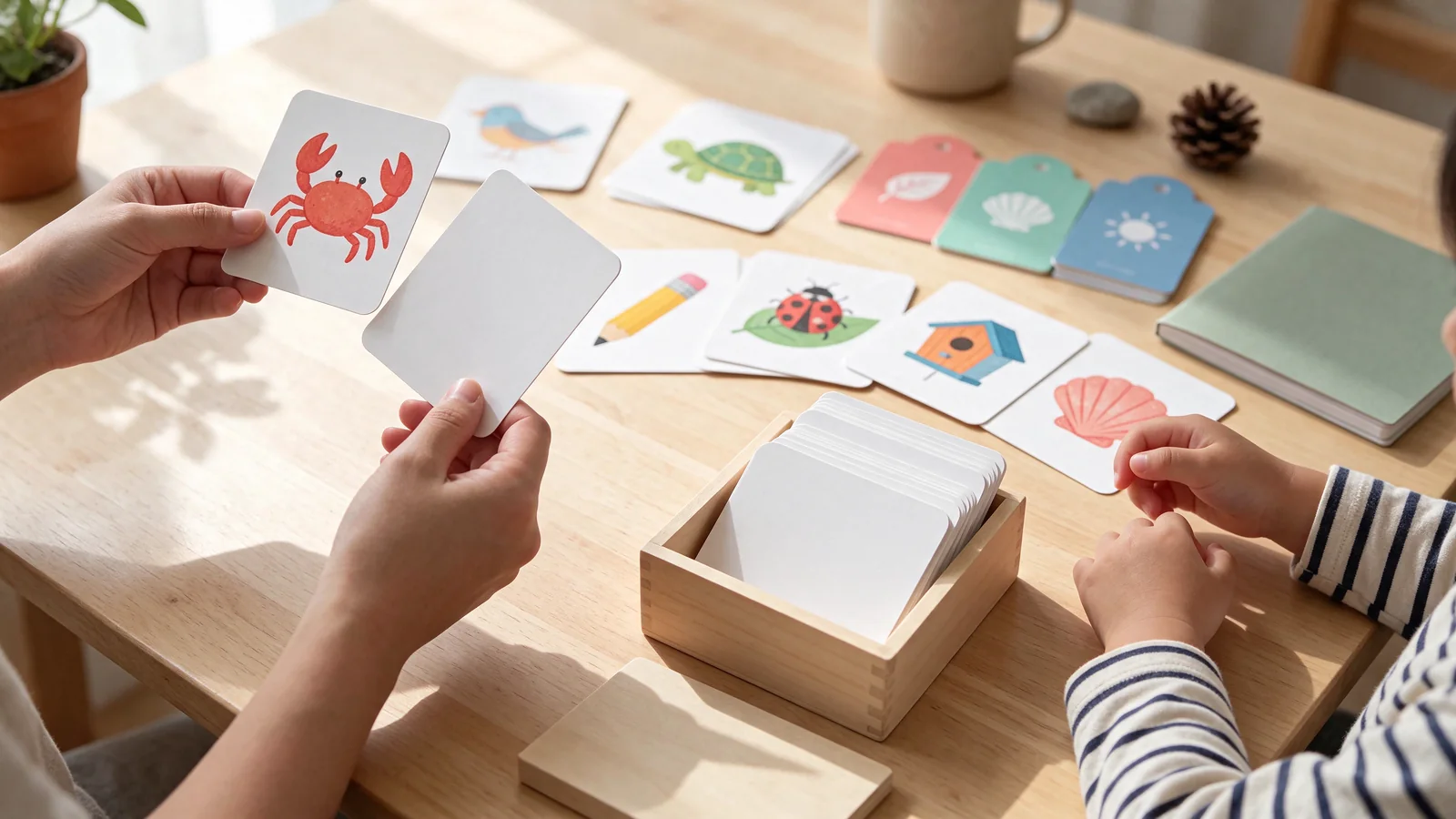
Choose a small sample set that exposes the deck's logic. Include material from the beginning, a later transition and cumulative review, plus different word lengths, layouts and any requested pronunciation patterns. Include representative guide content and assembled storage where these affect selection.
Ask an education reviewer to demonstrate a routine using only the proposed components. Can the adult identify the correct subset, introduce the intended response, revisit earlier cards and move into an appropriate application task? Record where additional explanation or materials are needed. This reveals content gaps that a card-by-card artwork check can miss.
Separate product usability observations from learner-outcome claims. A supervised sample session may show that the print is visible, a group is hard to locate or an instruction is unclear. It does not prove improved reading, predict individual progress or establish suitability for an assessment. Do not collect children's personal data for an initial supplier inquiry.
A useful review conclusion is specific: “the stage label is hidden by the grip,” or “the practice sentence contains an untaught spelling.” Corrections can then address the card, guide or grouping that caused the issue. Avoid vague approvals such as “educational quality accepted” when the review covered only a few samples.
Make the quote match the educational contents
Once the deck design is sufficiently defined, connect it to the commercial request. State the quantities per edition, card and supporting-component counts, print format, packaging and any requested audio work. Ask suppliers to separate content preparation, proofs, samples and recurring production items where relevant.
An offer with an adult guide should not be compared as identical to cards without one. Likewise, a quotation using buyer-ready illustrations differs from a request for new artwork and editorial development. Identify those differences before evaluating unit prices. No generic MOQ, price, lead time or warranty should be assumed for a ReadGlo project.
Rights review remains necessary for illustrations, photographs, guide text, translations and recordings. WIPO explains that material published online is not automatically public domain and that permission depends on the intended use and applicable licence.[3] Ask the appropriate rights owner or adviser to confirm the uses needed for the proposed edition; do not treat access to a competitor's downloadable cards as commercial reproduction permission.
Assign destination-market review separately. U.S. guidance explains that children's-product classification depends on factors including intended use and marketing.[4] The final cards, any rings, tools or electronic components need a configuration-specific review by the responsible parties. Editorial approval is not a safety certificate.
The ReadGlo Buyer FAQ provides wider questions for samples, quotations and handover. Keep this deck review focused on its educational contents rather than expanding it into a general device procurement exercise.
Buyer checklist before the next commitment
Use this short checklist with the proposed deck, not as a substitute for the editor's work:
- Identify the intended activity, starting knowledge and coverage endpoint.
- Obtain a stage map and the complete card, face and component list.
- Check practice words and child-readable instructions against their stages.
- Review pictures, typeface, grouping and adult-facing prompts.
- Specify pronunciation and review any requested audio on the selected sample.
- Demonstrate a representative routine with the proposed components.
- Resolve content corrections, rights questions and quote exclusions separately.
- Assign final market review and approve only claims supported by evidence.
Use the learning-card project checklist as a general inquiry aid, adding the phonics-specific stage and practice-word questions above. An unfinished deck can enter discussion; it should not be mistaken for approved production content.
Frequently Asked Questions
1. How many phonics flash cards should a buyer request? There is no useful universal count. Start with the intended correspondences, application activities and supporting pieces. Count physical cards separately from faces and teaching targets. Request any duplicates needed for word-building tasks explicitly, then evaluate whether a smaller defined pack meets the intended use better than a broad mixed collection.
2. Should the deck follow alphabetical order? Alphabetical order can help inventory and retrieval, but it does not establish teaching progression. Ask for a separate stage map matching the buyer's selected approach. If cards are permanently linked, check whether that assembly still permits the proposed introduction and review routines without unnecessary navigation.
3. Are picture cards or plain-letter cards the better purchase? Decide from the activity. Picture cues may support an adult's introduction, while a plain-letter view can serve a different practice task. Review whether cues can be hidden when required. Do not assume that attractive images demonstrate decoding or that every deck needs both formats.
4. Can a numbers-and-phonics pack cover a full reading programme? The product name does not establish that scope. Request separate phonics and number contents and their intended activities. Official validation criteria in England distinguish complete programmes from supplementary materials.[2] A combined card set should be described according to its reviewed contents, not as an automatically complete curriculum.
5. Is recorded audio necessary for a phonics deck? Not automatically. Establish who will model the sounds and what requested audio adds to the activity. If audio is included in the proposed configuration, approve its script, pronunciation and playback result. A recording does not remove the need for adult guidance or verify educational effectiveness.
6. Can the same card images be used in every English-language market? Only after regional review. A picture may suggest a different word, and the target word's pronunciation can vary. Ask the local editor to check cue choice, wording and sound model together. Confirm image permissions for the intended territories and uses rather than assuming a shared language clears the assets.
7. What should remain open after an attractive sample is approved? Everything outside the agreed review: unsampled content, unresolved editorial changes, asset permissions, final packaging, applicable market evidence and unconfirmed commercial terms. Record what the sample actually demonstrated. Do not turn sample acceptance into a therapy, learning-difficulty correction, exam-readiness or guaranteed-progress claim.
Conclusion: purchase a usable progression, not a bigger pile
The strongest phonics flash cards brief connects each proposed stage to its written targets, suitable practice material and adult guidance. Printing and optional audio should preserve that logic, while the contents schedule shows exactly what users receive. A useful buying decision is whether the defined deck supports the intended routine—not whether the box looks comprehensive.
Prepare the next deck discussion: Send a non-confidential summary to info@readglo.com and visit ReadGlo's custom learning-card project page. Include your market, deck boundary, proposed editions and the representative sample questions. Final contents, requested services, quantities, terms and release evidence require project-specific confirmation.
Sources and further reading
Continue your research
Related reading pen buyer guides
Use these related guides to compare the next product, content, sourcing or channel decision in your project.
Continue with ReadGlo
Review product or project scope, then confirm the proposed configuration and relevant documentation separately.
ReadGlo project support
Request a Project Discussion
Describe the purchasing decision you need to make. Confirm the final configuration, rights, evidence and supply terms before placing an order.
Open the related procurement route