Contents
Direct Answer
Talking pen and reading pen can describe the same children's book-linked audio category; the labels alone do not establish different capabilities. Start with the material, the learner's action and the content relationship. For ReadGlo's stated route, a compatible coded book or card triggers prepared audio. Use this reading pen selection guide to identify that route before discussing the exact device, edition, bundle or requested changes.[1]
What Do Talking Pen and Reading Pen Describe?
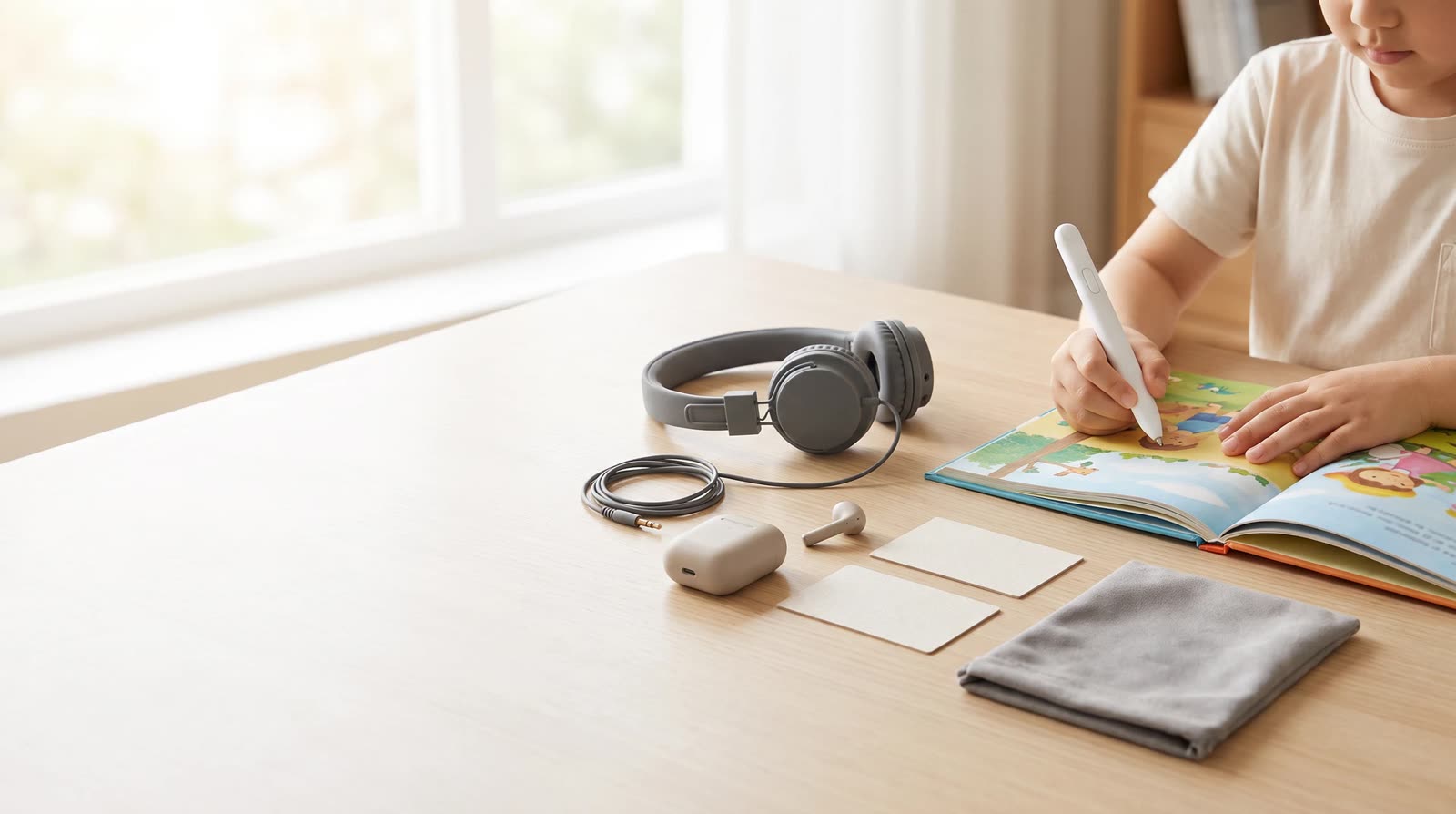
For procurement, treat these names as starting descriptions rather than specifications. “Talking” draws attention to an audible response; “reading” draws attention to the intended reading activity. Neither tells a buyer how the content is selected, which printed materials are supported, or what belongs in the offer. Two proposals using different names may describe the same interaction, while two proposals using the same name may concern different tasks.
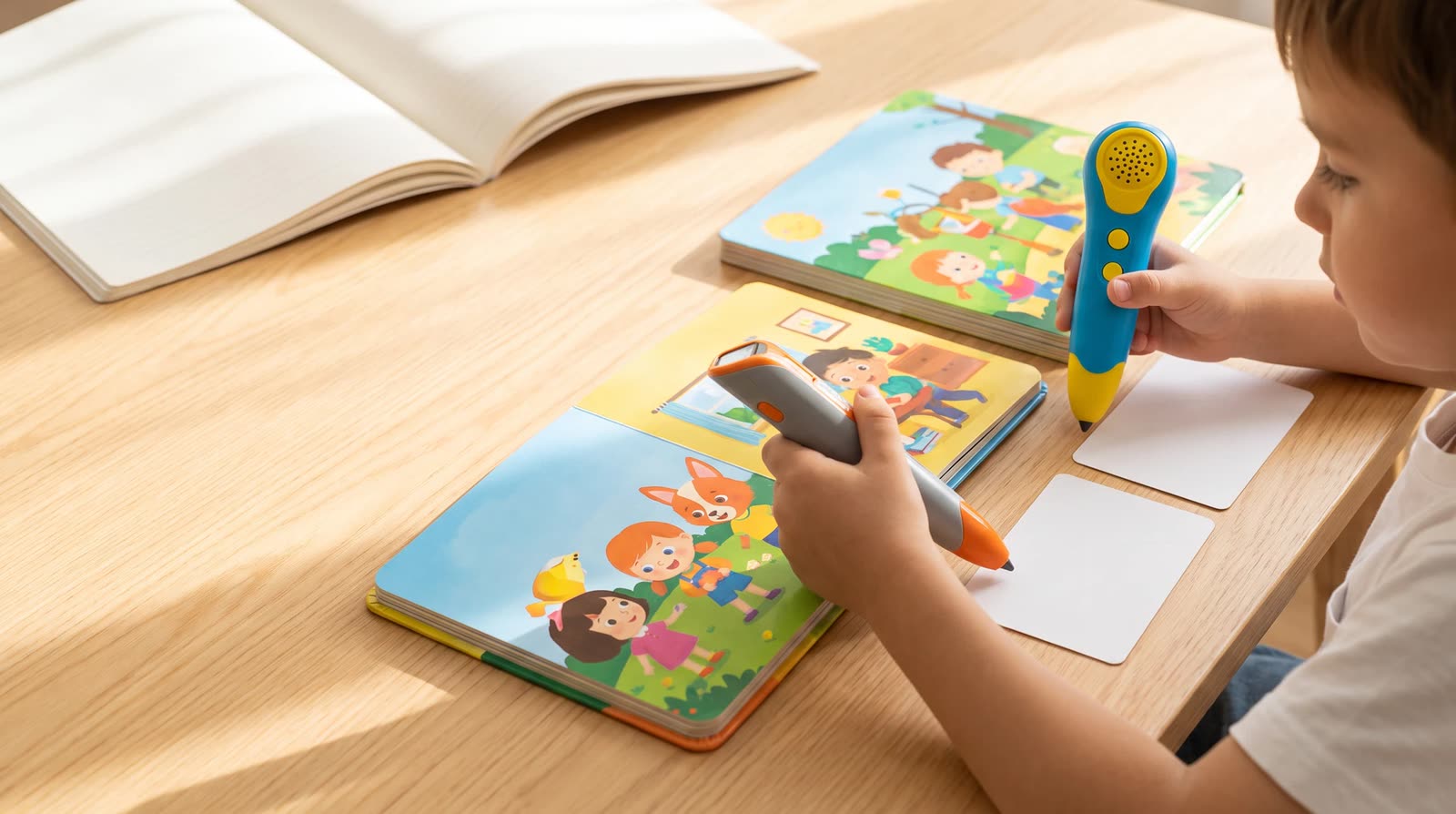
The useful category statement is more precise: a book-linked children's reading pen is a pen-shaped device used with compatible prepared content. In the coded-book route described by ReadGlo, an identified printed touch region points through a content map to a prepared recording. That response depends on the named print edition, device/build and audio-map version.[2]
Follow the touch-to-audio relationship Think in three references: the coded touch region, its mapped content reference and the recording intended to play. A printed picture can be a target without every nearby word being a separate target. A word-shaped region can trigger a prepared vocabulary recording without the device recognizing the letters. The requested response may relate to a selected picture, word, sentence or page, but each proposed granularity needs configuration review.[2]
This distinction changes the buying question. Instead of asking whether the pen “reads books,” ask which regions of which edition should trigger which recordings. At the initial selection stage, that description can remain nontechnical. Detailed code allocation, mapping revisions and assessment coverage belong in the specialist compatibility discussion, not in a category label.
Do not interpret “reader pen” as a feature promise In an unbranded inquiry, reader pen is an ordinary descriptive phrase, not evidence of a particular model. Ask what the reader is expected to read. If the answer is a prepared children's picture book, investigate the paired-content route. If it is an unrelated textbook, handwritten note or screen document, the task has changed.
Optical character recognition, or OCR, means recognizing or extracting printed or handwritten text from images and documents.[3] That is different from using a printed code to select prepared audio. This definition does not establish that any pen has OCR, spoken output or translation. Those capabilities cannot be inferred from the word “reading.”
Which Buyer Task Fits the Paired-Content Category?

| Material and buyer context | Intended action | Scope to name | Evidence needed next | First handoff |
|---|---|---|---|---|
| Named paired picture-book edition for a retail set | Touch selected regions for prepared audio | Device, edition, recordings and pack contents | Written pairing and inclusion references | B2B product inquiry |
| Publisher-owned title proposed for interactive print | Touch publisher-selected regions | Print draft, response plan and asset status | Permitted references and named editorial/technical owners | Publisher project brief |
| Named books used in supervised school sessions | Use selected touch targets during planned activities | Device count, book copies and adult assistance | Proposed activity, versions and observable review tasks | School project brief |
| Existing pen plus additional books or a changed edition | Access recordings from a proposed new pairing | Current device/build and proposed print/audio references | Named-pairing scope and unresolved access questions | Compatibility inquiry |
| Ordinary print, handwriting, PDF or screen material | Recognize or access unpaired text | Essential material and requested output | Evidence from the responsible category supplier | Different-category review |
Buyer decision table: choose a first handoff. This is a buyer planning framework, not a record of ReadGlo tests or supplier approval.
Swipe horizontally to view all columns.
Begin with the material the project must use. Is the buyer willing to adopt a named compatible edition, or must existing ordinary printed stock remain unchanged? This is more decisive than the desired housing shape. A device demonstration with a prepared book does not settle a request involving the buyer's unrelated print.
Next, describe the observable action. “The child touches a named picture region and hears its approved recording” is a useful requirement. “The child learns English” is an educational ambition, not a device interaction. The school or content owner must decide how the activity fits its teaching or editorial plan; this guide does not turn playback into a promised learning outcome.
Finally, identify the unit being purchased. A pen reference, a book collection and a finished kit are different scope lines. The initial brief should not treat a catalogue photograph as an inclusion list. Separate device counts from book copies, titles, editions and card decks even when the commercial intention is to offer one set.
Buyer Decision Table: Choose a First Handoff The table is a buyer planning framework, not a record of ReadGlo tests or an established supplier approval procedure. Complete the relevant row with your project references; keep unknown fields pending.
A useful outcome is one short decision: investigate the paired-content route, clarify missing material information, or refer the requirement to another category. This is not an order approval. If a project needs both prepared-book audio and ordinary-text recognition, retain two distinct requirements rather than treating the second as an optional setting of the first.
Record your chosen route, essential material, expected action, proposed included items, unresolved question and decision owner. That small record lets commercial and editorial teams discuss the same purchase instead of debating what the product name ought to mean.
How Should Buyers Interpret Smart, Electronic and Portable Labels?
Marketing adjectives should be translated into specific questions before they influence selection. “Electronic” or “digital” does not explain whether the device selects mapped audio or recognizes text. “Interactive” needs an interaction description. “Smart” does not establish AI, automatic correction, connectivity or a content platform.[1]
Ask what the adjective changes in use For a smart reading pen proposal, request the actual action and response that justify the description. Does the intended user touch a prepared region and hear an identified recording? What else is being requested, and has that additional function been confirmed for the named configuration? If there is no supported answer beyond ordinary paired playback, avoid expanding the specification to match the adjective.
Portable is a form-factor requirement, not a tutoring capability. Describe the intended handling, storage and listening setting. Dimensions, controls, power arrangements and accessory requirements need a configuration-specific answer. A small pen-shaped product should not be assumed suitable for an unsupervised child simply because it is easy to carry.
Separate language playback from language processing A request for two audio languages should identify two recording versions and the desired selection action. It does not mean the device translates new text. Likewise, requesting a recorded pronunciation is not the same as requesting AI correction of the learner's speech. Keep prepared content and live processing separate in the brief.
Headphone output, Bluetooth, recording, computer interfaces, software and download arrangements are also specific requirements, not default consequences of “smart” or “audio.” Mark a requested feature pending until there is a written answer tied to the proposed device and intended use. If a feature is essential, its unanswered status must remain visible in the category decision.
Ready to clarify the route? Take your completed decision row to the existing ReadGlo B2B reading-products inquiry page. Share nonconfidential material references, intended action, quantities and pending requirements through its current project form. This starts a scope discussion; it does not approve compatibility or commercial terms.
How Can a Vague Product Request Become a Useful First Brief?
The first inquiry does not need proprietary code tables or a complete production file package. It does need enough context to distinguish the requested category. Use one sentence that joins the user, material and action, then add separate references for the device and content under consideration.
Replace “a pen that reads” with the intended interaction A buyer-fillable statement could read: “We are considering a book-linked reading pen for [intended users] using [title and edition or proposed materials]. The requested action is [selected touch region] triggering [prepared recording reference and language]. Device reference, mapping and inclusion details are [known or pending].”
This is a template, not a customer example or confirmation that the proposed response is available. It is deliberately specific about the content relationship without prescribing an engineering solution. If the material is not yet selected, say that a compatible edition may be considered. If adopting new print is not acceptable, identify that constraint before a supplier responds with a different book system.
State whether content already exists Separate approved print, draft print, available recordings and recordings still to be commissioned. A printed language does not prove that matching audio exists. An audio file does not prove it is mapped to the selected edition. For an initial conversation, a nonconfidential asset-status summary is usually more appropriate than sending unrestricted manuscripts or recordings.
Name the people who can clarify editorial content, technical references and commercial inclusions. For publisher-owned assets, unresolved permission questions belong with the rights owner; they should not be silently converted into a production instruction. Use the publisher-owned interactive-book route for the detailed manuscript, script, recording and approval handoff.
Count the components without inventing a bundle List the proposed number of devices separately from printed copies. Identify whether “books” means titles, copies of one edition or a mixed-language collection. State whether packaging and accessories are requested, included in a named offer, or still unknown. For school use, explain how learners share the proposed materials rather than using enrolment alone as the device quantity.
At this stage, record desired timing and destination as buyer inputs, not promised dates. Prices, MOQ, sample scope, fees, delivery terms and after-sales boundaries need a scoped written response. A terminology decision establishes what to ask about; it cannot supply those commercial answers.
ReadGlo project support
Clarify your reading-product scope
Share your completed decision row, nonconfidential material references, intended action, quantities and pending requirements through the current project form. This starts a scope discussion; it does not approve compatibility or commercial terms.
Open the related procurement routeWhat Should Best and Reviews Mean in B2B Selection?
A search for the best reading pen is more useful when rewritten as “best fit for this material and interaction.” That changes the selection basis from an unsupported league table to a set of evidence questions. There is no justified overall winner when the books, recording package, inclusions and intended users differ.
Reading pen reviews can prompt questions, but the buyer should distinguish an identifiable observation from a marketing statement. A relevant review record names the device, printed edition, audio version, action performed and circumstances. An undated comment about another bundle may not answer whether the proposed purchase fits the current brief. Do not treat a review as a technical specification or a permission to repeat learning claims.
For a demonstration request, ask whether authorized footage or another permitted record is available. Require the starting material and demonstrated action to be identified. Hearing one response from one page establishes only that observed event; it does not establish whole-book coverage, another edition, production consistency or educational benefit.
A buyer can propose an observation such as “touch the named picture region and record which approved track plays.” This is a future review task, not a test this article has performed. If the offer cannot identify the demonstrated pairing, keep it as descriptive material and ask for clarification rather than awarding a comparison score.
The same principle applies to quotes. Similar names and similar totals do not establish equal scope. First resolve device, edition, recordings and included components. Then use the existing OEM quotation-scope guide for pilot, repeat-order and charge-line comparisons instead of rebuilding a pricing model here.
Which Existing Route Comes Next?
The B2B reading-products page is the commercial starting point when the buyer has selected the children's paired-content category but still needs to clarify product and bundle scope. Its buyer-specific routes help direct an inquiry by responsibility, not by whichever name appeared in the original search.
Use the book–device compatibility route when the question is whether a named existing edition, device/build and audio-map configuration can be assessed. Use the publisher route for a proposed title and its asset handoff, and the school reading-pen route for learner context, shared quantities and planned activities.
If the essential material is ordinary text or a screen, continue with the existing talking pen, tablet, audio-player and scanner comparison. That article handles the four-category choice. This terminology guide stops at identifying the appropriate first handoff; it does not claim ReadGlo supplies every category discussed.
Frequently Asked Questions
1. What Is the Difference Between a Talking Pen and a Reading Pen? The names can overlap in children's paired-content projects. Compare the material and selection action, not the label. Two names do not prove two technical categories, and one shared name does not prove identical device, book or audio compatibility.
2. How Does a Book-Linked Reading Pen Work? In the coded-book route, an identified touch region points through a map to prepared audio. The proposed print edition, device/build and audio-map references must be considered together. Visible words or pictures do not automatically establish individual playable targets.[2]
3. Does the Name Reading Pen Guarantee OCR or Handwriting Reading? No. OCR concerns recognition or extraction of text; paired playback selects an existing recording. If the requirement involves ordinary print or handwriting, state that material explicitly and investigate the appropriate category. Do not infer recognition, speech or translation from the name.[3]
4. Is Every Pen Compatible With Every Book? No universal compatibility should be assumed. Identify the proposed device/build, printed edition and mapped audio. A shared title, similar artwork or a demonstration with another book is not enough to establish the requested pairing.
5. How Should Buyers Use Best Reading Pen Searches and Reviews? Use them to develop fit and evidence questions, not a ranking. Ask which configuration was observed, which material was used and what action occurred. An unidentified review cannot confirm the buyer's proposed bundle or justify learning, medical or examination claims.
6. What Should the First Inquiry Include? Provide buyer role, intended users, material references, desired action, print and audio languages, separate device and printed-material counts, destination and pending requirements. State what is approved, proposed or unknown. Leave confidential assets and children's personal information out of the initial summary.
Conclusion: Select the Content Relationship Before the Product Name
Talking pen versus reading pen is a terminology question that should lead to a concrete procurement choice. Identify the material, intended touch or selection action, paired content and proposed purchase unit. Resolve unclear labels before comparing offers, and keep essential unanswered requirements visible.
Discuss your selected route: Submit a nonconfidential decision row and open-item summary through the existing ReadGlo B2B procurement page, or email info@readglo.com. Request clarification of the named scope; specifications, services, quotations and release decisions require separate written confirmation.
Sources and Further Reading
[1] ReadGlo B2B reading-product scope and existing inquiry routes
[2] ReadGlo named book-device pairing and prepared-audio scope
[3] Microsoft official overview of optical character recognition
Further reading: Talking pen, tablet, audio-player and scanner comparison; Publisher-owned interactive-book route.
Continue your research
Related reading pen buyer guides
Use these related guides to compare the next product, content, sourcing or channel decision in your project.
- Product GuideReading Pen vs Translation Pen: Which Product Fits Your Market?Read this guide
- Application SolutionsHow Can Talking Pens with Large Buttons and High Volume Support Senior Citizens Learning New Languages?Read this guide
- Product GuideHeadphone Jack vs Bluetooth Audio for Reading PensRead this guide
Continue with ReadGlo
See product specifications and request model-specific documentation.
ReadGlo project support
Submit your category-selection brief
Submit a nonconfidential decision row and open-item summary. Request clarification of the named scope; specifications, services, quotations and release decisions require separate written confirmation.
Open the related procurement route