Contents
Direct answer
Choose talking flash cards by the activity they must support, then verify the printed deck, matching equipment and approved language content together. Compare print-only, requested pen-tap and requested card-reader routes separately. Before ordering, review representative physical samples, confirm what each quotation includes and assign destination-market checks. A large vocabulary count, attractive box or successful demonstration with another deck cannot establish suitability for your project.
Start with the activity, not the advertised word count
A procurement brief should explain what the adult and child will do. Picture naming, category sorting, numeral recognition and beginning-sound activities place different demands on the artwork and instructions. A product manager choosing a vocabulary assortment needs different evidence from a publisher developing a defined teaching sequence.
Write one short activity description for each proposed deck. State the intended users, supervision setting, subject boundaries and how someone will introduce the cards. Specify whether the child points, arranges, turns, taps or otherwise handles them. Avoid making independent operation a requirement until the selected product and age guidance have been reviewed.
A larger assortment can support several activities, but it also increases editorial review, packing and content-checking work. Compare useful coverage rather than total words alone. A two-sided card, two spoken labels and two physical cards are different counting units. Ask what the supplier's count actually measures.
For an early-learning range, distinguish recognizing a picture from reading the printed word. Recorded playback shows what the equipment says, not what the child has understood. Do not turn a feature description into a speech-treatment, reading-performance or school-readiness claim without appropriate evidence.
Decide whether sound earns its place in the set
| Buyer situation | Route worth evaluating | Evidence needed before selection | Purchasing consequence |
|---|---|---|---|
| Adults need open-ended picture discussion | Print-only deck | Approved card list, clear faces, handling sample and instructions | Quote decks and packaging without assumed electronics |
| A defined recorded response is essential | Requested pen-tap or card-reader route | Named device, matching print and permitted content demonstration | Separate device quantity from deck quantity |
| Existing pens must be retained | Requested pen-tap route | Evidence for the exact pen/build and proposed cards | Do not price the deck as compatible before review |
| Two languages serve different channels | Bilingual deck or separate editions | Layout, terminology and audio-selection requirements | Quote each physical edition and requested language work |
| New topics may follow launch | Selected route with expansion request | Written update, pairing and repeat-order conditions | Do not assume future decks or recordings are supported |
Buyer decision aid; confirm the proposed configuration and responsibilities separately.
Swipe horizontally to view all columns.
Keep a print-only option in the comparison
Custom learning flashcards can be useful without electronics when adults need flexible descriptions, sorting or discussion. Print-only cards avoid a device-pairing dependency, although wording, physical quality, instructions and applicable safety requirements still need review.
Ask whether audio solves an actual operating need. A recorded label may provide a consistent pronunciation model, but a fixed response can also restrict the words available for discussing a picture. If the activity needs several acceptable answers, the instructions should explain that flexibility rather than treating every other label as wrong.
Describe the intended interaction before specifying technology
For a pen-tap request, identify the card region and expected response. For a card-reader request, describe the proposed handling action and what should play. Ask the technical owner to confirm the actual recognition arrangement and matching-card requirements. Insertion does not establish a particular technology, and the term “talking” does not identify the mechanism.
ReadGlo's Toddler Learning Flash Card Set reference is a printed-project planning reference. Its legacy URL does not confirm a phonics curriculum, reader, bilingual recording or supplied interactive configuration. Requested equipment and functions remain subject to project-specific review.
Procurement decision table
This table is a buyer decision aid, not a list of confirmed ReadGlo capabilities.
Review the deck as a physical learning material
Look for clarity under the intended viewing conditions
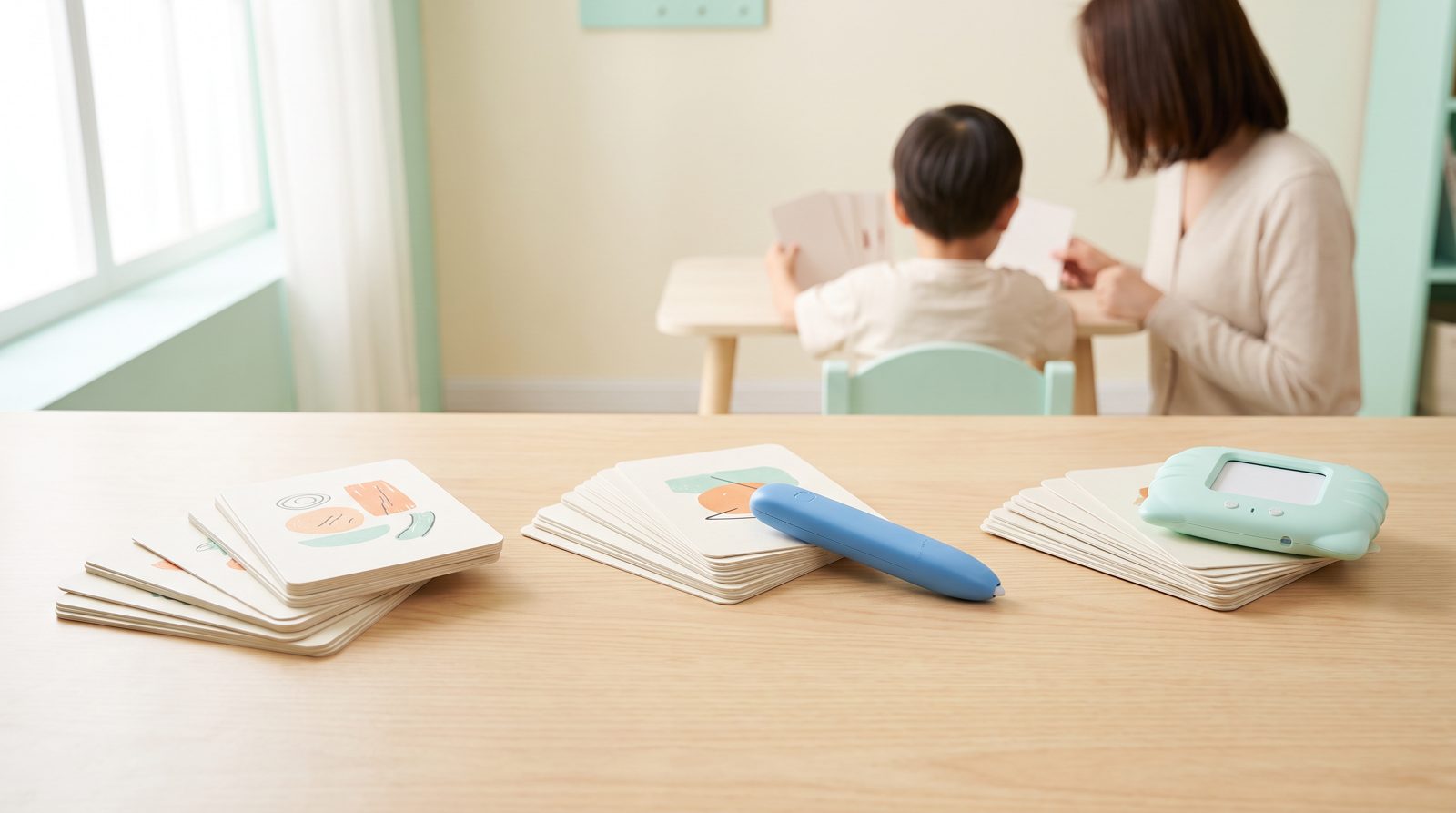
During sample review, a buyer should inspect the longest words, busiest images and least familiar symbols, not only the most attractive card. Check whether the image remains visible when held and whether front and reverse faces support the intended activity. Confirm typography, letter case, contrast and reading order with the editorial owner.
Compare finishes under lighting similar to the intended setting. Glare, obscured detail and competing visual elements are practical observations to record. Do not assume a named finish guarantees readability or that a generic material description establishes performance.
Match structure to the handling and equipment
Specify proposed dimensions, orientation, material, finish, corner treatment and loose or linked format. Agree measurement points and acceptance conditions with the supplier rather than importing another manufacturer's thickness or tolerance. For linked cards, review turning, grouping and access to both faces.
If a reader is proposed, physical fit and recognition must be demonstrated on the selected cards. Do not assume a thicker stock, coating, unusual shape or newly printed replacement will work. These changes may affect the interface even when the illustration remains identical.
For writing-led cards, identify the requested tool and surface together, including whether the tool is supplied. Ask for approved use and cleaning instructions. Reusability requires an agreed sample review; it is not established by a glossy appearance or an unsupported wipe-cycle claim.
Make language and audio review specific
Resolve editorial choices before recording
List the intended printed languages, layout and audio languages independently. A bilingual printed deck may place languages together, on opposite faces or in separate editions. Those choices change quantities, packaging and the review workload. They do not establish automatic language switching.
Assign a reviewer for regional terminology, spelling and pronunciation in each language. Confirm that every image communicates the intended concept. Where more than one label is acceptable, decide which label the recording will use and how the instructions will handle alternatives.
Give each card face an identifiable reference connecting the approved text, image and requested recording. Mark print-only audio fields as not requested. Keep missing translations and provisional voice scripts visible so suppliers can distinguish ready assets from work being requested.
Listen through the selected equipment
A clean source recording is not proof of satisfactory playback from a device. During an agreed demonstration, listen through the actual speaker in the proposed setting. Check intelligibility, the start and end of words, relative levels and whether extra sound effects obscure the learning prompt.
Request a demonstration of volume, replay and language selection only where those functions are proposed. Record what the device actually does and how an adult accesses the controls. Do not infer adjustable volume, recording, offline operation or a remembered setting from the product category.
Acoustic safety is a separate review from perceived clarity. A pleasant listening sample does not replace applicable sound-output evidence for the final product. Avoid publishing a response-time, audio-quality or battery-life number unless it has a valid configuration-specific basis.
Verify the deck and device together
Identify the selected equipment, available hardware or firmware information, card edition and audio package. The acceptance question should be concrete: does this card face produce this approved response through this device using the agreed instructions?
Select sample coverage that exposes different demands, including front/back relationships, contrasting layouts and requested languages. Agree how the complete assortment will be checked before acceptance; a representative sample alone cannot establish accuracy for every card.
Record expected and observed responses alongside the affected card references. Separate no response, incorrect recording, incorrect language and unclear operation. An observation is not a diagnosis. Do not dismantle equipment or improvise repairs outside approved instructions.
If existing equipment is a constraint, use the named-pairing compatibility review route to organize available evidence and unresolved access questions. The page's book-oriented framework does not establish that a particular card project can be assessed or supported.
Move from sourcing research to a scoped OEM inquiry
Share the proposed device, branding, book or card scope and target market. Requested configurations and commercial terms need separate confirmation.
ReadGlo project support
Compare Learning-Card Routes
Share a non-confidential summary of your market, intended activity, content readiness and quantities. Requested capabilities, samples and commercial terms require project-specific confirmation.
Open the related procurement routeMid-project CTA: request a route comparison
Bring your activity description, target market, proposed card list and separate deck/device quantities to ReadGlo's custom learning-card project page. Ask which requested routes can be reviewed and what representative evidence is needed. A brief starts a scope discussion; it does not confirm supply, samples, compatibility or commercial terms.
Compare complete offers, not unexplained set prices
Define the unit being purchased
Ask suppliers to state cards per deck, deck quantity, device quantity and contents per retail pack. Separate instructions, storage and proposed accessories. Mark each component included, excluded, optional or awaiting confirmation. A photograph showing equipment beside cards is not a pack-out specification.
A card-only quotation and a deck-plus-reader quotation are alternatives, not equivalent prices. Request itemization where possible. If the supplier cannot separate components, retain its bundled offer as a distinct option rather than calculating an invented device deduction.
Separate goods from preparation and later work
Request identifiable lines for printing, equipment, packaging and agreed preparation. Artwork adjustment, translation, recording, technical preparation and development should appear only where requested and confirmed. Ask which charges recur and which authorized deliverables can be reused.
Compare currency, quotation validity, payment terms, delivery basis, freight and tax treatment. Obtain minimum quantities and schedules against the actual project. A requested launch date belongs in the planning brief, not in the article as a supplier promise.
Use the OEM project scope when branding, device changes or wider packaging development are part of the request. Paying for preparation does not automatically transfer editable artwork, recordings, tooling or software rights.
Evaluate continued use without assuming expandability
Ask whether replacement cards, devices and relevant accessories can be supplied separately, and on what commercial basis. For proposed new topics, clarify supported equipment, permitted content preparation and who approves the result. Record an unsupported expansion request as a limitation.
For shared settings, decide how the deck will be divided for activities and returned to its intended pack. Review storage and first-use instructions as part of the sample, not as a separate software or memory-capacity project. These operating details should help buyers assess the chosen set, not create unverified support promises.
Keep rights and market release outside the sales shorthand
Clear every asset for the proposed uses
Words arranged into a deck, illustrations, photographs, translations, performances and recording masters can have different permission requirements. WIPO's copyright FAQ explains reproduction, recording, translation and related rights, and why online availability is not automatic permission.
For each relevant asset, identify the rightsholder, territory, medium/use, language, term, attribution and written permission. Include proposed print reproduction, device loading and distribution where applicable. Ask qualified advisers about uncertainties; file possession and sample approval do not clear rights.
For any Quran-related request, apply those seven checks separately to the selected text, translation, recitation or recording and layout. Do not assume permission, religious approval or a supported function. This guide is not legal advice.
Review the final product for its destination
Name the responsible importer or release coordinator. Provide the actual age context, materials, electronics, battery arrangement, tools and package contents to the appropriate reviewer. Printed-only cards and electronic sets should not inherit the same evidence checklist automatically.
For U.S. toy projects, CPSC business guidance explains that applicable requirements depend on the specific product and addresses sound-producing toys, accessible parts, batteries, instructions and certification. Request relevant reports and certificates for the final configuration where required. A general supplier certificate or another model's report is not blanket approval.
Do not equate safe-looking corners, a working speaker or a successful print proof with market clearance. Agree which outstanding documents prevent release and who can resolve them.
Buyer RFQ checklist
Before issuing an RFQ, confirm that your team has:
- An activity description, audience, supervision setting, market and channel.
- A proposed assortment with card identities, front/back relationships and editorial owners.
- A separate choice of print-only baseline and any requested interaction alternatives.
- Proposed physical format, sample coverage and agreed review conditions.
- Printed, audio and instruction languages listed separately.
- Permitted assets and missing translation, recording or artwork work identified.
- Independent deck, device and accessory quantities with clear inclusion statuses.
- Expected responses and pairing evidence requested for interactive routes.
- Itemized commercial questions, repeat-order needs and expansion limitations.
- Named owners for rights, applicable market evidence and release decisions.
After supplier responses arrive, resolve the missing material questions before ranking prices. Keep the supplier's stated exclusions alongside the buyer's comparison.
Frequently Asked Questions
1. Does “talking flash cards” mean a reader is included? No. Establish the mechanism, matching cards and pack contents through the selected sample and written offer. Cards, pens and readers require separate quantity and inclusion fields even when sold as a combined set.
2. Is the deck with the most words the best purchase? Not necessarily. Check relevant topics, reviewable content and practical activity groupings. Clarify whether the count refers to cards, printed faces, words or audio responses. More content also means more editorial and assortment checks.
3. Can we print cards for equipment we already own? Do not assume compatibility. Identify the equipment and available build information, then request review of the proposed print and authorized content combination. Similar appearance or a working book does not prove the new cards will work.
4. What should we check in a bilingual sample? Review layout, approved terminology, images and pronunciation in both languages. Demonstrate the requested audio-selection behavior on the selected device. Confirm instructions separately; printed bilingual text does not establish two recordings or switching functions.
5. Can we add our own recordings later? Ask whether that exact equipment supports the requested loading or recording route. Confirm permitted files, responsibilities, rights and commercial terms. Supplier-loaded audio and user recording are different capabilities; neither is assumed for a ReadGlo project.
6. How do we judge durability before a bulk order? Agree a physical-sample review linked to the final material, finish, structure and intended handling. Define acceptable observations with responsible reviewers. Do not borrow another supplier's thickness, lifetime claim or test threshold as your acceptance standard.
7. Does approving a sample complete the purchasing decision? It closes only the agreed sample checks. Outstanding language permissions, commercial terms, applicable safety evidence and release responsibilities remain separate. Changed cards, equipment or content may require additional review before the order proceeds.
Conclusion: choose the smallest complete specification
A sound buying decision connects the intended activity to a reviewable deck, justified equipment and approved content. Compare actual inclusions and demonstrated behavior before comparing totals. Favor a clear configuration that meets the task over a longer feature list with unresolved dependencies.
Next step: Email a non-confidential project summary to info@readglo.com, covering your market, activity, languages, proposed quantities and open decisions. ReadGlo can discuss the requested scope; final capabilities, permissions, sample arrangements, prices and supply terms require separate confirmation.
Sources and further reading
Continue your research
Related reading pen buyer guides
Use these related guides to compare the next product, content, sourcing or channel decision in your project.
- ProductsHow Should Buyers Choose Page and Audio Layouts for Bilingual Picture Books?Read this guide
- Buyer GuideHow Should Buyers Choose an Alphabet Learning Keyboard for Children?Read this guide
- Product DevelopmentHow Should Buyers Compare Touch and Talk Books for Repeat Use?Read this guide
- Retail StrategyHow Should Retailers Curate Educational Gift Sets That Work as One Bundle?Read this guide
Continue with ReadGlo
See product specifications and request model-specific documentation.
ReadGlo project support
Request a Project Discussion
Describe the purchasing decision you need to make. Confirm the configuration, permitted content, required evidence and supply terms before an order.
Open the related procurement route